

US grocery space player could add to S-Reit asset classes
United Hampshire US Reit believed to be aiming to raise up to US$400m
Singapore
THE sponsors of United Hampshire US Reit are looking to raise up to US$400 million from the Singapore market, and are on the lookout for cornerstone investors.
The Business Times understands that no meaningful range for a projected yield has been set yet, given the lack of precedence of the asset class in the real estate investment trust (Reit) sector here.
The firm's assets - a mix of grocery-led shopping centres and self-storage assets - will be a new addition to Singapore's Reit sub-sectors of office, retail, industrial, hospitality, healthcare and data centre.
The offering size is about US$300 million to US$400 million.
According to deal terms seen by BT, the Reit's portfolio has an appraised valuation of US$586 million, and comprises 18 grocery- and necessity-based shopping centres and four storage assets, two of which are under development.
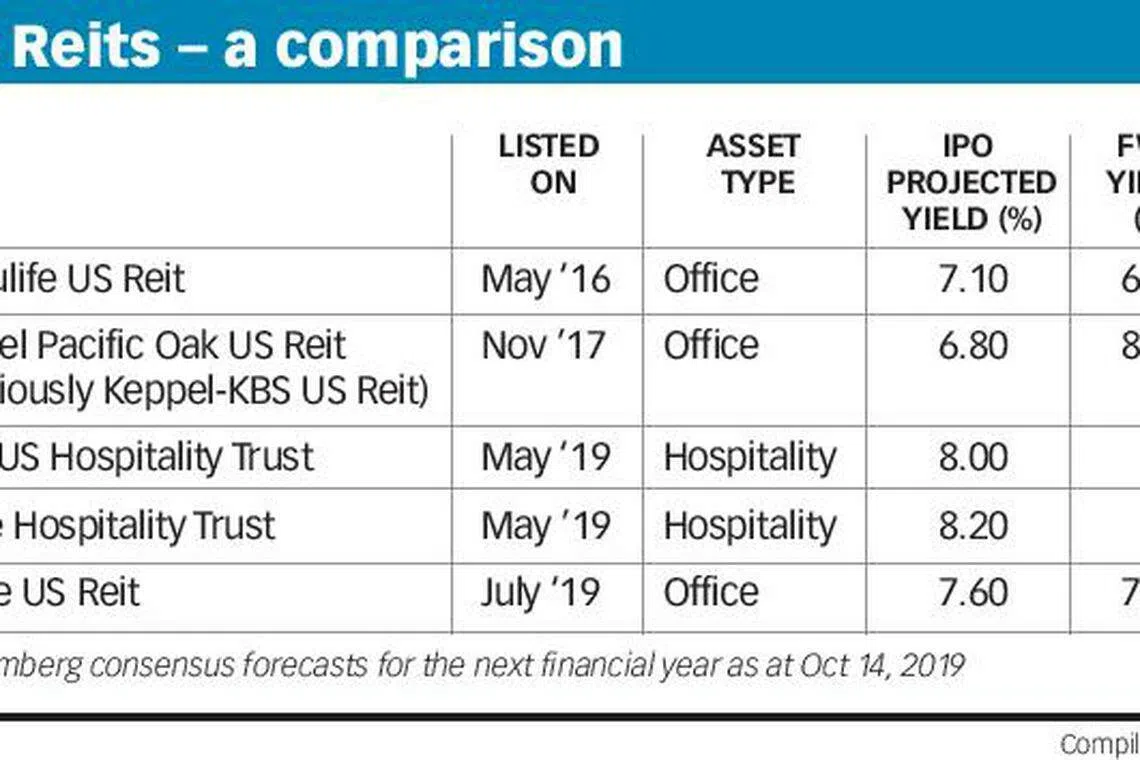
The portfolio aggregate value appears small compared to other US Reits here which mostly have portfolio sizes north of US$1 billion, except for ARA US Hospitality Trust whose portfolio was valued at about US$720 million at listing.
If successful, this would be the first US grocery-led shopping and self-storage Reit to be listed in Singapore. The issue managers from United Overseas Bank, UOB Kay Hian and UBS, are marketing it as a proxy for US consumption growth, promising stable and growing cash flows from an asset class they believe to be resilient to the threat of e-commerce.
"Structural impediments to online grocery puts penetration at under 2 per cent in the US. Grocery and necessity tenants are successfully adopting omnichannel strategies in stores, (and there is a) large number of service-sector tenants with limited online alternatives," the document said.
It added that the two asset classes of grocery-led malls and self-storage assets are expected to generate higher total returns compared to other property types.
Deal terms show that the Reit's portfolio has a weighted average lease expiry of about 8.6 years, with triple net leases, meaning that the tenants are responsible for the ongoing expenses of the property, including real estate taxes, building insurance, and maintenance, in addition to paying the rent and utilities.
Some 97 per cent of United Hampshire US Reit's portfolio by net lettable area is freehold.
Its largest tenants include warehouse club chain BJ's Wholesale Club Holdings, supermarket cooperative Wakefern Food Corporation and Inserra Supermarkets, Netherlands-based food retailer Ahold Delhaize, American retailer Lowe's, Walmart, American gym chain LA Fitness, and home improvement retailer The Home Depot.
Assets are mostly located in the northeastern part of the US, including Massachusetts, New York, New Jersey, Maryland, North Carolina and Florida.
Grocery makes up close to 30 per cent of the portfolio's base rental income, followed by wholesale (14.3 per cent) and home improvement (11.3 per cent).
BT understands that the Reit is still in the stages of obtaining approval from the Singapore Exchange.
The sponsors are UOB Global, a global asset management affiliate of the UOB Group, and The Hampshire Companies, a private real estate investment firm based in New Jersey.
The latter has not made much news in the American press in recent times, except for some headlines on its development work of self-storage facilities, mixed developments, as well as multi-family and industrial assets in the northeast of the US.
This would be the fourth US Reit to list this year, after ARA US Hospitality Trust, Eagle Hospitality Trust and Prime US Reit.
The Singapore initial public offering market has been quiet, having raised just over S$3 billion year to date through 11 deals, with Reits raising the bulk of the amount. Still the amount so far has already surpassed the S$730 million raised for the whole of 2018 through 15 deals.
The three issue managers, together with Credit Suisse and HSBC, are the book-runners of the deal.
TRENDING NOW

Indonesia begins cutting natural gas exports to Singapore from Oct 24: reports

Singapore’s central gas buyer affirms Indonesia’s role as ‘important partner’ amid export review warning

KKR founders among investors buying 42% of Peter Lim’s Valencia; club valued at US$1.4 billion

NEA issues notices to 10 Singapore-based companies, including Wilmar and APP, over haze

