

From US tech to emerging markets, investors urged to diversify in volatile year
Panellists highlight investment opportunities for 2026 amid geopolitical uncertainties
Koh Kim Xuan
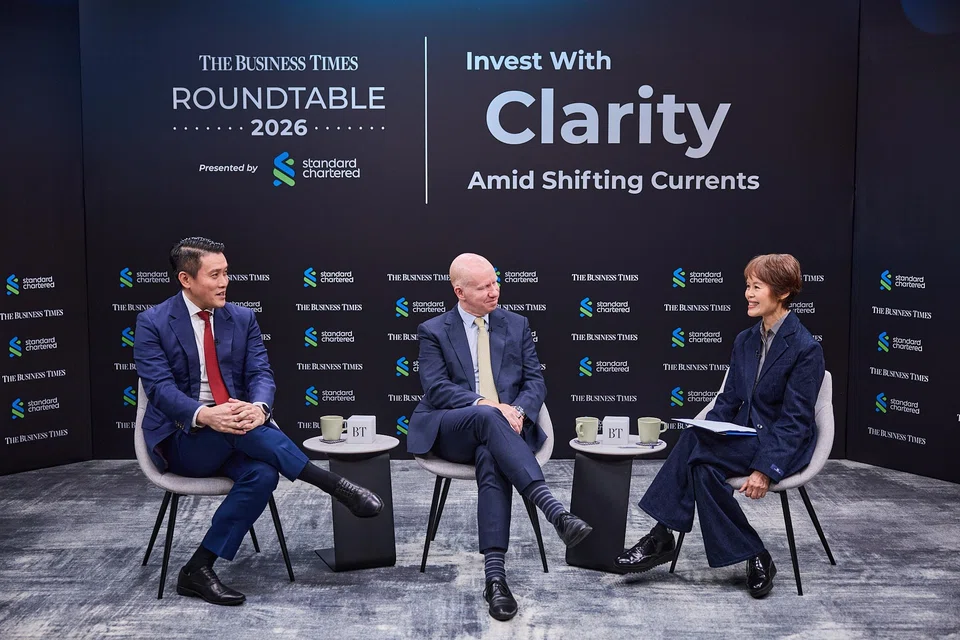
- Steve Brice, Global Chief Investment Officer of Standard Chartered
- Albert Tse, CEO of Amundi South Asia
- Moderated by: Genevieve Cua, Wealth Editor, The Business Times
Cua: What do you see as the most attractive opportunities for equities, especially for Asian technology, given that valuation gaps have narrowed in 2025?
Brice: Earnings growth is expected to remain relatively robust. The weakness of the US dollar will be good for emerging market investments – that is another tailwind for Asian equity outperformance.
We see the Chinese government being very keen to help support the technology market through significant policy easing.
For India, growth is very positive as we have a strong structural story, and the downgrading of earnings growth expectations is coming to an end. We are seeing policy reform on the Goods and Service Tax (GST) side of the equation as well.
One of the things that is going to be key is institutional or international investors and whether they start coming back to the market, even though the Indian market is largely driven by domestic flows.
Cua: We’ve spoken about the broadening of investment interest beyond AI. What else looks compelling?
Tse: We encourage investors to relook Europe. Besides seeing how German fiscal reforms are now encouraging other countries to do the same, we are also seeing improving fundamentals in Europe. We recognise that international investors are trying to avoid overconcentration on US assets.
We’re also seeing central banks being more accommodative. The European Central Bank (ECB) is not likely to cut rates yet, but our view is that they are more inclined to do so, either to keep pace with the US, or because they decided that they need to be more invested than before.
Brice: The geopolitical context has forced Europe to stand on its own two feet. The scale of what Europe has to do to provide its own security is huge, which creates opportunities, but there are also many voices at the table.

We’ve seen in recent times with Greenland: people wanting to push back against the US, through retaliatory or conciliatory actions.
Cua: Turning to income, including rate cuts and inflation – where are the most attractive opportunities?
Brice: We see 10-year US government bond yields coming slightly lower, but not materially lower, which helps drive positive returns across the US dollar bond spectrum.
But we are underweight on credit, as the incremental yield on top of the Treasury yield you can get is close to record lows, so you are not being compensated for the credit risk you are taking.
We should instead take up risk through equities rather than through corporate bonds.
The weak US dollar usually favours emerging markets over developed markets, and we’re also seeing emerging market central banks cut interest rates significantly.
Overall, we are underweight developed market credit and overweight emerging markets.
Tse: Many emerging markets have strong fundamentals with accommodating central bank policies, which will at least be keeping rates on hold or surprising us by cutting rates in the more disinflationary cycle in 2026.
We like European bonds as well. We see better valuations coming from European investment grade bonds. If the US dollar depreciation continues, this is when you benefit from both the better credit spread from European investment-grade companies, and the currency gains.
We are of the view that the ECB may cut rates which will allow us to enjoy more capital gains.
Cua: What about the inflation outlook?
Brice: Our view is that inflation doesn’t go significantly higher, but will moderate slightly this year. It would be challenging to get close to the Fed’s target of two per cent. It really requires the Fed to look at whether the labour market is weak enough for them to lower rates, and it will be a trade-off – inflation versus employment.
That’s why you get this balancing of rate cuts despite inflation being elevated. But if we did see something that shoots inflation higher, that would be very challenging.
That is a concern for the White House, as it’s an election year – they don’t want to lose on the affordability concern, I think we could see measures being taken to try and alleviate some of those inflation pressures.
Cua: Let’s talk about assets that help to diversify the portfolio.
Brice: We are still bullish on the outlook for gold. The number one thing to focus on, from a gold perspective, is continued emerging market central bank demand. There are diversification benefits, but even on a stand-alone basis, we think it’s going to be a good asset to have in your portfolio.
For silver, we see it more as an opportunistic trade. It is a super volatile metal with industrial purposes as well, so we have to be aware that if we see a risk-off environment or recession, silver would be hit whereas gold would be less likely to be hit as much.
Our sense is that silver is looking overextended in the short term. Institutional investors are overweight, so there is a risk of a significant shakeout in silver. We prefer gold to silver.
Cua: How do alternative assets like hedge funds, private markets make sense for a portfolio today?
Brice: We always argue for diversification, it is called the only free lunch in investing. If you add hedge fund strategies and private assets to a portfolio, then you usually see an increase in risk-adjusted returns.
There’s a lot of concern in private markets about the bubble alluded to earlier. Our sense is that private equity will generate returns of over 11 per cent, relative to equity markets of six to seven per cent.
There are concerns about transparency, particularly the circular loop within private equity and private credit, but we don’t want to be overly cautious.
Hedge funds are an important part of the portfolio from a stabilisation perspective. We can break it down to event-driven strategies, which include merger and acquisition type behaviours, particularly in the healthcare sector.
Tse: To improve returns, but also for diversification, private assets are a no-brainer. You should start to have them in your portfolio regardless of how small. So in the spirit of diversification, when you invest in private assets to capture higher returns, be aware of risk, certain sectors, countries or themes that may be overcrowded due to global demand.
Decoding Asia newsletter: your guide to navigating Asia in a new global order. Sign up here to get Decoding Asia newsletter. Delivered to your inbox. Free.
Share with us your feedback on BT's products and services
TRENDING NOW

OCBC mobile, online banking services restored after Friday afternoon disruption
SGX CEO Loh Boon Chye to step down; succession planning under way

Waymo founder predicts ‘landslide’ robotaxi adoption in Singapore, driven by high car costs

Vietnam’s northern provinces, not Hanoi or Ho Chi Minh City, are powering near 10% GDP growth

