Valley Point could be the hidden gem in Frasers Property’s S$2.1 billion hospitality ‘asset-light’ proposal
Strategically, the move gives the group the master key to the entire Valley Point site

[SINGAPORE] Real estate giant Frasers Property’s review of Frasers Hospitality Trust’s (FHT) portfolio following its privatisation last year has finally culminated in a S$2.1 billion game of asset musical chairs.
Controlled by the family of Thai billionaire Charoen Sirivadhanabhakdi, the Singapore-listed property developer on Thursday (Jun 25) unveiled a “portfolio optimisation” plan that will see FHT’s assets separated into four groups.
- Stabilised assets, which refer to mature assets with lower yield. Frasers Property will divest all assets in this group. Doing so will let the property group unlock capital from stabilised assets. At the same time, it can continue managing those assets for third-party investors and earn recurring fee income.
- Assets with the potential to achieve higher yield through value-enhancement initiatives.
- Non-core assets, which will continue to be held under FHT for future opportunistic divestment.
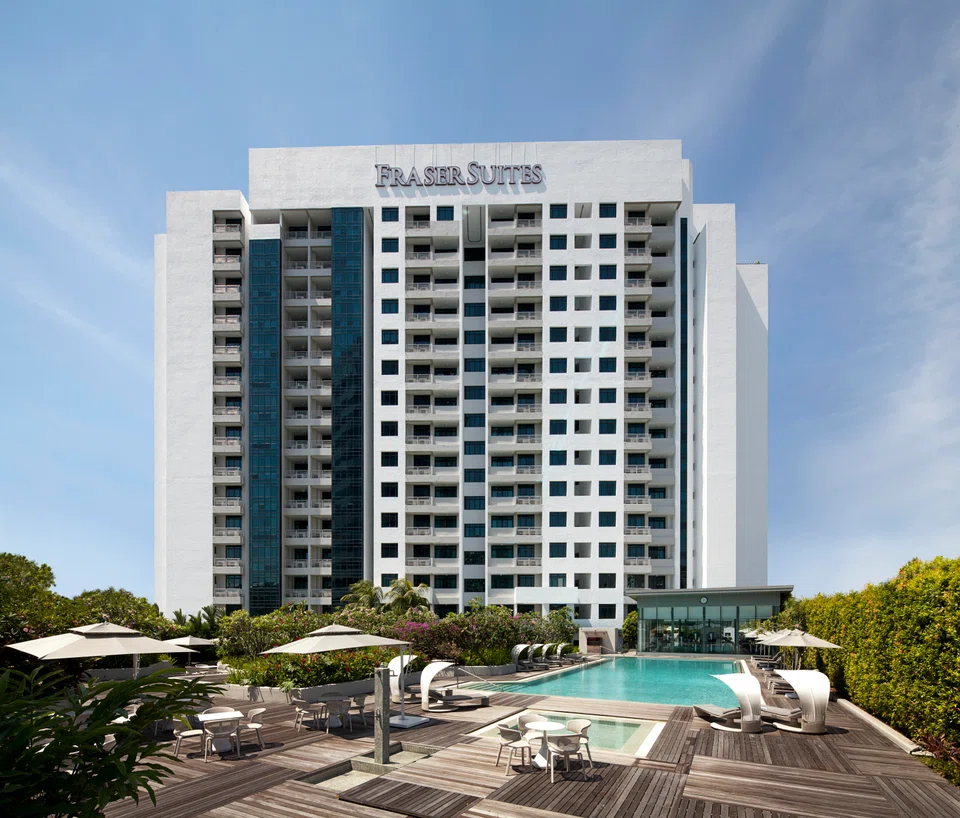
- Asset for potential redevelopment, which will be divested to Frasers Property to enable any potential redevelopment. This means that Frasers Property can consolidate full ownership of Fraser Suites Singapore, facilitating a potential redevelopment of the Valley Point site.
The restructuring will reverse certain legacy arrangements previously put in place for FHT’s listing. These include the removal of minimum fixed rental and corporate guarantee obligations by Frasers Property.
The deal will be transacted with TCC Group Investments (TCCGI), the parent company of Frasers Property, at about a 6.7 per cent premium to the latest independent valuation conducted on Apr 30.
It is also 1.6 per cent above Frasers’ implied take-private price of S$0.71 per stapled security of FHT last year.
It is perhaps worth recalling that Frasers’ first attempt to take FHT private back in September 2022 missed by a whisker. Some 74.88 per cent of unitholders voted in favour of the S$0.70 per stapled security offer – falling short of the required 75 per cent approval.
It waited three years to return with the slightly sweeter offer in 2025. That second attempt succeeded, setting the stage for today’s grand reshuffle.
“Following the privatisation of Frasers Hospitality Trust in 2025, we conducted a comprehensive review of the hospitality portfolio and reached clear conclusions on how each asset is best managed going forward,” said Eu Chin Fen, CEO of Frasers Hospitality.
“The proposed FHT portfolio optimisation is the outcome of that review, which strengthens our platform while we continue to drive performance through our operating capabilities,” she added.
Closed-door snub
But, during the media briefing on Thursday, a telling detail emerged regarding why this deal is being conducted as an interested person transaction with TCCGI.
Frasers’ financial advisers on the deal admitted that they quietly shopped the portfolio around to external third parties. But the result was a total snub.
Outside buyers did not bite for two clear reasons. First, they felt the asset valuations were far too full. Second, Frasers insisted on a strict precondition: the group must retain the long-term management rights to the hotels.
It comes as no surprise that independent global funds have zero desire to pay top dollar for a physical property while letting the seller walk away with the operational cream.
TCCGI is essentially stepping in to buy what the open market found unpalatable, providing execution certainty because they are the only buyer willing to accept Frasers’ terms.
Stopping the balance sheet bleed
Absorbing FHT in 2025 pushed its net gearing to an uncomfortable 89.2 per cent – and to 94.2 per cent by the first half of its FY2026 ending September.
And the market has long punished Frasers Property for its bloated balance sheet. The stock is trading at less than half of its net asset value.
It was a heavy, capital-intensive weight that dampened investor sentiment. Today’s transaction acts as a much-needed tourniquet.
“This is a capital structure transaction that lightens our balance sheet,” said Loo Choo Leong, group chief financial officer of Frasers Property, at the media briefing.
“It is a more capital-efficient structure, which will mean a lighter balance sheet for the group in general. That’s the target,” he added.
By engineering an “asset-light” pivot, Frasers is dropping the physical assets while retaining the lucrative management fees.
At first glance, slicing on-balance-sheet hospitality assets from S$3.7 billion down to S$2.5 billion might give the impression of a company eager to shed its hotel portfolio.
But Loo is quick to dismiss this.
“Hospitality is and will remain a key integral part of Frasers Property,” he said. “We’re not shifting our eyes away from (hospitality). In fact, we are increasing our focus on ensuring that we deliver quality hospitality products and services to our customers.”
For now, Frasers’ hospitality assets under management stay flat at S$4.2 billion. The group will continue to run the hotels and collect steady fee income. And the immediate result is that net gearing ticks down by 3.3 percentage points, offering some breathing room.
Heavy cost of moving money
On the face of it, the headline numbers look crisp: debt drops, and the transaction happens at a 6.7 per cent premium over the latest independent property valuations.
But the real story lives in the dense pages of the legal bourse filing, where that glossy corporate veneer begins to crack.
That celebrated 3.4 per cent boost to earnings per share (EPS) relies entirely on one-off divestment gains.
Before factoring in fair value changes and exceptional items, the transaction results in a core EPS dilution of 6.9 per cent because of lower attributable operating income.
Furthermore, shifting assets from one pocket of a billionaire’s empire to another is an expensive hobby.
Frasers expects to receive S$177.9 million in cash from the net difference between its acquisitions and disposals.
Yet, the total transaction cost sits at a staggering S$78.4 million due to stamp duties and capital gains taxes. By the time the tax collectors take their cuts, the net cash proceeds dwindle to just S$99.5 million.
Paying S$78.4 million in friction costs just to move assets to a sister company is a steep price to pay for corporate housekeeping.
Valley Point clincher
But experts in Singapore’s property and real estate investment trust space do not appear to be too worried.
“The transaction and structure looks reasonable and in line with recent market deals,” said RHB analyst Vijay Natarajan. “The move will lower gearing and provide clarity on redevelopment potential in the hospitality portfolio, while retaining the fee income from the assets.”
“Markets have been typically rewarding an asset-light real estate business model that improves ROE (return on equity) and offers scale, and this transaction fits well with that approach.”
But the real clincher of this S$2.1 billion game of musical chairs is not the fee income or the debt relief. It is a hidden local prize.
As part of the deal, Frasers is shelling out to take 100 per cent ownership of Fraser Suites Singapore. On paper, it is a serviced residence valued at S$320 million. But, strategically, it gives the group the master key to the entire Valley Point site.
Valley Point has long been a slightly sleepy, ageing fixture along River Valley Road.
By unifying the ownership, Frasers gains complete flexibility to tear it down and start over.
During the morning media briefing, management was noticeably coy when pressed about the specific number of residential units a redevelopment could yield. But the intent is clear.
In a land-scarce market like Singapore, a prime plot in a prestigious district is worth its weight in gold. A full-scale redevelopment of Valley Point – potentially adding shiny new luxury residences and a revamped retail podium – offers a massive runway for long-term value creation.
Ultimately, the asset-light pivot will help repair a stretched balance sheet and stop the financial bleeding. But financial engineering alone rarely excites the public market.
Frasers wants retail investors to finally stop discounting its stock. And if this proposed deal goes through, the grand reveal after of what it actually plans to build at Valley Point could be the story that matters.