Virtual AGMs on extended run but challenges remain
With companies now given the green light to hold online meetings for the foreseeable future, service providers are eager to meet that demand
Singapore
AS THE Covid-19 pandemic disrupted business operations for the better part of 2020, annual general meetings (AGMs) were among the many activities forced to move online.
And now, for the second straight year, many shareholders of listed companies find themselves having to attend an AGM virtually as part of the new normal.
On Tuesday, companies learned that AGMs and shareholder meetings could continue to be conducted online beyond the stipulated June 30, 2021 deadline.
The Law Ministry extended the legislation, allowing for alternative arrangements for these meetings indefinitely, with the new rules in place until they are revoked or amended.
Although sentiments around the relatively new virtual AGM concept have been mixed, service providers here say they are prepared to deal with this year's greater demand.
Growing trend
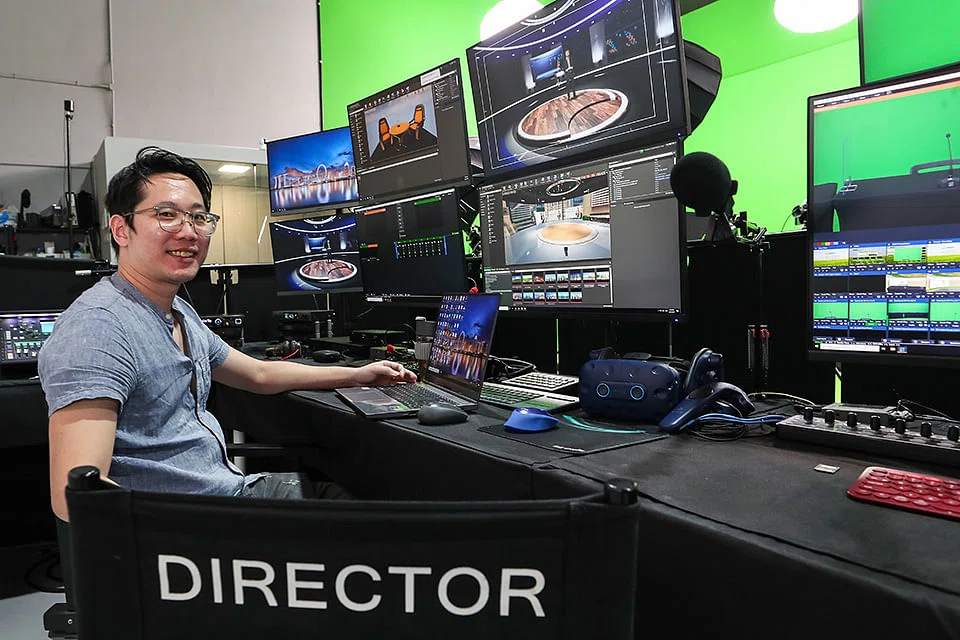
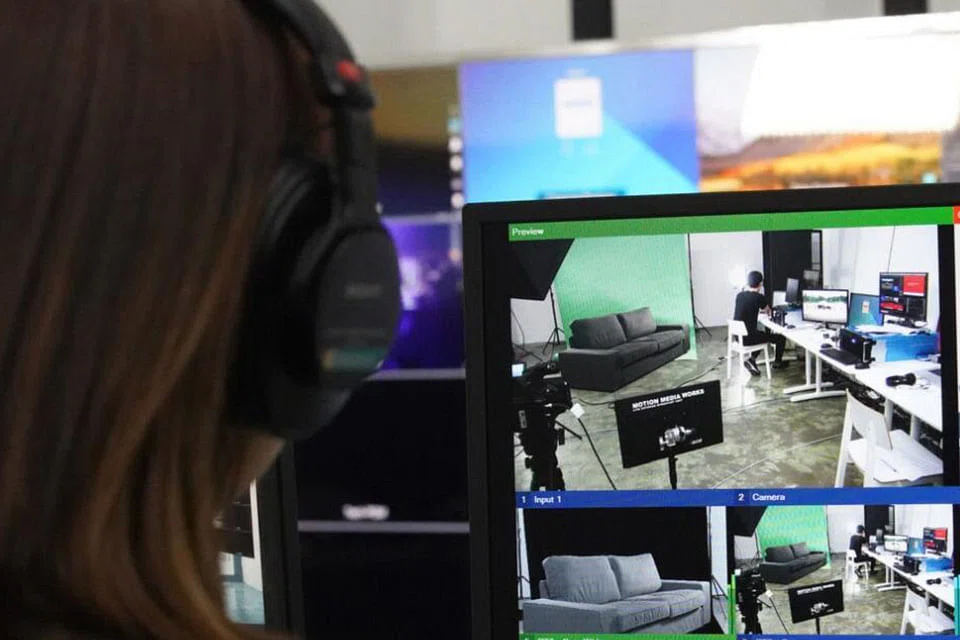
Production company Motion Media Works has so far been contracted by about 50 companies to host their virtual AGMs this year, compared to the same number for the whole of last year.
As the financial year draws to a close for more companies, producer Lionel Low expects demand to continue to grow.
Another player in this business is Hong Bao Media, which specialises in media training, but which has diversified in recent years to offer live streaming services to its clients. Dozens of companies used its virtual AGM services last year.
This year, all those AGM clients have returned, and new clients have also come on board, "learning from the mistakes they made last year", said Mark Laudi, the company's chief executive.
Last year, video production services company Will Dylan was met with a sudden fall in demand for its corporate video work. But jobs were there for the taking in virtual AGM services, so the company took on the challenge.
Owner Dylan Tan said that the company took on about 40 virtual AGMs last year. This year, careful not to bite off more than it can chew, it has accepted a similar number of jobs.
Unified communications company NTT Cloud Communications (CC) has not repeated the 200 per cent jump in revenue from virtual AGMs it handled last year from 2019, but it has nonetheless recorded a 40 to 50 per cent uptick in revenue from virtual AGMs year on year, said Sean Kwek, its managing director for the Asia-Pacific.
Multiple models
Virtual AGMs run the gamut from audio-only to full studio experiences, depending on the companies' areas of expertise and customer preferences.
All four companies that The Business Times spoke to have adapted their traditional businesses to accommodate completely virtual AGMs.
NTT CC had been providing supplementary phone dial-in services at AGMs even before they went fully virtual.
Now, as all AGMs have moved online, a significant portion of these meetings occur solely over a telephone network, though they do offer alternative channels such as live streams. Clients usually present from the comfort of their own boardrooms, where a crew deployed by NTT CC handles the technical aspects.
At both Hong Bao Media and Will Dylan, top executives have the option of streaming from in-house studios, where a professional set up can maximise the quality of their streams.
Other directors choose to dial-in remotely.
Will Dylan has leaned on its video production background and its experience with live-streaming physical events such as town halls and keynote speeches, Mr Tan said.
Hong Bao Media recently launched Investor.Exchange, a self-service portal for companies to manage registration, provide details and link to the webcast.
Partnering with webcast hosting platforms such as Intrado, On24 and Wowza, these companies gather and channel live feeds from multiple cameras to these content delivery networks, some of which can simulate the format of a physical AGM, with multiple features offered on a landing page, to broadcast these streams.
Motion Media Works has had decades of experience with connecting businesses and shareholders gathered in physically separate locations together virtually.
"Nobody used to call it a hybrid event," said Motion Media Works' Mr Low. "This is pretty much the same thing."
Cautious of sensitive information, the company does everything in-house, handling processes from registration to broadcasting on its own platform.
The cost of running a virtual AGM varies based on stream quality and the supplementary services taken up.
An hour-long live-stream for a panel of eight directors and beamed to a thousand shareholders would cost in the ballpark of S$7,000 to S$10,000, said NTT CC. Hong Bao Media, meanwhile, cited a fee of between S$8,000 and S$14,000, which includes the use of a studio.
All four companies agree, however, that extensive rehearsals and technical runs are necessary to ensure that virtual AGMs go off smoothly.
Elements like lighting, audio and framing are especially important if executives and directors are dialling in remotely.
NTT CC has contingencies in place to switch to an audio-only format if live streaming is disrupted.
In its studio, Will Dylan ensures that it has back-up service providers for its Internet connection.
Both companies also said that preparation is necessary to prevent incidents like firewalls preventing access to the stream.
And despite the different formats of virtual AGMs offered, these four companies have identified multiple similar issues.
A common challenge lies in keeping shareholders engaged, given the static format of virtual meetings. AGMs have become shorter affairs as a result.
Will Dylan uses two monitors in their studio - one for live feeds of the directors, and another for the teleprompter, which presenters must manage concurrently.
In an effort to partially offset the problem, it is experimenting with the use of Unreal Engine, a 3D creation platform commonly used in gaming and becoming popular in film production, which makes virtual AGMs more visually appealing.
Another challenge is that many clients opt for audio-based AGMs because they are uncomfortable with being on camera, said NTT CC's Mr Kwek.
Mr Laudi, with his background in media training, hopes to address this, and bust the myth that Singapore lacks eloquent speakers. Since 2018, Hong Bao Media given out awards to honour those it regards as having "excellent interview skills on various media platforms".
While all these companies have the technology necessary to include interactive elements such as live question-and-answer segments and weighted polling in the AGMs, they have found these features under-used in some cases.
Managing customer expectations has also been a learning curve, said Motion Media Works' Mr Low. For example, some clients expect set-ups similar to those for physical events, with everything including a stage and even flowers to decorate the set.
Future of AGMs
As virtual events establish themselves as the norm, the competition to provide such services to organise them has also increased.
"A lot of companies are jumping on the bandwagon," Mr Kwek said. "We are seeing some cannibalisation of our market share."
In many cases, the companies offering virtual AGM services are traditionally part of physical AGMs, like marketing companies, which now have diminished roles, he added. Mr Tan said that hotels, for example, have also begun to offer virtual AGM services.
On the whole, listed companies and shareholders alike have largely recognised the convenience and efficiency of virtual AGMs.
Mr Kwek suggests that they are also likely to be more cost-effective over time, as there is no need to cater food or book a venue, say, a function room in a hotel.
Regardless, the service providers expect that virtual events are here to stay, although likely in a hybrid format. Companies will then have to adjust to make sure that they are prepared to make these mixed-format events successful.
Mr Kwek predicts that expectations for the virtual meetings will increase. In the past, on-site events were the primary focus, and the virtual element was organised mainly for those who were unable to attend.
"Now, the demand is that the online experience has to be just as good as an on-site one," he said.
READ MORE: AGMs: virtual, but not unilateral, please