Volatility could roil base metal markets in 2025; analysts favour copper, tin amid energy transition
Potential headwinds include stronger US dollar, escalating trade tensions and China’s economic momentum

BASE metal prices have been lifted this year by robust market fundamentals and a rise in green sentiment. But market watchers warn that the potential of a stronger US dollar and escalating trade tensions as Donald Trump returns to the White House could weigh on the market in 2025.
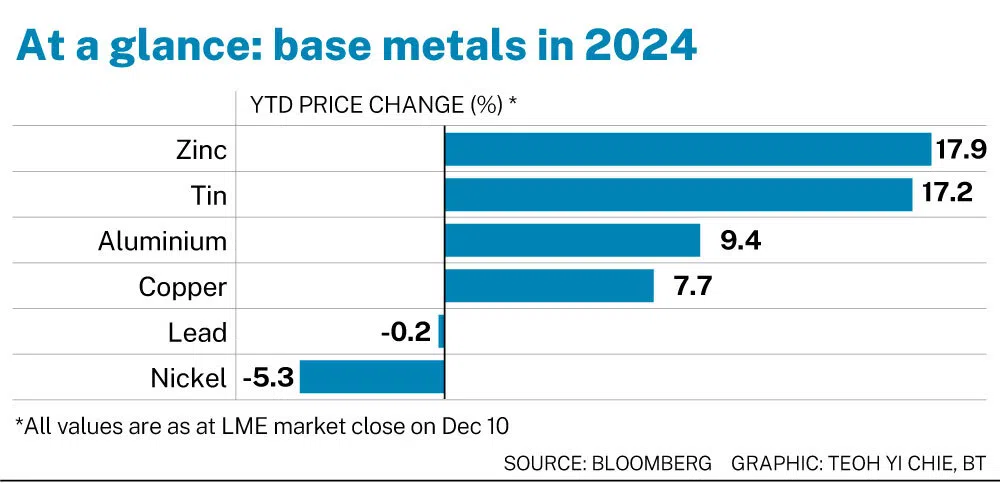
Base metals, in general, have touched new highs in 2024.
Through Dec 10, London Metal Exchange-listed tin and zinc have climbed about 17 per cent, followed by aluminium (9.4 per cent) and copper (7.7 per cent). Lead has traded relatively flat so far this year, while nickel is the only metal down.
But Sabrin Chowdhury, head of commodities research at BMI, believes that the base metal market could see a period of significant price volatility ahead.
While anticipated US dollar strength and shifts in trade policies remain major headwinds, the outlook will also be affected by economic momentum in China, she added.
“The Trump victory is likely to bring about US dollar strength that would work to cap commodity prices in general,” Chowdhury explained.
“A likely slowdown on ‘green’ policies will also cap demand for and sentiment towards energy transition metals including copper, aluminium, and nickel.”
However, Alexandra Symeonidi, a corporate credit analyst on William Blair’s emerging-markets debt team, believes that energy transition will remain a long-term structural trend and support the demand for the base metals in the long run.
Such demand also provides opportunities for emerging-market debt investors, particularly in regions investing heavily in renewable energy infrastructure. Despite potential price volatility under Trump’s administration, the emerging-market metal-producing regions remain poised to benefit, Symeonidi added.
Increased demand
Specifically, Symeonidi sees the potential for increased demand for copper, driven by energy transition, which represents a long-term structural trend in China. She noted that the country has been increasing investment in electric vehicles, grids and solar panels.
Edward Meir, a senior base metals analyst at Marex, also expects copper to perform well in 2025, assuming geopolitical and macroeconomic concerns dissipate.
He noted that copper has widespread application in a number of industries, ranging from power cables to data centres. Unlike other metals such as nickel, cobalt and lithium – which have their fortunes mainly tied to electric vehicle batteries – copper has a wider role in the green transition, he said.
Goldman Sachs’ commodities research team also prefers copper and aluminium over iron ore, as China’s recent stimulus sees a shift in focus from property to green energy.
Meanwhile, investments in semiconductors and energy storage are expected to further boost copper demand, particularly in Malaysia, Singapore, Japan, South Korea, Taiwan and India, according to construction consultancy Linesight.
It said that copper demand will also grow in Saudi Arabia and the United Arab Emirates on rising renewable energy investments.
Natalie Scott-Gray, a senior metals analyst at StoneX, noted that investor sentiment will be a key driving force in the copper market to monitor in 2025, as speculative trading could increase price volatility.
She explained that speculative trading could have had a part to play in copper hitting a historic peak of US$11,105 per tonne in May, as the contango market also recorded historical highs, adding: “We view copper’s price range as narrowing on the upside and increasing to the downside from previous expectations, to average at a similar level to 2024.”
Favourable fundamentals
Meanwhile, StoneX’s Scott-Gray believes that tin has “arguably the best” fundamentals among the base metals.
With uses in renewable energy, new technologies such as artificial intelligence and electronics, as well as energy storage, demand for tin is expected to rise by 2.8 per cent in 2025, following a 3 per cent increase in 2024.
Global production of refined tin, however, is forecast to remain below 2023 levels, despite an expected rebound next year.
Citing International Tin Association projections, Scott-Gray noted that tin is forecast to reach a record 35,700-tonne deficit by 2030, from a deficit of just 15,300 tonnes in 2024.
Marex’s Meir attributed the rise in tin prices in 2024 to a supply crunch, even as demand – particularly in the chip sector – continued to strengthen.
He pointed out that main exporter Indonesia cracked down on tin exports to maintain domestic supply, while there was a supply cut-off in tin ore concentrate from Myanmar.
The absence of Myanmar’s largest tin mining operation, which represents a 9 per cent loss of global tin supply, is expected to continue into 2025.
Meir added that tin could have done even better in 2024.
Prices were up around 35 per cent until a sharp selloff in October on profit-taking and a pickup in Indonesian exports.