

With voluntary carbon markets, it’s still buyer beware
After net-zero pledges, companies are stumped navigating a fragmented carbon marketplace

Wong Pei Ting

IN 2012, before it became trendy for companies to make “net-zero” or “carbon-neutral” promises, Jebsen & Jessen Group was already buying carbon credits to voluntarily offset its carbon footprint.
The Singapore-based industrial group’s chairman, Heinrich Jessen, a biologist by training, had championed it as an extension of the family enterprise’s long-running efforts to cut the business’ impact on the environment to a minimum.
But despite having spent hundreds of thousands of dollars on these voluntary offset carbon credits since, Jessen confessed that there is “always that little devil at the back of (his) head” questioning if these credits – each supposedly representing a tonne of carbon that has been permanently avoided or removed from the atmosphere – are bona fide.
So even though he had only dealt through a reputable broker – South Pole – and bought credits tied to projects accredited by Verra, which administers one of the world’s leading carbon credit standards, he had to perform random checks to be surer about using the credits to justify the company’s carbon-neutral claims.
This once had him engaging a fresh graduate from Yale School of the Environment to verify the veracity of a Northern Thailand-based project by spending time in Bangkok, conducting face-to-face meetings with various South Pole contacts.
In another instance, worried about whether credits linked to a micro hydroelectric dam project in Vietnam would force whole villages to relocate without proper compensation, he commissioned an engineering firm to study the dam’s hydrological effects downstream and ascertain its social impacts.
“I mean, you don’t want to be spending lots of money over many years on a particular thing only to find out that the whole thing was a scam, right?” Jessen said.
Double-edged tool
Annette Nazareth, chair of the Integrity Council for the Voluntary Carbon Market (IC-VCM), alluded to this double-edged nature of today’s carbon credits as well in a separate interview with The Business Times. IC-VCM is an independent governance body set up last October to take forward the work of a private sector-led taskforce formed in September 2020 to push for threshold standards in the space.
Nazareth spoke of big corporations resorting to hiring scientist-like figures to do the due diligence on projects linked to the carbon credits they had invested in to ensure high integrity in the process.
“Every investment requires a lot of work. You can’t have a highly-efficient scaled market if every time you trade, you have to kick the tyres, look at the project and talk to the people,” said the former commissioner of the US Securities and Exchange Commission.
Indeed, behind the ambitious pledges made by companies eager to jump on the ESG bandwagon today is the reality that many are unsure of how to navigate the murky carbon marketplace with its many unresolved issues.
For one, there is no widely accepted framework for what denotes credit quality, noted Sean Penrith, the chief executive officer (CEO) of climate consulting firm Gordian Knot Strategies.
And while he could name at least five major carbon credit registries – Verra, Gold Standard, the American Carbon Registry, Climate Action Reserve and Puro.earth – there is no underlying support for any one registry’s methodology, he added.
Without these, the scene continues to draw detractors and gets flooded with alternative approaches, he pointed out, lamenting that the latter has added a high degree of confusion to the marketplace “where everything is referred to simply as a carbon credit”.
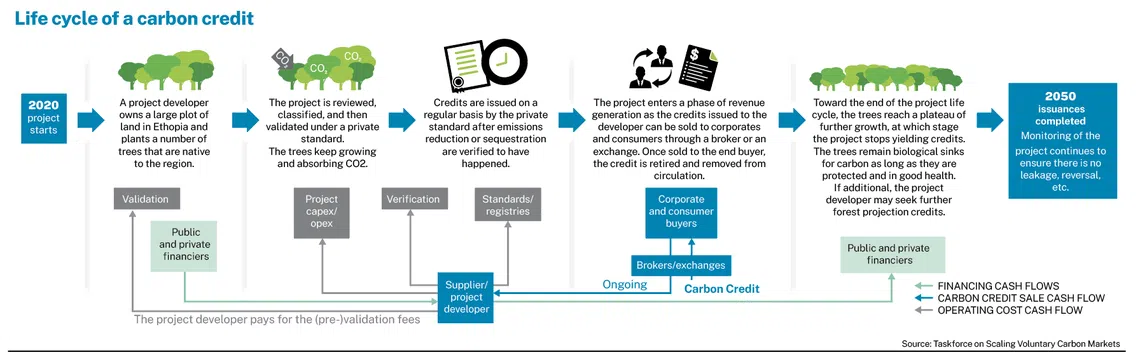
Controversies to do with unclear rules in the market still occasionally make headlines.
The Financial Times last month reported about three US-based oil extraction projects that sold nearly three million carbon credits, just because it engaged a method that involved carbon capture. The sale ignored emissions associated with the extracted oil, and accounting for this could negate any of the credits’ supposed climate benefits.
Temasek portfolio company Surbana Jurong’s head of sustainability and resilience office Praveen Hassan Chandrashekar struggles with a lack of assurance in the market, saying that no one can say for sure if the assets are secure in the event of a government change, for example.
The question comes as the urban and infrastructure consultancy is interested in nature-based offsets, given that South-east Asia holds the highest density of carbon prospecting for nature-based solutions, such as reforestation and blue carbon (carbon stored in coastal and marine ecosystems), but has not taken a position on them.
Technology like satellite imagery may be relied upon to track whether a certain number of acres of reforestation was carried out as promised, but they cannot account for influences that are political in nature, he added.
Oil giant ExxonMobil, which owns and operates an integrated refining and petrochemical complex in Singapore, told BT it is still determining if or how it will potentially utilise voluntary carbon offsets.
Its spokesperson said: “ExxonMobil believes carbon trading programs could be an effective method toward achieving lower-carbon ambitions, provided that the voluntary carbon offsets are available economy-wide, quantifiable, do not expire, and are independently certified through a publicly-available tracking system and are based on approved methodologies.”
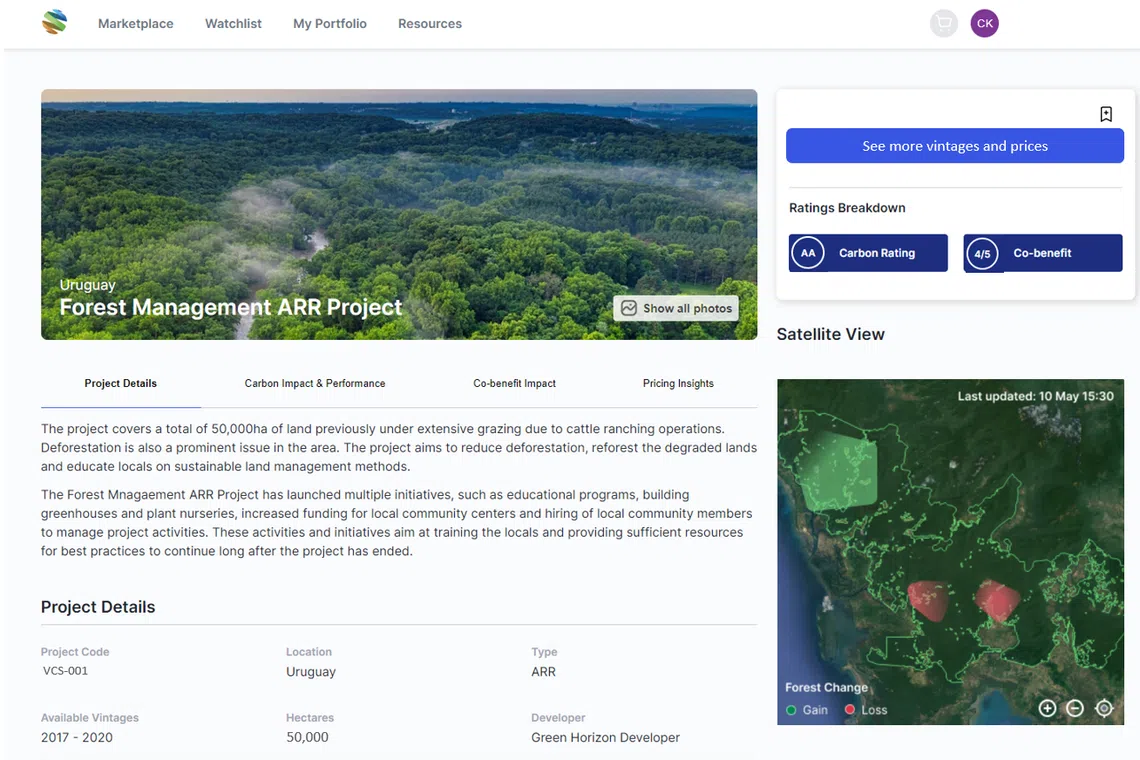
Opaque market
Ambiguity over what is the right price to pay for these carbon credits is another sticking point among buyers. While prices in compliance carbon markets are often set by governments or regulators, it is not the case for those in the voluntary markets, which follow market forces.
But prices are not transparent, given that most transactions in the voluntary space are still over-the-counter trades, noted Swiss financial services company SIX in a white paper published in March. Nazareth went as far as calling current pricings “flawed”. “The market is opaque. It lacks liquidity. There is no good reporting,” she added.
Several carbon exchanges allowing these credits to be traded in a secondary market have emerged in recent years, lending some clue as to what the prevailing prices are, and how the prices for the various types of credits have moved up over the months.
For instance, a chart on Xpansiv’s website showed that the assessed price for N-GEO, a futures contract for nature-based offsets, traded at close to US$6 per tonne in August last year before shooting up to US$14 per tonne by the end of the year. Movements were not updated thereafter.
In contrast, the Singapore-based AirCarbon Exchange (ACX) provides a more updated sensing of the prices through a ticker on its landing page. As of Friday (May 6), its Global Nature Tokens, which provide exposure to forestry projects from 2012, traded at US$6.53, down 10.4 per cent from US$7.29 on March 4, while similar tokens with a cut-off at 2016 traded at US$11.10, down 12.9 per cent from US$12.75 on March 4.
But the fact remains that the market is highly fragmented fielded by at least 20 players – including 11 brokers and auction platforms listed by SIX in its own survey – with no clear market leader and little to no consensus on the best practices that could be upheld.
In Singapore alone, there are three carbon exchange players – ACX, Metaverse Green Exchange (MVGX), and Climate Impact X (CIX) – each with their own philosophies, naming conventions and curation standards.
Outsized ambitions
Finding it is more important to first tackle the issue of integrity before scaling the market, CIX made it as one of its priorities to build a community of buyers, sellers and non-governmental organisations that could teach each other about the responsible use of carbon credits.
This was why CIX, an outfit established by DBS, Singapore Exchange, Standard Chartered and Temasek last year, was not quick to “push products off the shelf” unlike some of its competitors, its CEO Mikkel Larsen told BT.
“Is (community building) going to make me a lot of money? Well, maybe one day, but certainly not in the short run. But it is time worth spending because if we don’t stand for integrity, if we don’t stand for education of why people should be using (carbon credits) in a certain way and not another way, we might be able to sell a little bit of credits in the beginning, but the whole market is going to crash,” he said.

Guiding this approach is the special mandate given to CIX as an initiative borne out of the Alliance for Action on Sustainability under the Emerging Stronger Taskforce, which was set up to guide Singapore’s economic recovery from Covid-19, he pointed out.
“The mandate was always to try to do the best you can to regain trust in the system and create impact. Is it a commercial entity? Absolutely… But that means staying away from anything that doesn’t have integrity,” Larsen said.
CIX launched its first platform, Project Marketplace, in March, and was said to be working on rolling out its spot exchange platform in the fourth quarter of 2022.
For its platforms, this means that “there will be a lot that we don’t sell”, said Larsen, who served as one of the more than 50 members on the Taskforce on Scaling Voluntary Carbon Markets, the initiative behind IC-VCM’s formation.
Larsen added: “We cannot just rely on rating agencies. We got to have our own assessment. We have to stand for our own policy seal, and it is much more complicated than just looking at carbon for the sake of carbon attributes. We have to think about whether (the project) does the right thing for local communities and for biodiversity.”
Also professing to be tackling the integrity issue is MVGX, which takes the angle that the outcome of last year’s Glasgow Climate Pact, or COP26, still does not give assurance that a clearinghouse of sorts will track credits across borders and avoid double-counting.
Its co-founder Bai Bo said underpinning MVGX’s approach is the fundamental belief that carbon credit registries will be nationalised at some point, just as a country would never let another country print its currency.
Bai explained that certain countries may want to assert their “sovereign power” when they find themselves caught between the responsibility of keeping up their Nationally Determined Contributions (NDCs) and being a country that supplies carbon credits.
NDCs are climate action pledges that countries have submitted under the landmark 2015 Paris Agreement, or COP25, and it was agreed at COP26 that countries can use emissions trading to meet their 2030 emission reduction obligations, he pointed out.

MVGX’s solution lies in its carbon neutrality tokens that are supported by a proprietary distributed ledger technology, which can provide buyers and issuers with an immutable and constantly updated record of the carbon performance of their tokens.
In its statement, it said that the sale of a first tranche of 5,000 carbon credits to Hong Kong-based private equity firm Celadon Partners demonstrates that there is ample demand for voluntary emission reductions, which do not interfere with NDCs. It is something no other solution has been able to address, MVGX highlighted.
Bai added the company had a breakthrough in March when it managed to get the British Standards Institution (BSI) to accept its tokenised cross-border carbon credits to certify MVGX as a carbon neutral business. This was the first time the certification body has accepted tokenised carbon credits, he stressed.
ACX CEO and co-founder Thomas McMahon, whose experience in the world of commodities stretched back to his trading cotton and orange juice in New York, takes a longer term view with the platform that was launched in 2019.
“We are in a cycle, and it is really relevant if you think about today what we take for granted as benchmark prices,” he said, as he pointed out that the Brent crude only came into being in 1988, while 2005 heralded the advent of iron ore.
He believes soon it will be “carbon’s time”. The cost of carbon will be embedded into the cost of entire supply chains, he said, adding: “If you look at the commodity food chain – electricity, transportation, aviation, shipping, and so on – they all have been defined to have a carbon footprint.”
To support this vision and more efficiently facilitate carbon trading, which he believes will be the “main show”, McMahon said ACX was built with T-0 settlement time.
In addressing concerns of a lack of transparency to the credits being traded, ACX last July integrated on its platform carbon ratings by a London-based climate solutions provider called BeZero Carbon.
The ratings, on a scale ranging from AAA+ to A, are calculated by taking the weighted average score of six risk factors – additionality, over-crediting, leakage, permanence or enforceability, perverse incentives and the political environment.
An AAA+ rating gives the confidence that there is a 90 per cent or more chance that the credit truly equals a tonne of carbon dioxide equivalent avoided or removed, while an A rating represents a 30 to 40 per cent chance.
And companies are biting. On average, a week, ACX had been onboarding five to 10 companies, while another 8 to 15 companies would be expressing their interest to join the platform, McMahon said.






