

Wall Street strategists wrestle with war’s toll on 2026 outlook
Consumer sentiment has plunged to the lowest on record
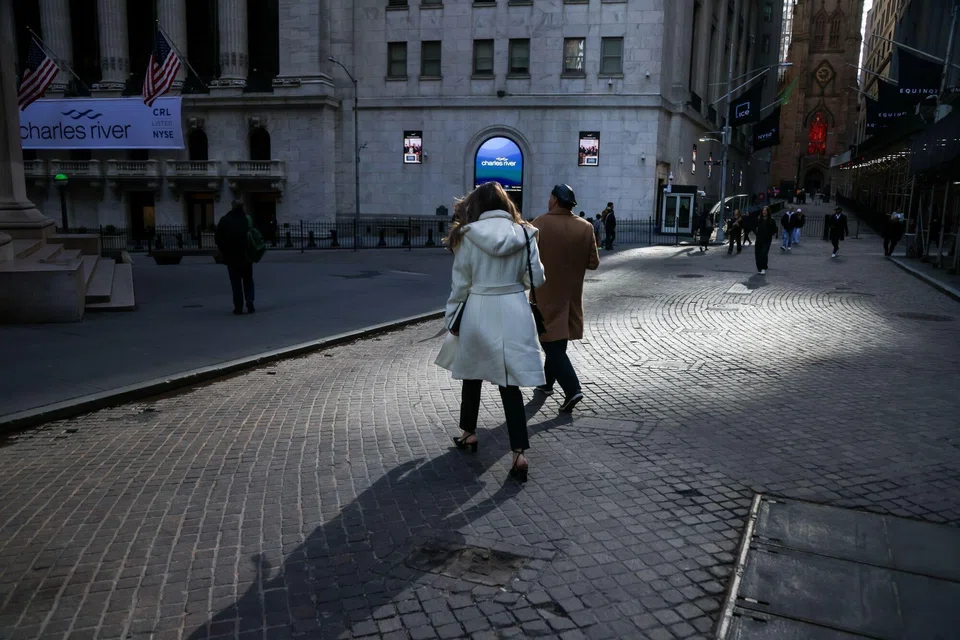
[NEW YORK] A fragile Middle East ceasefire sent traders rushing back into risk assets this week. Yet Wall Street strategists warn that the war has already scarred inflation, energy supplies and the US Federal Reserve’s ability to act – damage no truce can quickly undo.
That cast a shadow over the rallies that erupted across markets this week and sent the S&P 500 Index up 3.6 per cent, its biggest jump since late November. Emerging-market equities surged, the US dollar tracked oil lower, Treasury yields dipped and Bitcoin pushed back over US$70,000.
Yet by Friday (Apr 10) afternoon, the stock market’s advance had already stalled amid mounting angst that this weekend’s peace talks will fail to end a six-week war that’s rippling through the economy.
The whiplash has forced a reckoning among Wall Street strategists who entered 2026 predicting another banner year for markets. In interviews, several of those featured in Bloomberg’s annual outlook survey described how they are recalibrating – stress-testing targets, pushing out rate-cut expectations and gaming out scenarios they had not considered.
This week carried echoes of last year’s tariff reprieve, when markets staged another rebound from a crisis US President Donald Trump unleashed. But the fallout from the bombing of Iran will not be as easily contained as a trade war – and is already showing up across the economy.
The oil-price shock caused the biggest monthly jump in inflation since the 2022 surge. Consumer sentiment has plunged to the lowest on record. And there’s little expectation the Fed will be able to swoop in to jumpstart things if they stop spending: Traders see only an outside chance of a single quarter-point interest-rate cut before the year is over as rising consumer prices threaten to tie the central bank’s hands.
Even as oil futures dipped, one key benchmark this week hit more than US$144 a barrel, a record high, as the closure of the Strait of Hormuz hits supplies. Even the terms of the ceasefire have been a source of dispute, with Trump ratcheting up his threats again on Friday before the onset of negotiations.
All of that has cast uncertainty over what had been a relatively optimistic outlook on Wall Street, where strategists started the year confident stocks would keep climbing and the Fed would give the economy another jolt by resuming its interest-rate cuts.
Here’s how some are adapting to the rapid turn in markets and how their views have changed.
JPMorgan Asset Management
David Kelly, the chief global strategist for the bank’s investment arm, remains optimistic as the productivity gains dangled by rapid artificial-intelligence advances promise to boost the pace of growth. “If anything, there’s even more promise in AI than there was three months ago,” he said.
“What we had not anticipated at the start of the year was that we would see this conflict in the Middle East with petrol prices shooting up over US$4 a gallon,” he said.
That’s pushed off his timetable for when the Fed will dial its rate back to the neutral level – of around 3 per cent – from its current range of 3.5 to 3.75 per cent. He said that year-on-year inflation could hit 4 per cent this summer.
“Because a lot of what’s pushing up inflation this year is temporary, it actually leads to less inflation next year,” he added. “So I think inflation could dip below 2 per cent next year, and that should enable the Fed to perhaps give us one to two more rate cuts next year.”
Goldman Sachs Asset Management
Alexandra Wilson-Elizondo, the firm’s global co-head and co-chief investment officer of multi-asset solutions, said the Fed is likely to remain “firmly on hold” until clear evidence emerges on the direction of growth and inflation, though she still expects a cut before year end.
But central banks that have a sole mandate to focus on price stability, like the European Central Bank, will likely be forced to hike rates. “We could see that coming to fruition in Europe,” she said.
Even so, the reset expectations in the US have pushed up short-term bond yields, with the rate on two-year Treasuries around 3.8 per cent, up nearly half a percentage point since the war began. “We think the market has created opportunities to start dipping our toes back into fixed income, particularly in the US,” she said. “Yields are a strong indicator of forward returns over the medium to long term.”
On corporate credit, Wilson-Elizondo sees the potential for more risk to be priced in as businesses feel the impacts of shifts in the economy. “The credit cycle appears to be turning,” she said.
BlackRock Investment Institute
The team adopted a more neutral stance towards risk assets last month, a shift from the overweight allocation coming into the year, when it was focused on the positive impacts from AI.
“We are going to need to see how things shake out,” said Jean Boivin, head of BlackRock Investment Institute. “It’s a bit binary. We could go back to our pro-risk stance or we might conclude that the damage from the supply shock and the stagflation is going to be more of the story.”
How AI will play out – which before the war was fuelling sharp investor pullbacks from companies likely hit by the competitive threat – is also not clear cut. “We believe in AI and the build out is real but the build out requires very deep financing and leveraging,” he said.
The team has maintained its underweight position in long-term US Treasuries due to the inflation pressures and favours European bonds. He expects long-term rates to rise, with a key risk being an abrupt and significant shift in interest rates. “The inflation story was not as benign as the market and envisioned it earlier this year,” he said. “We have already seen disruptions that are probably enough to create pressure on inflation that will make it hard for the Fed to cut in 2026.”
Allspring Global Investments
Ann Miletti, the firm’s head of equity investments, entered the year predicting two Fed rate cuts but now thinks one could get pushed into 2027. “We see a bigger slowdown in growth,” she said. “The ramp-up to inflation is stronger than we expected.”
In US equities, she still expects the market’s focus to broaden and has been surprised by the resilience of small caps. “Investors are not completely panicked about rates going higher,” she said.
She sees the recent jump in yields as an opportunity to boost exposure in the US and Europe. “Most geopolitical events, in the moment, seem very urgent and creates a lot of anxiety for investors. But in the longer term, they look like little blips in the past.”
Pictet Asset Management
The European firm had been close to reassessing its positioning, but Tuesday’s ceasefire shifted the calculus. For now, its projections for this year remain unchanged, according to Luca Paolini, the firm’s chief strategist: The S&P 500 will finish at 7,250 – up more than 6 per cent from Friday’s close; European equities will rise some 10 per cent; and the 10-year Treasury yield will fall below 4.25 per cent from a little over 4.3 per cent now.
The team moved to a more neutral stance on equities in early March and to a more neutral stance across most asset classes at the end of the month. Still, its longer-term outlook remains intact. The firm expects one rate cut from the Fed, one from the Bank of England, and none from the European Central Bank. “Every crisis is different,” he said. “So there is no obvious way to deal with these kind of events.”
“We are having more meetings, more e-mails, more discussions,” he said. “When we talk about geopolitics, everybody has a view. So there is more interest by everyone.”
Evercore ISI
At Evercore ISI, chief equity and quantitative strategist Julian Emanuel remains relatively optimistic, pointing to resilient earnings, contained bond yields and a Fed that’s likely to hold rates steady. Ten out of 11 years when there has been double-digit earnings growth, as US companies are currently expected to post by Wall Street analysts, stocks have marched higher, he said.
“The key difference this year is oil’s unique ability to shape whether the economy trends towards growth, stagnation, or recession,” he said.
“However, the key is duration. Prices need to stay elevated for a sustained period, or spike significantly higher, for that dynamic to fully play out,” Emanuel added. “Ultimately, if WTI can stay sustainably below US$90 over the remainder of the year, equities should be fine. The uncertainty is how events unfold from here, but that’s the key threshold we’re watching.” That crude contract was around US$96 on Friday.
Citigroup
Citigroup’s Scott Chronert, the head of US equity strategy, said he’s sticking to the upbeat market outlook he published in mid-December for now “because much of what we are seeing looks transitional”. Yet he acknowledges the risks.
Among them is a prolonged oil surge that will keep interest rates elevated for far longer than expected, which he said would be a “potential black swan” event. Stress in the private credit industry is another tail risk. There’s also the potential disruption caused by AI and Trump’s renewed tariff push after his others were struck down by the Supreme Court.
He said that his expectations for market broadening have stalled, given that rising earnings estimates are concentrated in a narrow group of large-cap names, such as Nvidia, Broadcom, and memory-chip-related companies.
“So while we maintain a constructive full-year view, we’re also acknowledging that some of the underlying assumptions are under pressure,” he said. “It’s simply too early to make a definitive call. This is a market still searching for clarity.”
Wells Fargo
The bank is among the few that downgraded its year-end forecast for the S&P 500, knocking it to 7,300 from 7,800. Yet it is standing behind its bullish view, given the target is still well above the 6,817 close on Friday.
Ohsung Kwon, the bank’s chief equity strategist, said economic sensitivity to oil is lower than in past cycles, reducing the direct impact of the energy-price shock. Meanwhile, he anticipates that tax refunds will offset some of the hit to household budgets.
“Unless we see a meaningful, earnings-driven deterioration, we still expect equities to have a solid year,” said Kwon. BLOOMBERG
Decoding Asia newsletter: your guide to navigating Asia in a new global order. Sign up here to get Decoding Asia newsletter. Delivered to your inbox. Free.
Share with us your feedback on BT's products and services
TRENDING NOW

DBS, OCBC, UOB rout lops billions off STI as inflation, rate concerns spook investors

Grab CEO’s wife Chloe Tong on life with Anthony Tan and finding her purpose

OCBC sheds S$8 billion in value as shares close nearly 6% down; analysts cautious on banks

Deal between tycoon friends sparks scrutiny of Philippine power sector

