

Wanted: More and better data on private markets
Survey of nearly 500 investment institutions worldwide flags demand for data platforms that allow these market participants to analyse their private markets holdings


GROWING interest in private markets is creating demand for more and better data on these relatively opaque assets, although improvements may be several years away.
Challenges include the cost of gathering data, and the disparate nature of private markets. As this market segment matures, however, various push and pull factors are emerging.
A survey commissioned by financial services provider State Street of nearly 500 investment institutions worldwide flagged a demand for data platforms that allow these market participants to analyse their private markets holdings in the same way they analyse their public markets holdings.
State Street’s 2024 Private Markets Outlook report, released Monday (Apr 29), said a quarter of respondents believed such a data platform would be “transformational” for their private markets operations.
Better data would help with risk measurement, survey respondents said, and would also be useful in justifying risky investments.
“Asset owners are worried. They want to know their correlation risk,” said Eric Chng, Asia-Pacific head of alternatives solutions at State Street. Investors who put money into five different private equity funds may not know until it is too late that all five funds were invested in the same company, for instance.
Investors are also seeking financial metrics about funds and their portfolio companies, Chng added, and they want this data to be harmonised and digitalised. Without such data, they have little visibility over when they will get returns, how much their returns will be, and how those returns compare against their other investments.
Among limited partners (LPs) surveyed by State Street, the most-cited investment and operational challenge in private markets was justifying risky investments in high-yield environments. Among general partners (GPs), risk measurement and management was the top challenge. GPs are managers of private equity funds while LPs are investors in the funds.
Top data challenges were frequency and timeliness of valuations, accuracy of valuations, and the ability to conduct analysis of a portfolio with both public and private assets.
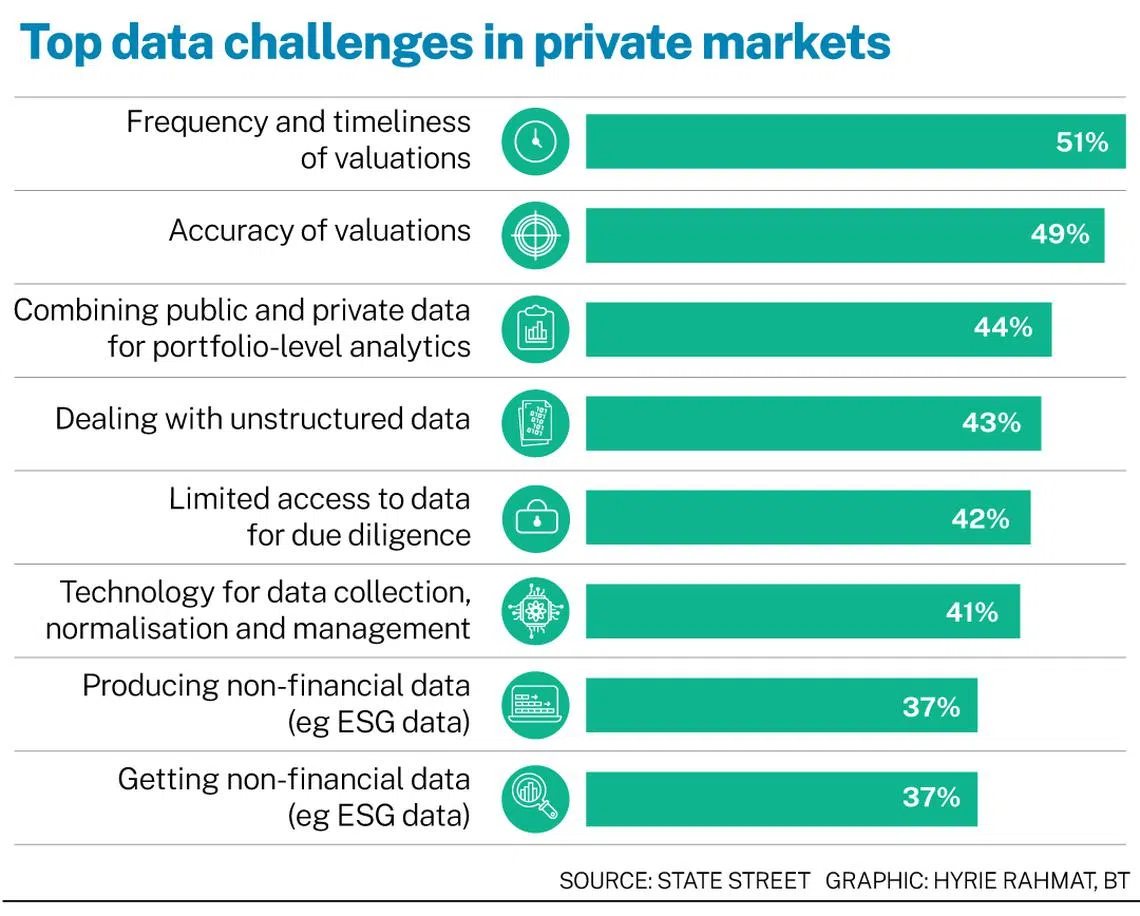
The private markets space has grown exponentially, adding to the complexity of data collection and evaluation. Ten years ago, Chng noted, private markets were largely equated with private equity. The space now includes a range of other illiquid investments, including toll roads and private debt, with their own idiosyncratic data requirements.
Kavilash Chawla, founder of Foresight Economics, knows something about the difficulties of obtaining and organising private markets data.
His company is trying to bring better data to the private markets space, starting with variables that drive country-level attractiveness for greenfield foreign direct investments.
Chawla believes a whole-of-fund platform that gives investors a portfolio-level view of private and public markets is still some four to six years from being a reality.
Private markets transactions are usually “relationship-based”, he said. Frequent and well-disseminated data for such transactions has, historically, been neither necessary nor valuable. “The cost of collecting and disseminating that data does not make economic sense,” he added.
As the private markets grow, however, Chawla sees growing demand for data. “We are close to the tipping point of where private markets are just too important to investment returns, and the quantum of capital being allocated to private markets is so significant.
“We already have the technology to be able to collect, aggregate and disseminate the data. A lot of the work that needs to be done over the next few years is to analyse and understand the factors and variables that drive investment returns, at both the asset and portfolio levels,” he said.
State Street’s Chng noted that regulatory requirements are also fuelling data needs. “Disclosure requirements are creating a new challenge for private markets managers. I see this creating a new ecosystem of service providers.”
Increased transparency could increase the investment audience for private markets. “It’s already engineering a new breed of investor,” Chng said.
Data availability could make life easier for GPs, too. Calvin Ng, co-founder of Aura Group, which manages several funds, said due diligence in the private markets space is often “costly, time-consuming and painstaking”.
Ng described the arrival of cloud accounting as “one of the great leaps forward in the private markets space, making due diligence easier”. He also thinks artificial intelligence tools will begin to aid in the analysis of unstructured data that is currently being done manually.
While deals might become easier to clinch if more and better data is available, however, Ng said returns on average would most likely fall.
Asymmetry of data is one of the drivers of returns, and not having to disclose data is one of the key benefits of private markets.
Chng thinks the industry will eventually strike a balance between the transparency of public markets and the current levels of opacity. “I think the market will reach a new equilibrium to be more semi-opaque than fully opaque.”
TRENDING NOW

Cracks emerge in AI borrowing boom as CoreWeave, Oracle and SoftBank debt worries grow

Could stablecoins be the future of money?

‘How many will survive?’: Bubble fears arise as China’s humanoid robotics face reality check

Philippine power giant First Gen rebuffs foreign offers, plans up to US$2.6 billion in expansion

