

Data centres, 5G and technology are possible re-ratings catalysts for telcos
Singtel, StarHub and M1 moving to enhance their enterprise offerings; some aim to reposition their business as a tech company, expand data centre capacity

Singapore
COMPETITION in South-east Asia's telecoms market is not likely to let up next year, but analysts see opportunities for market players to diversify into new segments and reposition themselves for higher stock market valuations.
Among the big drivers of such opportunities is the adoption of 5G, which appears to have more initial use cases within the enterprise.
This was not the case with previous technologies, said DBS analyst Sachin Mittal, as it was retail consumers who were the early adopters of 3G and 4G, with businesses following behind.
Nitin Soni, senior director of Fitch Ratings' Asia-Pacific telecoms, media and technology (TMT) team, sees 5G as being initially more useful for enterprise customers such as financial institutions and multinational companies, before trickling down to Internet of Things (IoT) use cases to connect machinery, and then to retail consumers.
Singapore's telcos are already moving to enhance their enterprise offerings.
Singtel has been repositioning NCS, its technology services arm, to capture new business opportunities in Singapore, China and Australia. It is also running trials to showcase the possibilities of its network. On Sentosa it demonstrated this year a road sweeper vehicle that could be remotely controlled by an operator 20km away in Jurong.
Group chief executive Yuen Kuan Moon said Singtel is expanding its partner ecosystem with more applications, devices and developing platforms to help businesses integrate 5G into their operations: "We are doubling down on customer engagement in various verticals that are looking for solutions to achieve both top and bottom line optimisation for their business."
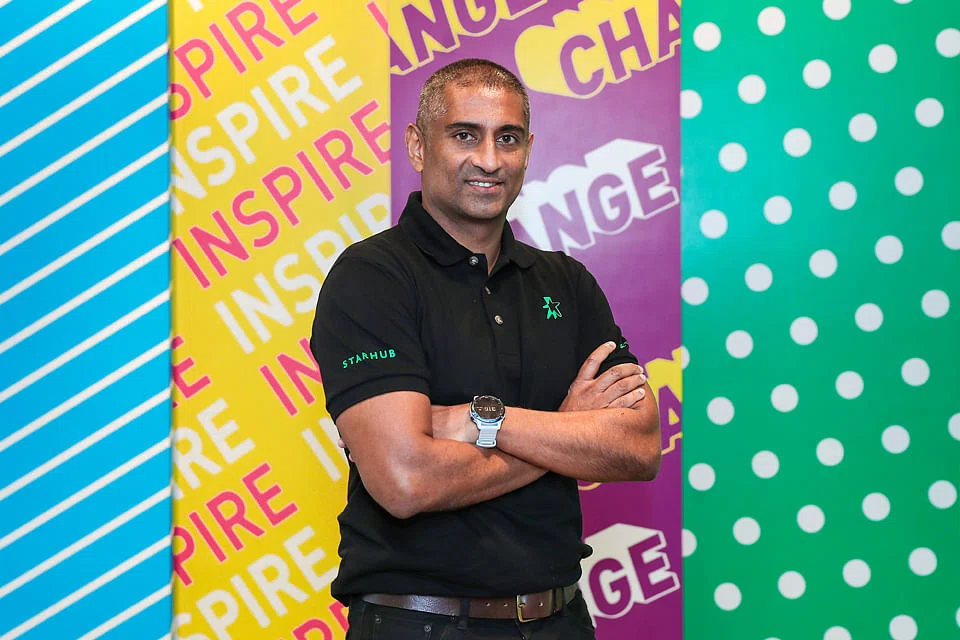
StarHub, as part of its Dare+ programme, hopes to drive some gross profit growth through 5G and enterprise products. To that end, it acquired a 60 per cent stake in information and communication technology (ICT) provider JOS from HKBN and a 50.1 per cent stake in MyRepublic broadband.
StarHub chief executive Nikhil Eapen said: "Customers can expect more of such managed solutions, delivered in an integrated manner, to help them secure and transform their business and operations expeditiously and cost-effectively, with comprehensive after-sales support."
Keppel Corp-owned M1 has also signed an agreement to acquire up to 70 per cent of Malaysian enterprise services group Glocomp Systems, which has experience in areas such as computing and information management as well as security and privacy. M1 has also partnered with more than 20 technology companies to launch a Digital Transformation Alliance (DTA), which aims to serve 1,000 SMEs by 2022.
Relative newcomer TPG, meanwhile, does not offer other corporate ICT services. Its enterprise-level products are limited, at the moment, to a 50 GB mobile plan at S$8 for businesses, charged at S$5 for the first 3 months of service.
The company's CEO, Richard Tan, said TPG would work "expediently" to roll out its 5G network. TPG was provisionally awarded 2 lots of 5 MHz paired spectrum within the 2.1 GHz spectrum in November this year.
But CGS-CIMB analysts, in a research note on Nov 29, said 5G deployment ideally requires 80 to 100 MHz of frequency.
"Given the relatively narrow bandwidth, we think TPG will not be able to make use of the 2.1 GHz (spectrum) to deliver 5G speeds that are much faster than on its existing 4G network," they said.
CGS-CIMB has an "overweight" call on the Singapore sector as it sees mobile competition stabilising with the transition to 5G networks, while enterprise revenues are expected to strengthen in the coming years.
The brokerage's top pick is Singtel, for its asset monetisation efforts and expansion into higher-growth business areas such as regional data centres.
Mittal of DBS also said Singtel is likely to have an advantage in the enterprise race: "Singtel has the bigger ICT workforce. The question is whether they can transform this workforce into more expertise across the sector."
But he warned that local telcos have not been particularly successful at capturing customers in the corporate ICT space in the past due to their lack of domain knowledge - a gap they are actively trying to close via acquisitions.
New services
Outside of Singapore, it may take longer for 5G to be adopted. But the regional telcos are looking no less exciting as they, too, seek new sources of revenue.
KPMG Asia-Pacific's head of TMT Darren Yong said many telcos are actively pursuing "journey to tech" aspirations in search of new revenues as they have seen average revenue per user (ARPU) growth stall.
"This has resulted in sector convergence: where telcos aim to reposition their business as a tech company. If executed well enough, it can imply a more aggressive stock market valuation for the telco," he said, adding that KPMG has seen telcos converge into sectors such as banking, insurance and health spaces.
One such example is Singtel's Philippines associate Globe Telecom, which has seen its valuation climb 65.7 per cent this year to 448.42 billion pesos (S$12.1 billion) as at Dec 23.
This investor optimism has come on the back of developments at Mynt, in which the company has a 40 per cent stake. The Ant Group-backed fintech company recently hit a valuation of US$2 billion after a US$300 million funding round.
Citi analysts said such investments into adjacent industries might not have been taken so favourably by investors in the past, due to the associated losses.
"Losses, however, don't necessarily mean the absence of value. This could be seen with significant value attribution to some loss-making web and fintech plays," they said, adding that telcos need to set adequate valuation reference benchmarks for these assets.
Telcos have advantages in distribution reach and customer relationships in these spaces, Citi analysts said. Telcos could, therefore, leverage their stronger cross-selling capabilities to lower user acquisition costs versus traditional financial services options.
Data centre rush
Amid the pandemic, many telcos have also discovered that they were sitting on potential gold mines in the form of data centres and their data centre operating capabilities.
Most have operated their own data centres for years, even decades. But Covid-19 has created new demand for data centre space, as more work is done remotely.
Reliance Jio, India's largest wireless operator, announced in February this year that it plans to build a US$950 million data centre campus in Uttar Pradesh.
Singtel and its Indonesian partner Telkom also said in October that they were in advanced talks to acquire and build data centres in Indonesia and South-east Asia.
Globe also announced in November this year that it was in advanced discussions with ST Telemedia Global Data Centres to form a joint venture to further expand its data centre capacity.
Mittal of DBS noted the data centre business is not new to telcos, although there is now a renewed focus on it due to increased demand for data centre capacity.
"The (data centre) market is seeing high growth and very good valuations, so I think they are going to focus more and more on this," he said.
The telcos already have the infrastructure, such as good landing connectivity, to bring these data centres online, he said, which gives them a fair chance of success.
TRENDING NOW

Once staunchly pro-China, Malaysian Chinese businesses are now distancing themselves from Beijing

Looking beyond looming CEO succession, should UOB potentially pursue a transformative merger?

Could stablecoins be the future of money?

Grab CEO’s wife Chloe Tong on life with Anthony Tan and finding her purpose

