FLCT banks on scale, industrial sector strength
Aside from post-merger enlargement and an expanded investment mandate, fund-throughs and rentals are also potential opportunities for growth. BY JUDE CHAN

Singapore
UNDERTAKING major corporate action in the thick of "the crisis of a generation" could easily be disastrous. But, for Frasers Logistics & Commercial Trust (FLCT), it has been a blessing in disguise.
The S$1.6 billion merger between Frasers Logistics & Industrial Trust (FLT) and Frasers Commercial Trust to create FLCT was mooted in early December 2019 and completed in mid-April 2020 - just as the Covid-19 pandemic forced countries around the globe into lockdowns.
But the manager of the enlarged real estate investment trust (Reit) believes the scale from the merger and the expansion of its investment mandate may have helped FLCT thrive in spite of the pandemic.
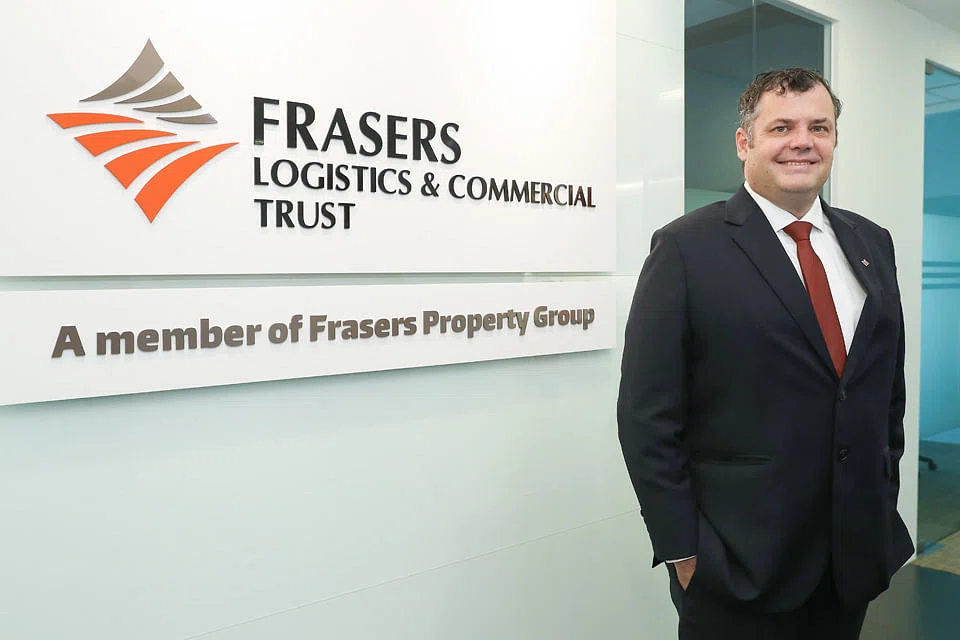
"Diversification is a benefit, particularly when you're going through challenging periods like a pandemic," said Robert Wallace, chief executive officer of FLCT's manager. "Our mandate has now expanded... and that has enabled us to grow and acquire assets that we weren't able to look at before."
He cited the Blythe Valley Park business park in the United Kingdom, which was among the 6 Europe properties that the Reit proposed in May 2021 to acquire for a total property purchase price of S$548.7 million.
"That property actually has an adjoining industrial component. If we didn't have that expanded mandate, I don't think we would have been able to buy the industrial component," Wallace said.
Since the completion of the merger on Apr 15, 2020, FLCT has seen its unit price soar 46.5 per cent to S$1.45 as at Jan 14, 2022, with an annualised total return of 30.1 per cent.
But it should be noted that these figures are off a low base as pandemic panic had sent units of FLCT plunging to as low as S$0.665 on Mar 23, 2020 - just weeks before completion of the merger.
Even compared to FLT's price of S$1.24 when the merger was first proposed on Dec 2, 2019, however, the counter has done relatively well - up 16.9 per cent and with an annualised total return of 13.8 per cent.
FLCT has also outperformed other merged S-Reits.
Ascott Residence Trust is down 20.3 per cent since the effective date of its merger with Ascendas Hospitality Trust, with an annualised total return of negative 6.5 per cent; OUE Commercial Reit has lost 16.3 per cent since its merger with OUE Hospitality Trust, with an annualised total return of negative 2.8 per cent; while ESR-Reit has dipped 2.7 per cent since its merger with Viva Industrial Trust, but has managed to record an annualised total return of 6 per cent.
Even Singapore's largest Reit, CapitaLand Integrated Commercial Trust (CICT), has only managed to register a price gain of 5.2 per cent, with an annualised total return of 9.1 per cent, since the effective date of the merger between CapitaLand Mall Trust and CapitaLand Commercial Trust.
"Obviously, the pandemic has been a challenge when it comes to office occupancy," Wallace said. "From an office perspective - in Singapore, at least - we've seen some challenges, particularly for the retail component of office buildings because they haven't had the patronage that they've seen in the past."
But the pandemic has been a boon for the industrial sector, he said: "We can see that there's obviously been strong growth in e-commerce in all of the major markets that we're in, which has resulted in very healthy space take-up in Australia, Germany, the Netherlands and the UK, and we've seen very strong rental growth.
"In fact, in most of those markets, we're anticipating future rental growth as a result as well."
Index addition
Post-merger, FLCT has grown from strength to strength. For the FY2021 ended Sep 30, the Reit posted a 7.9 per cent increase in distribution per unit (DPU) - to 7.68 Singapore cents from 7.12 cents in the previous year.
FY2021 revenue rose 41.4 per cent to S$469.3 million and adjusted net property income jumped 37.5 per cent to S$355.2 million. The increase was attributed to the full-year effect of the merger, new acquisitions and early surrender fee received from various tenants.
The enlarged Reit also earned its place on the benchmark Straits Times Index (STI) in April 2021.
"I really think it's probably the merger that was the big contributor, which resulted in us being a constituent of the STI," Wallace said. "What we have seen is certainly a larger volume in units traded on a daily basis - we're around about 10 million units per day now, on average."
"Certainly, the inclusion in the index has helped," he added. One of the merits of the merger had been a combined market capitalisation of S$4.2 billion that would have placed the enlarged Reit as ninth-largest S-Reit then. Its market capitalisation has since grown to S$5.3 billion - ranking it as the sixth-largest S-Reit currently.
It has grown its portfolio too.
Apart from the 6 freehold properties in Germany, the Netherlands and the UK that it acquired last year for S$548.7 million, FLCT also acquired a freehold warehouse property in the UK for £28.3 million (S$51.5 million).
At the same time, it divested a non-core asset - a leasehold property in Port Melbourne, Victoria, Australia - for a consideration of A$42.5 million (S$41.7 million). This was more than double the property's book value of A$21 million as at Sep 30, 2021. FLCT had forked out A$21.7 million for the property at its initial public offering in 2016.
"We still have been quite active and we'd look to, in a measured way, continue to pursue growth opportunities," Wallace said. "We'd like to grow with an industrial bias, as much as we can, supported by business park acquisitions."
But he also stressed that FLCT does not have any targets on the value or number of acquisitions it aims to make. "We don't like to be led by targets; we'd like to be led by opportunities," he said. "We'd like to look at every opportunity, and if it makes sense from a portfolio perspective, we'll go and look to acquire that portfolio," he added.
Expansion opportunities
Wallace anticipates that the Reit could look for opportunities to grow its presence in Germany, the Netherlands and the UK, as well as explore adjoining markets such as France, Belgium, or Spain.
"I would probably, at this point in time, say that there's more growth potential in Europe than there is in Australia," Wallace said.
Australia accounted for 45.5 per cent of FLCT's portfolio value as at Sep 30, 2021. "We're not looking to reduce our portfolio in Australia," Wallace said. "We'll look to grow it as much as we can as well, so it'll always be a major market."
But he noted that capitalisation rates in Australia have compressed by "100 basis points at least". "It's harder to get accretive acquisitions (in Australia), so that may result in us being more involved in, say, development participation," Wallace said.
FLCT may also consider "funded throughs" with other developers or with a joint venture partner. "A fund through is when you actually buy something that hasn't been built yet. So you buy it from a third party - they will build it and then you will fund that through the development of the property," he said, calling it "an efficient way of buying properties".
As at end-September 2021, FLCT's aggregate leverage stood at 33.7 per cent - translating to a debt headroom of around S$2.5 billion.
But Wallace said that the Reit manager was comfortable with keeping the gearing ratio at under 40 per cent. "If we got to 40 per cent, we would be uncomfortable. (Under 40 per cent is) certainly the range that we'd like to be in. And that does give us some opportunities to use our balance sheet to potentially find some new opportunities," he said.
Apart from potential acquisitions and development, Wallace said the third prong for growth would be rental growth.
"There's also growth available through some of the vacancy opportunities in our commercial portfolio as well," he said. "I think there's reasonably good market rental growth that we have seen and hopefully we'll continue to see in some of the major industrial markets that we're in, such as Australia."
As at end-September, FLCT's portfolio of 103 properties across 5 countries was valued at approximately S$7.3 billion - up from S$6.2 billion a year earlier. Its net asset value (NAV) per unit rose 12.7 per cent to S$1.24 as at Sep 30, 2021, from S$1.10 a year ago.
FLCT is currently trading at nearly 1.2 times its book value - lower than most of its S-Reit peers.
Mapletree Logistics Trust, Mapletree Industrial Trust, Ara Logos Logistics Trust and ESR-Reit are trading between 1.2 and 1.4 times their respective book values.
"Industrial S-Reits' pivot towards new economy assets have paid off as they continue to demonstrate their resilience throughout the Covid-19 pandemic," said DBS analysts Dale Lai and Derek Tan in a recent report. "With the continued strong demand for logistics properties and outperformance of the sector, we believe that there is potential for further cap rate compressions in (FY2022), albeit at a slower pace than FY2021," they added.
DBS has a "buy" recommendation on FLCT, with a street high target price of S$1.85. The research house has also named FLCT as one of its top picks among the industrial S-Reits.