

Webtoons are comics for your phone, and they are driving investments into the entertainment media industry

Tan Nai Lun
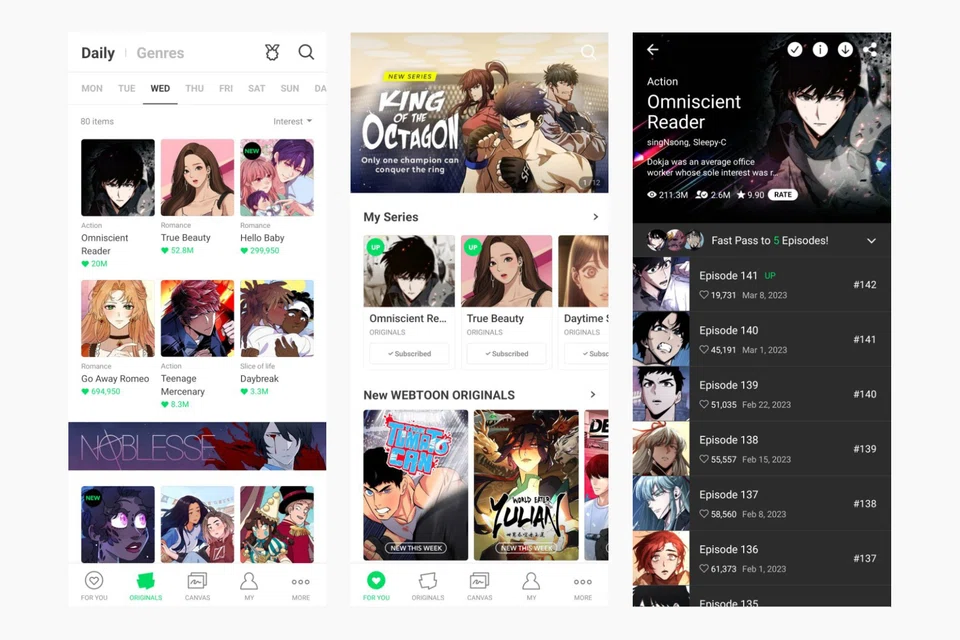
EVERY morning on the train to work, Jermaine Siew can be found scrolling through pages of colourful artwork on her phone.
The 27-year-old food technician is one of millions of readers globally who have found joy perusing mobile-optimised comic strips called webtoons.
Originating in South Korea, webtoons were initially a “snacking media” – readers can absorb content in a few minutes regardless of where they are, instead of needing to actively listen to or watch a story, as with movies.
The industry has since ballooned, and is attracting investment dollars for its youthful demographic and TV series spin-off potential. But some market watchers caution that the wave of excitement may have crested.
According to a 2022 survey by the Korea Creative Content Agency, sales in South Korea’s domestic Webtoon industry in 2021 amounted to 1.6 trillion won (S$1.6 billion). This represents a 48.6 per cent increase year on year and is 4.1 times what it was in 2017.
A report by Research and Markets also expects the global webtoons market to reach US$56 billion by 2030, from US$3.7 billion in 2021.
Neeraj Sharma, managing director and growth markets lead for media at Accenture, noted that a key factor for webtoons’ rising popularity is its easy access through smartphones.
The vertical scrolling format, as opposed to the traditional horizontal format of print comics, is well-suited to the smaller screens of mobile devices, Sharma said.
Kim Hyeonmi, partner at Boston Consulting Group (BCG), also noted that webtoons serve an audience with shorter attention spans.
And, they have the appeal of a community. Hosting sites have comment sections, which make it easier for readers to post feedback after each chapter, Kim added.
Billion-dollar industry
Investors around the world are picking up on this craze. Last year, Seoul-based GVA Asset Management, which manages about US$600 million in assets, reportedly put US$15 million into webtoon producer Kenaz.
Also in 2022, Singapore’s GIC led a 120-billion-won investment round in e-book and webtoon provider Ridi Corporation. Ridi operates webtoon subscription platform Manta, animation streaming service Laftel and e-book retailer Ridibooks.
In January this year, GIC and Saudi Arabia’s Public Investment Fund also invested 600 billion won each in Kakao Entertainment, which operates Kakao Page, one of the largest webtoons hosting sites in South Korea.
BCG’s Kim noted that these platforms have the potential to also reap returns outside the webtoon sites, especially as they neither require high investment nor have high operating costs.
Operating models vary by platform. Readers of Naver’s platform, called Webtoon, purchase coins to gain instant access to the latest chapters of ongoing webtoons. But they can also wait for about a week after the next upload for each chapter to become free.
Manta, meanwhile, offers a certain number of free chapters. Readers must purchase coins to unlock further chapters, or they can purchase a subscription for unlimited content.
Webtoon producers and writers are paid for their intellectual property when their stories are adapted for film or television, which has been happening more often of late.
Some notable examples of TV series originating as webtoons include horror series Sweet Home, revenge and romance drama Itaewon Class, fantasy series Tomorrow and romance drama Business Proposal.
BCG’s Kim said: “Webtoons provide a good mix of characteristics to be picked for OTT (over-the-top) platforms such as Netflix and Disney Plus, because they are looking for interesting stories that haven’t been aired to compete against the traditional free-to-air dramas.”
Kim said stories in the webtoon sphere may be more creative, as writers can be very diverse. She noted that the barriers to entry for publishing a webtoon are very low, and writers do not need to be signed to a big publisher to put their work out.
One of the first webtoon authors, Kang Do-young – better known by his pen name Kang Full – had no formal training in art or writing. But his works gained popularity after he uploaded them online in the early 2000s, with several being eventually adapted for film, including Miracle of a Giving Fool and 26 Years.
More recently, the author of hit webtoon True Beauty was revealed to be a single mother. Kim Na-Young, who writes under the pen name Yaongyi, started uploading the series on Naver’s Webtoon platform in 2018. It was adapted for TV in 2021.
International appeal
The biggest webtoon producers in South Korea are those owned by Internet companies Naver and Kakao.
For the fourth quarter of 2022, Naver said its global webtoon revenue was up 133.1 per cent on year to 382.9 billion won, including the impact of accounting method changes. This made up around 16.9 per cent of the group’s total revenue for the quarter.
Its global webtoon gross merchandise volume rose 4.1 per cent on year to 403.3 billion won in Q4.
Kakao’s story business segment – which includes its global webtoon operations – reported revenue of 920.9 billion won for 2022, up 16 per cent on year. The story segment made up 12.5 per cent of Kakao’s revenue last year.
Both also have significant footprints outside their home markets. Kakao’s Japanese webtoon platform, Piccoma, recorded more than 10 million monthly active users in Q3 2022, while Naver’s Webtoon reached 180 million global monthly active users as of March 2022.
Accenture’s Sharma noted that Korean media companies, by design, create content in multiple international languages, allowing them to reach a global audience.
Webtoons are also joining the suite of Korean content such as films, dramas and music that is gaining popularity around the world, Sharma added.
But Ian Goh, managing partner at venture capitalist 01VC, said the webtoon industry in South-east Asia should be seen as an extension of the publishing industry and is “not a new space”.
His firm took a stake in Chinese webtoon publisher MangaToon around 2017. MangaToon licenses content from China for publication overseas. Most of its users are located in South-east Asia.
While the webtoons space did “decently well” over his years of investment, Goh said the space is now “quite dead” as monetisation of content in South-east Asia is low. Audiences in the region are not as willing to pay for such content.
“These Korean players are huge domestically, but it doesn’t mean that their international audience is moving the needle,” Goh said.
Of course, these large South Korean players are looking beyond the Asian region too.
Webtoon’s chief executive Kim Junkoo said at an event in the United States that the company expects to go “beyond web comics and become a global top-tier entertainment company”.
The company is looking to the US as a strategic market. In 2021, Webtoon acquired Toronto-based storytelling platform Wattpad and merged their content studios that produced original works to streamline content.
But solid growth will require expansion into new mediums as well as new geographies.
Mirae Asset Securities analyst Lim HeeSeok expects new user growth in global markets will decelerate, as demand for print manga has increased amid the economic reopening.
Lim also said South Korea’s domestic webtoon market has likely matured, although he noted that Naver saw a rise in transaction value as users spent more time and money on the platform due to the increasing number of high-quality webtoons adapted from novels.
Lim expects content platforms will need to drive growth through synergies between webtoons and web novels to sustain growth.
BCG’s Kim, meanwhile, expects the crossover of webtoons into games will be the next big thing beyond movies and dramas: “Games require some world building, and webtoons have a lot of motifs to build on.”
Accenture’s Sharma, however, cautioned that “hype cycles are getting shorter”.
“Whether this trend is here to stay over a long term or not will depend on the ecosystem embracing this format.”
TRENDING NOW

‘My grandfather’s legacy’: Sherman Kwek lays out three-year plan for CDL to drive returns

He built the Vingroup empire. Now South-east Asia’s richest man is handing some key roles to his sons

Canada is upping oil flows to Asia, but South-east Asia’s refineries aren’t ready to handle them yet

What role can Japan play in Asean’s future?

