
NEWS ANALYSIS

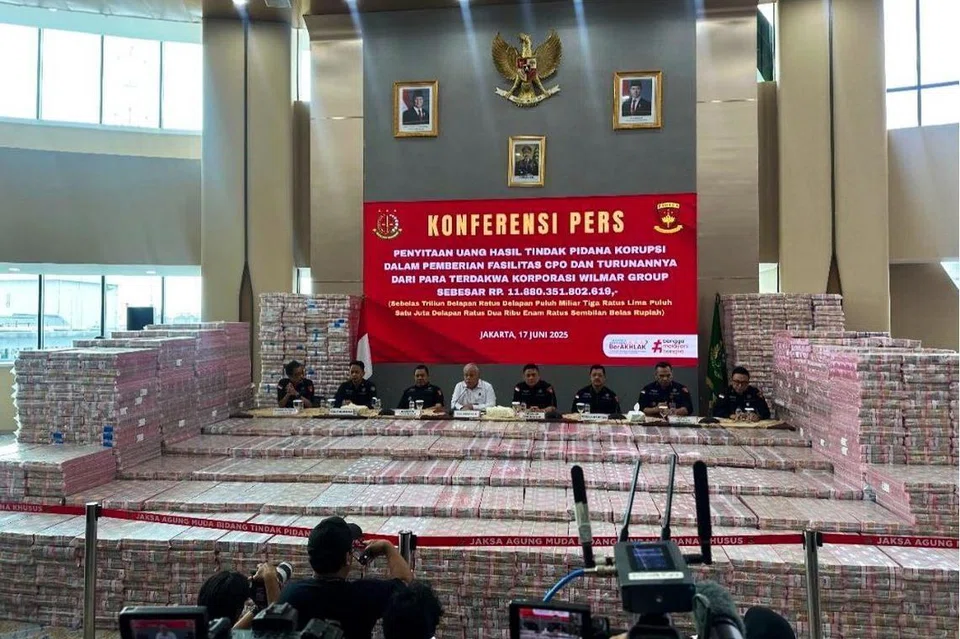
What does 11.9 trillion rupiah in cash look like? For Wilmar, it could spell trouble

Loss of the ‘security deposit’ in relation to an Indonesian probe could account for a 65% drop in FY2025 earnings, according to DBS and RHB estimates

Summarise
Jude Chan
Published Fri, Sep 26, 2025 · 05:14 PM
    • Wilmar's 11.9 trillion rupiah security deposit, laid out at a press conference in June, could be forfeited, following an unfavourable ruling by Indonesia's Supreme Court over a corruption scandal tied to the country’s 2021 cooking oil shortage crisis.
    • Wilmar's 11.9 trillion rupiah security deposit, laid out at a press conference in June, could be forfeited, following an unfavourable ruling by Indonesia's Supreme Court over a corruption scandal tied to the country’s 2021 cooking oil shortage crisis. PHOTO: ATTORNEY-GENERAL'S OFFICE OF INDONESIA

    [SINGAPORE] It was an astounding sight, when Singapore-based global palm oil company Wilmar Group in June laid out 11.9 trillion rupiah (then worth around S$928 million) – stacks of cold hard cash – before the Indonesian authorities.

    This was taken to be a “security deposit” as the authorities re-examined the alleged role of five Wilmar subsidiaries in a corruption scandal tied to the country’s 2021 cooking oil shortage crisis.

    This sum could now be forfeited, following an unfavourable Supreme Court ruling disclosed by Wilmar in a bourse filing on Thursday (Sep 25).


    While details of the grounds of judgement and final award amount have not been released, it is likely that Wilmar will lose the 11.9 trillion rupiah security deposit – and more.

    Earnings hit

    “We note that the full written judgement, including final penalty details, has not yet been released and, as such, there may be potential for additional financial liability,” said RHB’s research house in a flash note on Friday.

    RHB analysts downgraded Wilmar to a “sell” recommendation, and cut its target price by 9.1 per cent to S$2.50. Its target price on the mainboard counter at the start of the year was S$3.

    “We make no changes to our earnings (forecast) for now, until we receive full details of the penalty,” the analysts said. But they estimate that the security deposit’s forfeiture could cut Wilmar’s earnings forecast for FY2025, ending December, by 65 per cent.

    DBS analyst William Simadiputra downgraded Wilmar to “hold” earlier this month with a reduced target price of S$3, from S$3.80 previously.

    While Wilmar broadens its downstream operations and builds a business platform with stronger and more stable margins, he believes the legal overhang clouds its strong fundamentals.

    The 11.9 trillion rupiah provision also represents around 65 per cent of DBS’ earnings forecast of US$1.2 billion for FY2025, or around 55 per cent of the consensus FY2025 earnings estimate of US$1.3 billion, he said.

    “We believe the penalty will not impact Wilmar’s strong balance sheet, as its cash position as of June 2025 stands at US$3 billion, excluding less liquid bank deposits of US$3.7 billion,” Simadiputra added.

    The way RHB sees it, however, the cooking oil scandal could be just the tip of the iceberg.

    “We are also wary that this could signal the way the Indonesian government is leaning, with respect to other ongoing rice investigations on the group,” the RHB analysts said, in reference to Wilmar’s involvement in criminal investigations against some rice producers for suspected violations of rice quality and measurement standards.

    These include allegedly selling rice that does not meet packaging quality standards, and mislabelling practices by allegedly blending lower-grade rice with premium-grade grains.

    Wilmar has denied the allegations, and said it will “continue to assist with the investigations to clear its name”.

    Share price tumble

    In April last year, Indonesia’s Attorney-General’s Office (AGO) brought charges against Wilmar – the Singapore-listed group owned by billionaire “palm oil king” Kuok Khoon Hong – for allegedly “harming state finances, (making) unauthorised profits and harming the business sector”, and claimed for losses totalling 12.3 trillion rupiah.

    Wilmar’s subsidiaries were accused of “corrupt actions” to illegally profit from the evasion of state-imposed export controls on cooking oil and palm oil, which were put in place to stem a domestic shortage amid a surge in palm oil prices.

    Wilmar has maintained that its actions during this period were in compliance with prevailing regulations.

    The group was vindicated when the Central Jakarta Court in March this year acquitted it and two other palm oil companies – Musim Mas and Permata Hijau – of charges of misconduct in obtaining the export permits.

    Then, the story took a darker turn. By April, news broke that the AGO had arrested all four judges handling the case, on charges of taking at least US$1.1 million in bribes to arrange a favourable verdict.

    Wilmar’s 11.9 trillion rupiah security deposit – displayed in full glory at an AGO press conference in June – was to have been a demonstration of the company’s “belief in the Indonesian judicial system and their good faith and innocence”.

    This came after the AGO submitted an appeal against the lower court decision to the Indonesian Supreme Court. The security deposit would have been returned to Wilmar if the Supreme Court had upheld the decision.

    “While Wilmar maintains its innocence, we believe (the overturning of the lower court decision by the Supreme Court) will result in a negative perception of the group,” RHB analysts said.

    On Friday, shares of Wilmar slumped as much as 3.8 per cent to the lowest level in nine years – since February 2016 – before clawing back some losses.

    The stock closed 1.4 per cent or S$0.04 lower at S$2.85.

    In the year to date, the counter is down 8.1 per cent. In contrast, the benchmark Straits Times Index is up 12.6 per cent so far in 2025.


