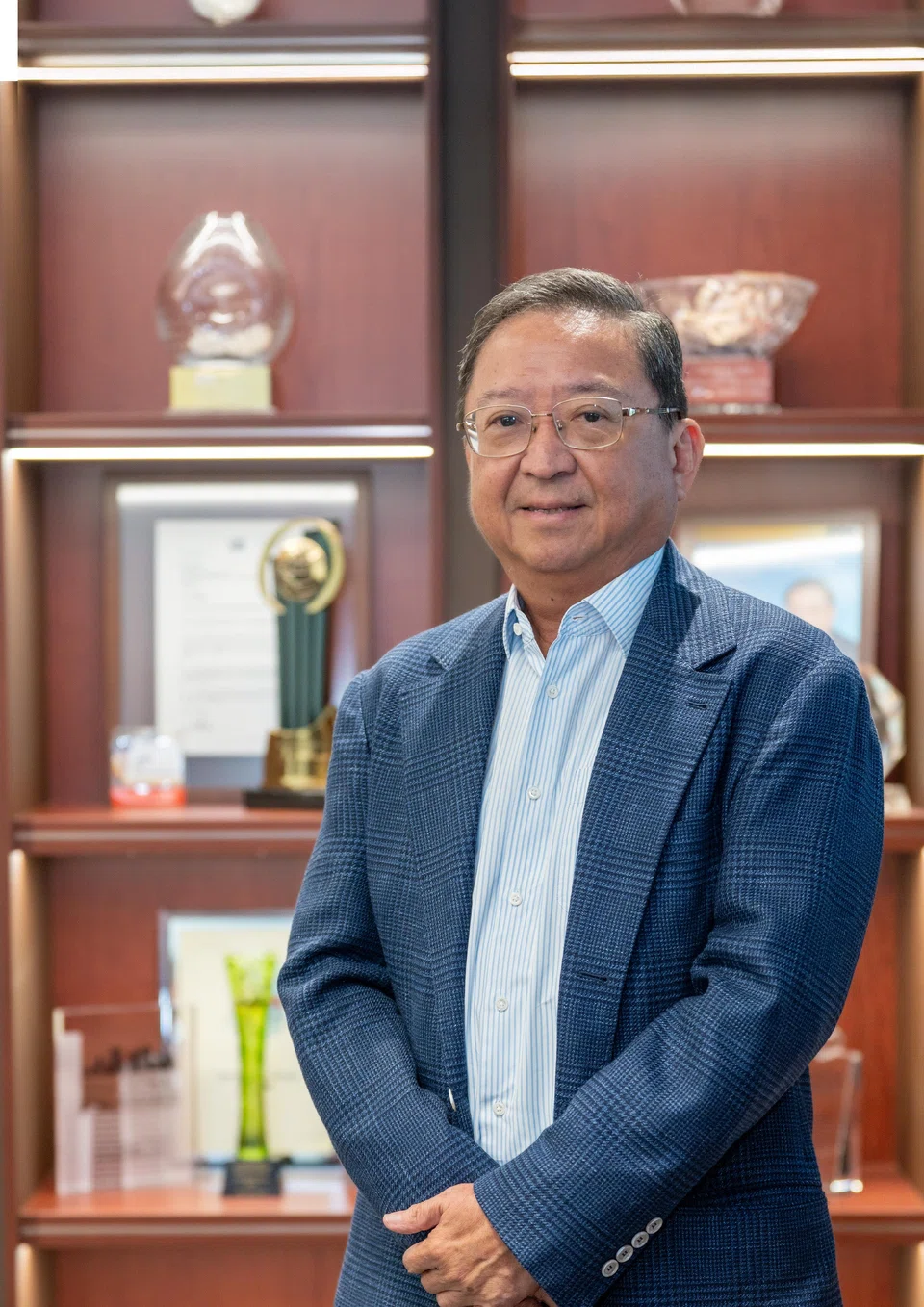
What Singapore needs is not more Reits, but bigger ones: ARA co-founder John Lim
The local market must move towards consolidation and aggressive global expansion, says the industry veteran

[SINGAPORE] The Singapore-listed real estate investment trust (S-Reit) sector does not need more Reits; it needs bigger ones.
That is the candid assessment of industry veteran John Lim, who believes the local market’s growth strategy requires a fundamental shift towards consolidation and aggressive global expansion.
Lim’s perspective carries the weight of history. Having spent over two decades building ARA Asset Management into a US$100 billion behemoth, he was instrumental in listing pioneering vehicles such as Suntec Reit and Fortune Reit at a time when the market was highly suspicious of the asset class.
Now, he argues, the path forward is not relentlessly pushing for more initial public offerings.
“What’s the point of another?” he asked at the sidelines of the Asia Pacific Real Assets Association (Aprea) conference in Singapore on Wednesday (Mar 25).
The numbers bear out his argument. According to Aprea, the regional Reit universe has ballooned to over 300 entities worth about US$439 billion as at end-February.
But a glaring disparity exists in scale. Australia, for example, boasts 40 Reits with a combined market capitalisation of US$124.6 billion, while Singapore’s 39 Reits command just US$82.1 billion.
It is not that S-Reits are underperforming. In fact, they delivered their strongest performance since 2019, generating returns of over 20 per cent in the 12 months through February.
Aprea CEO Sigrid Zialcita noted that global risks are driving institutional capital towards the city-state.
“We are seeing a profound ‘flight to safety’,” she said. “As risk levels spike globally, institutional investors and ultra-high-net-worth families are pivoting toward Singapore’s stable balance sheet. This ‘certainty premium’ is expected to drive investment volumes.”
To capture this capital and allow local Reits to punch above their weight, however, Lim believes regulators need to hand them heavier gloves.
As that global real estate landscape shifts, scale and agility will dictate the winners. For Singapore to maintain its crown as the Reit hub of Asia, policies must pivot to empower growth, expanding asset eligibility and improving capital-raising flexibility.
Lim pointed to current regulatory limits, such as the 50 per cent leverage cap, which restrict nimbleness amid what is now a “buyer’s market”. He suggested that relaxing these caps and providing targeted incentives for overseas acquisitions could provide the firepower needed to snap up distressed or undervalued global assets.
This push outward would naturally bump up against the persistent “foreign ownership discount” applied by local investors who prefer familiar domestic brick and mortar.
However, Lim cautioned against hyper-local complacency. Noting the slump in local office rentals just over a decade ago, he warned that remaining heavily Singapore-centric carries concentrated risks. Geographic diversification, he said, is the most effective hedge against a domestic downcycle.
If scale is the endgame, Lim believes the rumoured mega-merger between CapitaLand and Mapletree would be “a good move” – and is precisely the kind of bold manoeuvring the sector needs.
“I’m one who always advocates that size is important,” he said, noting that such a merger would form a much stronger entity capable of competing globally.
But why stop at CapitaLand and Mapletree? “Actually, they should even merge with Keppel,” he quipped.
TRENDING NOW
He built the Vingroup empire. Now South-east Asia’s richest man is handing some key roles to his sons
Grab CEO’s wife Chloe Tong on life with Anthony Tan and finding her purpose
What role can Japan play in Asean’s future?
From folding clothes to factory work: Why China is sending humanoid robots to school