

Why tariffs won’t shock the STI in 2026
Stocks know their bark is worse than their bite
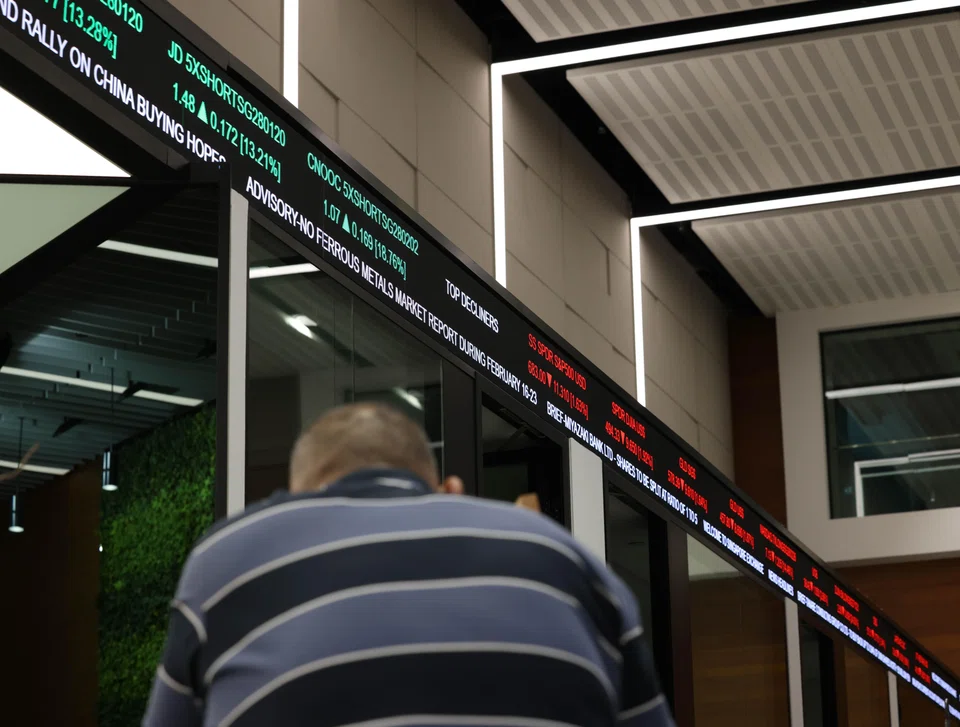
[SINGAPORE] All the rejiggering after the US Supreme Court ruling killed most of US President Donald Trump’s tariffs, plus his mulling exiting the US-Mexico-Canada Agreement (USMCA), Greenland-related threats, threatening embargos and more – tariff fears resurge.
Slow down. You may note tariffs didn’t feature in my 2026 forecast. February’s ruling and Trump’s subsequent actions and threats won’t change my outlook.
Why? Surprises move stocks most, and tariff turmoil is old news, lacking power over stocks. The Straits Times Index’s (STI) great 2025 – and 8.8 per cent rise through Feb 23 – proves it.
Don’t misunderstand. Tariffs are always bad – especially for the imposer, as US stocks’ 2025 lag versus world stocks shows.
When Trump unveiled his “reciprocal” tariffs last April, their breadth, magnitude and bizarreness were a sharp downside surprise. So stocks swooned, pre-pricing worst-case scenarios of retaliation against America and deep hits to world trade.
Those fears were overdone, for all the reasons detailed here last May. The World Bank estimates global trade grew 3.4 per cent in 2025. Even Chinese exports – among Trump’s chief tariff targets – rose 5.5 per cent, despite US-bound shipments’ plunging.
Why? First, firms found workarounds. China’s 2025 exports to South-east Asian economies soared – helping drive Singapore’s booming re-exports to the US. In parallel, America’s full-year 2025 imports from Asean nations leapt 29 per cent.
Second, in last May’s column, I noted America’s Customs and Border Protection (CBP) had only about 2,500 employees to monitor hundreds of entry locations. No surprise, then, that in the 2025 fiscal year, CBP performed just 465 audits for over 50 million shipments entering the US.
CBP did upgrade some of its ancient software, helping collect US$216.7 billion in duties – easily double the prior year. But that is just roughly 7 per cent of America’s’ US$3.44 trillion in annual goods imports.


The fact is that the globalised world cannot unwind fast. Few products come wholly from one nation. If a good is designed in Singapore, built in China with parts from 20 different countries, using US machinery, what is the nation of origin? What tariff rate applies? That is before transhipping and illegal tariff avoidance, which abound.
Firms appear to have front-run tariffs in early 2025.
Data showed real US imports surged in Q1 – consistent with stockpiling ahead of anticipated levies – before contracting in each of the next three quarters as that front-loading unwound. That rippled across global gross domestic product. Now, many fear stockpiles are running out. Don’t. Firms keep finding workarounds.
In April 2025, the World Bank estimated US tariff rates averaged 28 per cent. January’s update cut that to 17 per cent.
With most 2025 receipts in, actual US tariff rates averaged less than 10 per cent. February’s developments lower that to around 8 per cent. Not good, but far better than initially feared. New tariffs might not even stick, as further legal challenges swirl now.
Exemptions are a big reason why tariffs did not bite badly. Over half of US imports from both the European Union and Singapore are duty-free – including the big pharmaceuticals and most semiconductors. Over 80 per cent of US imports from Canada and Mexico are too. Firms moved fast to nab those exemptions.
Take Canada: Pre-2025, the percentage of USMCA-compliant US imports from Canada hovered around 40 per cent. Now? Nearly 90 per cent. Trump’s order enacting February’s 10 per cent global tariffs (or 15 per cent maybe) actually increases exemptions slightly.
As for Trump’s allegedly weighing quitting the USMCA, nothing is official. Chatter may be another negotiating tactic ahead of renewal talks. Expect such noise throughout 2026 – stocks do.
Deal-making also muted tariffs’ impact. Canada and China’s electric vehicle agreement. US deals with China, Japan, India, Taiwan and more. The UK and EU. The EU and India, Mercosur and others. The UK and India. Expect more to come.
The widely feared tariff that many expected wasn’t just delayed. It isn’t coming. Stocks saw that quickly last year, when few fathomed it.
Trump’s threats had ever less effect since then. See Greenland. Or his October China threats. Or all of February’s bluster. The STI keeps booming through it all. Stocks know tariffs’ bark is worse than their bite.
The US Supreme Court’s ruling doesn’t change much. It limits presidential emergency powers. Yet Trump’s replacing many tariffs on other grounds shows little actual change. No shock to stocks.
Yes, formerly high-tariff nations’ US duties now match Singapore’s extant 10 per cent – supposedly eroding your “competitive edge.” But Singapore’s economic strength comes from innovation, expertise and global trust – not relative tariff rates. Regardless, your big exemptions still apply, as I noted.
Tariff talk won’t vanish from headlines soon. But the fear is priced. Stay bullish.
The writer is the founder, executive chairman and co-chief investment officer of Fisher Investments, an independent investment adviser serving both individual and institutional investors globally
Decoding Asia newsletter: your guide to navigating Asia in a new global order. Sign up here to get Decoding Asia newsletter. Delivered to your inbox. Free.
Share with us your feedback on BT's products and services
TRENDING NOW

DBS, OCBC, UOB rout lops billions off STI as inflation, rate concerns spook investors

Grab CEO’s wife Chloe Tong on life with Anthony Tan and finding her purpose

OCBC sheds S$8 billion in value as shares close nearly 6% down; analysts cautious on banks

Deal between tycoon friends sparks scrutiny of Philippine power sector

