WTI crude oil prices may trend lower
The commodity’s recent price weakness could be attributed to several factors

[SINGAPORE] Since the beginning of November, West Texas Intermediate (WTI) crude oil prices have pulled back 19 per cent, at the time of writing, from the swing high of US$105 per barrel reached on Oct 30.
The commodity’s recent price weakness could be attributed to several factors, primarily expectations of improving supply and softer demand.
On the supply side, growing signs of a recovery in oil flows through the Strait of Hormuz, have reinforced expectations of a potential global supply surplus. This is despite reported mine attacks on tankers near the crucial waterway, with Middle East exports showing resilience and recovering faster than anticipated.
In addition, recent reports from major energy organisations, such as the International Energy Agency have highlighted the global oil market will return to a surplus in the fourth quarter of this year with an average supply of 105 million barrels per day (bpd), 1.7 million bpd higher than forecasted demand.
Another factor is softer demand signals from major oil-consuming nations. China’s National Bureau of Statistics showed refinery throughput for October fell 2 per cent from a month earlier and was down 8.1 per cent from a year ago in the world’s second-largest oil-consuming country. This has stoked concerns over slowing industrial momentum and consumption, leading oil refiners to pull back on crude intake, which in turn cools benchmark prices.
In Europe, countries have also reported double-digit declines in diesel demand, while US petrol consumption was marginally lower than a year earlier during the peak summer driving season.

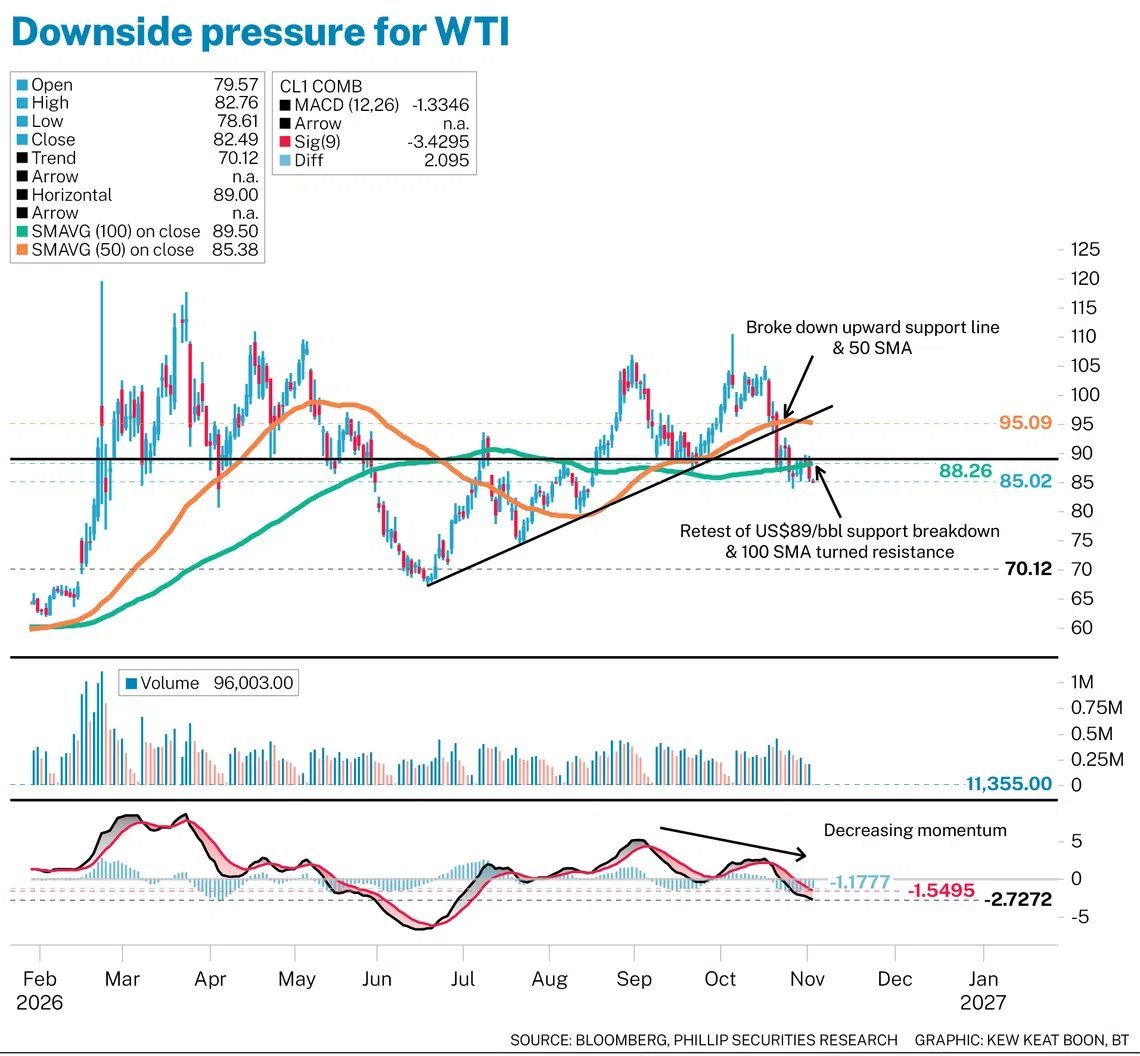
From a technical perspective, WTI oil prices have exhibited signs of price weakness lately. The price broke down a key upward support line at US$94 per barrel on Nov 4, which had been holding higher lows for the commodity since the beginning of July. This coincided with a breakdown below the 50-day simple moving average (SMA), which the price had traded above since mid-August and had previously served as a dynamic support during a pullback in the beginning of October.
The weakness in the medium-term price trend became more apparent when prices failed to reclaim the US$89 per barrel level on Nov 16. Previously a horizontal support level in the beginning of October, oil prices have now fallen under, turning it into a potential resistance zone. The breakdown below the 100-day SMA further reinforces the weakening trend.
Looking at the Moving Average Convergence Divergence, the momentum indicator also points to decreasing bullish momentum since mid-September, which complements the recent price weakness.

To conclude, WTI crude oil prices are likely to face continued downside momentum ahead on the back of softer demand and expectations of a supply surplus, coupled with technical breakdowns on the chart signalling a shift from bullish to bearish momentum.
If selling pressure persists, prices could continue to trend lower towards the next support levels at US$80 per barrel and US$75 per barrel, to retest the previous swing lows formed on Aug 26 and Aug 5 respectively.
The writer is a senior research analyst at Phillip Securities Research
Decoding Asia newsletter: your guide to navigating Asia in a new global order. Sign up here to get Decoding Asia newsletter. Delivered to your inbox. Free.
Share with us your feedback on BT's products and services