Yangzijiang Financial leans on maritime expertise to carve niche in investment space
Investment manager also sees opportunities to participate in fundraisings as companies de-list from US markets and re-list in China

Tessa Oh
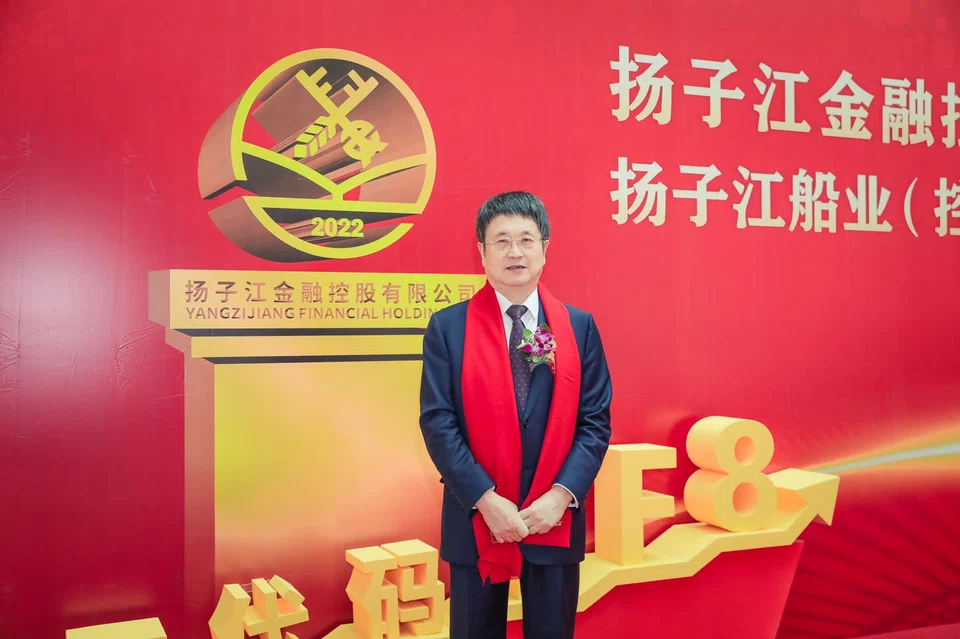
Yangzijiang Financial Holding (YZJFH) , recently spun out of Yangzijiang Shipbuilding (Holdings) , is betting on its years of expertise in the maritime and manufacturing industry to carve a niche for itself in the asset management space.
“Our biggest unique factor is that we never left our original competencies in the maritime and construction industries,” executive chairman Ren Yuanlin told The Business Times in Mandarin in a recent interview.
That, and the investment manager’s ability to exploit opportunities in and outside of China, is how it plans to stand out from its peers, added chief executive officer Vincent Toe.
“We can deploy capital both inside and outside China to capitalise on opportunities both ways. This is a unique platform that we have – most asset managers are either onshore or offshore, whereas we are a Singapore-listed company with capital pools in and outside of China.”
One example is the maritime fund that it will soon establish, which will focus on investments in maritime assets for the purpose of leasing, chartering or sale, as well as providing funds to small- to medium-sized shipping companies.
The fund has an initial target size of up to US$250 million, of which up to US$100 million will be funded internally.
For the remaining US$150 million, Toe said the company is looking at institutional investors who are similarly familiar with the maritime sector. “These could be shipping companies or shareholders of maritime companies who are very familiar with the industry or have some funds which focus on (this area).”
Talks with third-party investors for the fund are in the “advanced stage”, and the company will have more to announce in about a month’s time.
Diversifying risks
YZJFH, which made its trading debut on the Singapore Exchange on Apr 28, was spun out of Yangzijiang Shipbuilding with the aim of unlocking value for the latter’s shareholders.
Prior to its listing, YZJFH was focused largely on debt investments and microfinancing loans using capital from Yangzijiang Shipbuilding.
Following the spin-off, however, the company is shifting its strategy towards offshore investments, with the aim of bringing debt investments down to 30 per cent of its portfolio, from 60 per cent.
At the same time, it plans to raise its private equity to 60 per cent – from 15 per cent currently. The remaining 10 per cent will be in cash.
For the first half ended June, YZJFH’s interest income – earned on debt investments and microfinancing loans – fell 3 per cent to S$184.9 million. Total income for the half-year fell 27.3 per cent to S$173.8 million, while net profit fell by 30.6 per cent to S$136.4 million – on the back of a S$19 million loss arising from fair value changes.
YZJFH is also looking to move some of its investments out of China to Singapore as well as other international markets such as the United States, Vietnam and Indonesia.
As at end-December last year, all of YZJFH’s investments were in China. This shrunk to 89.2 per cent as at end-June this year, while investments in Singapore went up to 10.8 per cent.
The plan is for the company’s assets under management in Singapore to eventually make up half of its total portfolio, though Ren did not specify when it hopes to reach this target.
Asked whether the decision to diversify the company’s exposure to China was motivated by the country’s recent troubles, what with the Covid-19 pandemic and ongoing real estate crisis, Ren said while it was “a factor”, the spin-off was already in the works for quite some time.
Nevertheless, the company has had to make some adjustments to the segments it is targeting in response to the changing economic landscape.
For one, it has moved to reduce its stake in the property market – the company reported that it has reduced its total portfolio exposure to China’s property sector from 21.4 per cent as at end-2021 to 18.3 per cent as at end-June in its latest financial statement.
“The real estate sector has been undergoing changes. It was previously a more speculative investment product, while now more people are buying for own stay, so the growth will be more mature,” said Ren.
YZJFH’s participation in the real estate sector will therefore mostly be through collaborations on government projects, where the company can come in as a financial partner.
As for direct investments, it will now focus on companies with good collateral coverage – for instance, “high quality, high credit” companies in the Jiangsu area.
Said Ren: “I am not optimistic about China’s current economic outlook. The current policies are not in line with the rest of the world. But we have to go with the flow.”
Aside from these, YZJFH also has its eyes set on investing in growth sectors, such as clean tech and clean energy.
Ren believes there are a lot of opportunities in the capital market in China. For instance, with many Chinese companies delisting from the United States and returning to China, YZJFH can invest via limited partnerships or pre-IPO investments.
The company also sees potential in the logistics segment of the mining sector: “We are already looking at companies in the Changjiang area where the mine production is in the north, then we can be involved in the manufacturing, transportation, storage and sales,” said Toe.
“Our target is to be different from the rest of the finance companies,” Ren added. “We aim to be unique and grant ourselves an advantage. We want to be an outstanding finance company, and not a mass market finance company.”