Yoma Strategic: a bet on Myanmar
Singapore-listed business corporation has been busy entrenching itself in the core facets of the country's economy.

Angela Tan
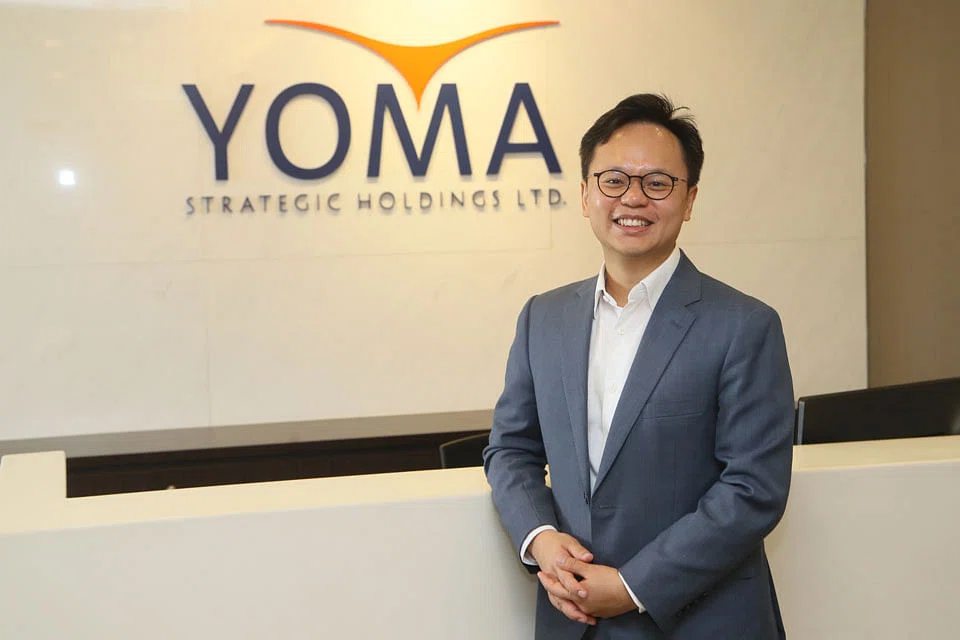
AFTER years of isolation, Myanmar under civilian leader Aung San Suu Kyi's government has been pushing to accelerate reforms and Singapore-listed Yoma Strategic Holdings has been busy entrenching itself in the core facets of the economy, standing out as a partner of choice for foreigners seeking a foothold in the frontier market with more than 50 million people.
The group, led by former Goldman banker Melvyn Pun, the son of Yoma's chair Serge Pun, is a leading business corporation focused on four segments of the economy - real estate, automotive and heavy equipment, food and beverage (F&B) as well as non-bank financial services.
"We believe these are the key growth areas in the country where we have expertise, and we plan to dedicate our investments in these key areas," the younger Pun told The Business Times recently.
Analysts see Yoma as a proxy to Myanmar, which according to the Asian Development Bank could see its gross domestic product grow by 6.6 per cent in 2019 and 6.8 per cent in 2020.
DBS Group Research is keeping its "buy" rating on the stock, and has a target price of S$0.40.
"Despite some disappointment on Myanmar's economic growth, we believe Yoma remains the best proxy to ride on the country's potential economic turnaround with a new government in place. With its diversified portfolio in property, consumer and automotive sectors, Yoma is well-placed to tap into the growth," DBS analysts said.
RHB analyst too has a buy call and a target price of S$0.57. "We believe Yoma Strategic is well-poised for its next leg of growth, with the steady expansion of its non-real estate segment offsetting weakness in its real estate unit," analyst Vijay Natarajan said.
Plans to triple the size of each of Yoma's four pillars by 2023 remain intact despite the slowdown in the country's economic growth.
Melvyn Pun, who took over as CEO in 2015, said each business pillar is "growing at rapid pace" such that the group, currently with a market value of slightly over S$600 million, could be worth S$3 billion within five years.
"Many of our businesses started operations within the last three years and just came out of the incubation stage," he pointed out. "Going forward, we are focused on driving scale and efficiency. We believe the operating leverage in our various businesses will result in much-improved profitability to support a growing valuation."
Undervalued stock price?
Looking at the group's various businesses, Mr Pun believes Yoma's stock price is undervalued. Its share price has taken a hit the past 18 months due to weaker sentiment on Myanmar's economy and the negative news from Rakhine State, where Rohingya Muslim minority has been persecuted by the country's military over the years, according to United Nations experts.
Foreign investors have recoiled as the Rohingya refugee crisis tarnished the government's international reputation, and democracy appears tenuous following the arrest of two Pulitzer Prize-winning Reuters journalists, who were subsequently released in May.
"We expect these to normalise and the much-improved economic policies to provide a better background to reflect the intrinsic value in our businesses," Mr Pun said.
He explained: "For example, Yoma Fleet (the group's vehicle leasing business) currently constitutes a small part of analysts' estimates of our valuation, while Tokyo Century, a leading finance company from Japan, recently purchased a 20 per cent stake valuing the company at US$133 million after a thorough valuation exercise. This puts Yoma Fleet's implied valuation alone equivalent to around a quarter of Yoma Strategic's current market capitalisation."
In April, Yoma said Japanese leasing company Tokyo Century Corporation would acquire a 20 per cent stake in Yoma Fleet for S$26.6 million. The latter boasts of more than 1,100 vehicles and total assets under management (AUM) of over US$40 million as of March 31, 2019. Yoma plans to leverage on Tokyo Century's vast experience in leasing and financing related businesses regionally as it looks to expand the non-bank financial business.
"Tokyo Century also has relationships with several large Japanese and international banks, and we anticipate that with the new partnership, Yoma would be able to deploy more funding that is arranged through external funding loans which will allow this business to grow rapidly in the coming years," Mr Pun said.
Elaborating on how Yoma Fleet intends to expand its AUM to US$200 million by FY2023 from US$40 million, Mr Pun noted expansion would be driven by demand for new cars, resurgent infrastructure and construction sectors and greater demand for small-medium enterprises and consumer rentals.
"Yoma Fleet's existing broad branch network and brand equity coupled with Tokyo Century's financing and leasing expertise will allow us to capture opportunities here," he explained. "What's more, Myanmar has a low rate of vehicle penetration compared to other countries in the region and the cash-based nature of the economy and limited bank lending outside of key cities have created big opportunities in the automotive and heavy equipment industry for non-bank lenders."
As for Yoma's other pillar, Wave Money - a mobile payment provider in Myanmar - the business saw revenue quadruple during 2018, turning profitable during the September quarter. "It has transferred two trillion Myanmar kyats (around S$1.8 billion) in remittances during this period, equivalent to almost 2 per cent of Myanmar's gross domestic product," Mr Pun said.
Yoma is exploring future partnerships with other strategic players, and exploit synergies with its automotive and consumer businesses, to grow its financial services platform.
Yoma's F&B has more than doubled its store count during the past year, growing from 33 to 72 stores. It is the second-largest contributor to Yoma's FY19 revenue growth due to higher sales at KFC and the additional revenue from the newly acquired YKKO in March 2019. Revenue from its KFC business grew 42 per cent year-on-year following the expansion of new stores across Myanmar (+11 stores in FY19). "We believe we have created the largest F&B operator in the country by rapidly expanding the KFC business, adding Auntie Anne's and Little Sheep Hot Pot and acquiring a majority stake in YKKO to our portfolio of brands," Mr Pun said.
According to a forecast by McKinsey, the number of consumers in Myanmar with income for discretionary spending could potentially increase from 2.5 million today to 19 million in 2030, with consumer spending tripping to US$100 billion.
Larger market
In terms of real estate, Yoma Land recently expanded into the mass market with the launch of City Loft, targeting the underserved middle-income segment in Yangon by combining a competitive price point with mortgage repayment terms of up to 25 years. "This is a significantly larger market than our previous focus and the fast pace of its initial launch was encouraging compared to the sales volume in previous years," Mr Pun said.
Yoma Land's FY19 revenue almost doubled to US$32 million, mainly from the progressive recognition from a higher number of units sold at StarCity Zone C, and previous sales from Pun Hlaing Estate and Yoma Central. The successful launch and sales (90 per cent of 357 units launched) of City Loft@StarCity in Q3 2019 has yet to be recognised as construction works only started in April 2019. Progressive revenue recognition should begin from April 2019 onwards. For the fourth quarter ended March 31, 2019, Yoma Strategic generated US$25.7 million in net profit, compared to a restated US$432,000 in net profit a year ago.
For the full year, its net profit was US$34.1 million, compared to a restated net profit of US$11.9 million for FY2018. Its bottomline was boosted by about US$96 million of fair value gains versus US$20 million of fair value gains and US$21 million of divestment gains in FY18.
Revenue for Q4 rose nearly 80 per cent to US$31.83 million, compared to US$17.90 million. Real estate services accounted for 53.8 per cent of total revenue, at US$17.1 million. Its other core businesses comprise real estate development (10.2 per cent of total revenue); automotive and heavy equipment (15.4 per cent); financial services (5.6 per cent); consumer (14.3 per cent) and investments (0.7 per cent).
Armed with cash and bank balances at US$29.88 million as at March 31, 2019, and a net gearing of around 26 per cent, Yoma expects to fuel its expansion through sales of non-core assets and internal resources.