

APB Singapore wants Asia to say cheers to zero-alcohol Heineken
In partnership with EDB, it's investing S$3.8m in new 'de-alcoholiser' at Tuas brewery

Janice Heng
Singapore
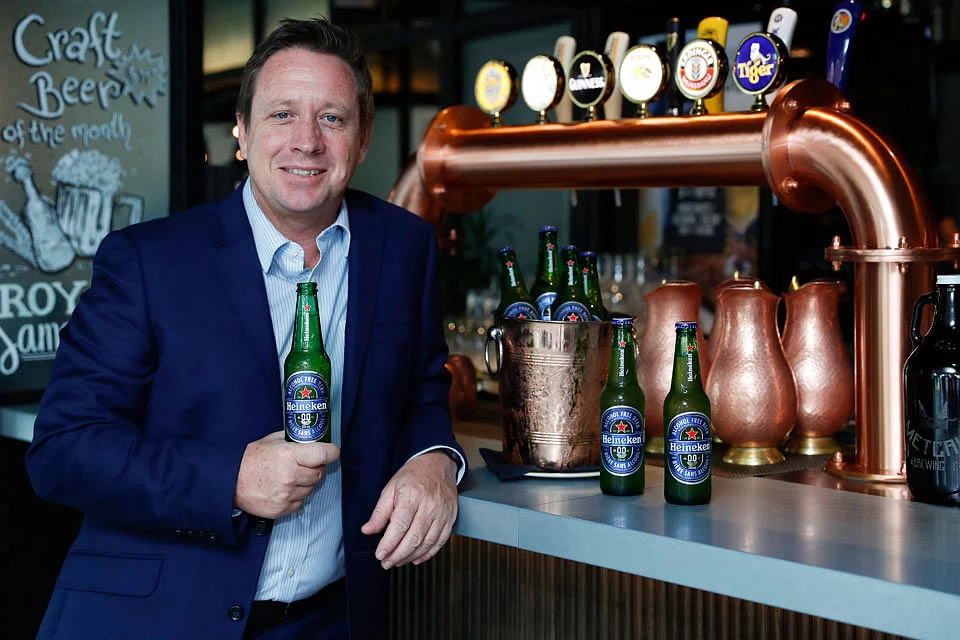
AFTER becoming the first Asian market for Heineken's zero-alcohol brew Heineken 0.0, Singapore is set to be its supply hub for the Asia-Pacific region, Asia Pacific Breweries Singapore (APBS) managing director Andy Hewson told The Business Times.
In partnership with the Singapore Economic Development Board, APBS is investing S$3.8 million in a new "de-alcoholiser" in its Tuas brewery.
Launched in Europe in 2017 after two years of development, Heineken 0.0 is first brewed the same way as regular lager, then has all its alcohol content removed.
After a soft launch last year, APBS is now embarking on its "largest ever sampling campaign" for the drink, from offices to shopping malls, said Mr Hewson. Apart from supermarkets, pubs and clubs, Heineken 0.0 may also appear in "non-beer" contexts such as salad bars or even gyms: "Everywhere you can buy a Coke is where we want to see a Heineken 0.0."
This year, a fifth of APBS' total marketing budget will go towards its low- and no-alcohol (LNA) category, led by Heineken 0.0. The ambition is to grow the total Heineken brand here by 5 to 10 per cent year-on-year for each of the next three to five years, strongly driven by Heineken 0.0.
In a pilot during the fourth quarter of 2018, Heineken 0.0 was offered at all Shell service stations, selling over 200 bottles a day. Four-fifths of the 20,000 consumers who sampled the brew liked it, and 90 per cent of those said they would recommend it to friends, said Mr Hewson. "That's when we really realised that the market was ready for Heineken 0.0."
Based on both the Shell pilot and its Europe experience, Heineken expects the new brew to result in negligible cannibalisation of sales for the lager itself. "We also see this as great news for our partners: the pubs and the clubs, the service stations."
He attributes this to the product's target audience: "You're really shifting beer drinkers who wanted beer but couldn't for certain reasons."
Heineken 0.0 makes it possible to have the closest thing to a cold beer before driving, say, or during lunch before returning to work.
Busy modern lives - that make it hard to stop for a drink - are one of four trends that Mr Hewson identifies in favour of Heineken 0.0's success.
Another is rising health consciousness. A 330ml bottle of Heineken 0.0 has 69 calories, about half that of a regular Heineken.
A third is the overlap between consumers of beer and soft drinks. With some 70 per cent of beer drinkers also buying soft drinks, Heineken 0.0 aims for that overlap "since you have to like the taste of beer already".
The idea is not to simply take a share of the existing LNA category, but really "create" the category in Singapore, said Mr Hewson.
LNA beers by other brands have failed due to their taste, but Heineken 0.0 tastes like the real thing, he said. "You get the credibility of the refreshingness, a bitter taste, also with the health credentials."
The fourth trend is an appreciation of premium products. According to APBS, the Heineken brand currently has almost half of Singapore's premium beer market.
Globally, Heineken saw volumes grow 7 per cent year on year in 2018, its strongest showing in over a decade - and driven by Heineken 0.0. "We really expect the same result here in Singapore," said Mr Hewson.
In the long term, APBS expects its LNA category to do better than its cider category's performance in the past five years. Cider now forms about 3 per cent of APBS' beer category in Singapore.
To support both Singapore's and the broader region's demand for Heineken 0.0, the de-alcoholiser in Tuas is expecting to be operational by Q3 2019, with some existing production capacity - including spare capacity - to be diverted to the production of Heineken 0.0.
While APBS is "not sure of the size of the Asian market" for the new brew yet, it is building a forecast of demand and will launch Heineken 0.0 in other Asian countries by the second half of the year, targeting "more developed" markets with "big beer consumption profiles".
TRENDING NOW

MAS allocates S$1.45 billion to five asset managers in third EQDP batch: Chee Hong Tat
‘My grandfather’s legacy’: Sherman Kwek lays out three-year plan for CDL to drive returns

He built the Vingroup empire. Now South-east Asia’s richest man is handing some key roles to his sons
‘How many will survive?’: Bubble fears arise as China’s humanoid robotics face reality check

