Creating a circular plastic economy
Plastic credits scheme may help to encourage recycling and reduce the usage of virgin plastic materials in products.
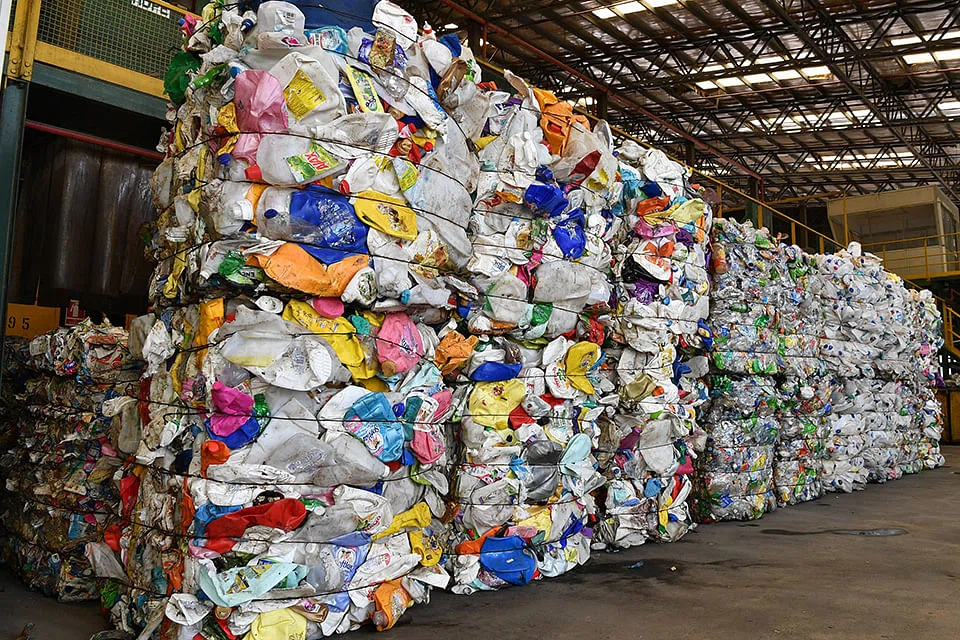
LET'S face it. We simply can't get rid of plastic in our modern life today. Especially not when they're in every aspect of our daily lives and the economy in general. Take the singular example of disposable plastic containers, the use of which surged during the circuit breaker period in Singapore when people had to do food take-aways and order-ins.
A National University of Singapore (NUS) Master of Science (Environmental Management) online survey (done from May 17-25) showed that an extra 1,334 tonnes of single-use plastic waste, equivalent to the weight of 92 double-decker buses, was generated during the two-month circuit-breaker period.
The inevitable truth is that plastic is present in every human activity - from personal products like whitening toothpaste to things we consume, even teabags, and also in metal cans, Tetra Pak and paper cups; not to mention in every single appliance and machinery we use.
Since we need it to live, work and play, and there still is no less costly and more environment-friendly substitute, governments have been trying to increase plastic recycling. They haven't met with much success on that front, however, as only 12 per cent of all materials currently find their way back into the economy via recycling and re-use, and a lower percentage for plastic alone.
There are several reasons why recycling has not taken off in a substantial way, including the fact that it's not as easy to recycle as we think, and recyclates cost more than virgin plastic. An October 2019 report from S&P Global Platts, a commodity market specialist, revealed that recycled plastic costs an extra US$72 a tonne compared with newly made plastic.
Current European Union regulations recognise the importance of circular economy in theory, but policies like the EU Circular Economy Action Plan (2015), EU Plastics Strategy in the Circular Economy (2018) and the EU Packaging and Packaging Wasted Directive (which set recycling targets of 55 per cent of plastic packaging by 2030) focus on plastic products' design and waste management, and do not address how recycled plastic would be used.
It has resulted in a product-oriented and linear policy typical of a "command and control" -- regulation that forces producers of plastic products to facilitate the recycling process.
However, it is not until regulations take into account the entire value chain that there are economic incentives to recycle.
Introducing an alternative circular value chain approach (CVCA) - from carbon credits to plastic credits
A circular value chain approach (CVCA) is not only focused on the sustainability of the products themselves, but rather on the entire process. To aid this, a plastic credit scheme that is similar to the carbon credit scheme would be necessary.
From an economic perspective, a regulatory approach focusing on the entire value chain may yield financial advantages by preserving the value of plastic in the market - more than 100 billion euros (S$156 billion) a year in the EU. From an environmental perspective, it may encourage recycling and reduce the usage of virgin plastic materials in products - thereby significantly influencing the plastic footprint and pollution.
So how would a plastic credit system work - one that captures the economic benefits of the entire plastic value chain?
Give out certificates representing the right to produce a unit of virgin plastic material - plastic credits - to industries.
Periodically allocate plastic credits to industries to enable the initial production of new products with virgin plastic material once the plastic credit scheme kicks in.
Producers with a greater need for virgin plastic materials would value such plastic credits over producers who can switch away from virgin plastic to more sustainable alternatives.
Consequently, the former would be able to trade plastic credits with the latter and establish a secondary market for such plastic credits.
Additional plastic credits would be allocated when plastic materials are recycled and used in new products. Over time, the periodic allowances would be reduced as the total amount of available plastic credits in the secondary market reach an optimal level.
On a technological level, to govern the CVCA mechanism, it will be necessary to implement tracing capabilities within the plastic materials.
Governmental grants and/or tax benefits are required to incentivise infrastructure investments in order to support transition of resources from virgin materials production to recovery and recycling technologies.
Detractors might point out that the carbon credit system isn't exactly a great model to follow, but the issue with carbon credits is that the polluting industries are not reducing their greenhouse gas emissions.
In the case of plastic credits, the proposed CVCA will enable the trading of these credits between different parties across the value chain. Producers of new products will have added incentive to reduce their dependency on virgin plastic material and use recycled plastic materials as this would allow them to receive supplementary plastic credits.
Want a circular economy where plastics are concerned? Make the value chain circular as well, and close the loop.
Decoding Asia newsletter: your guide to navigating Asia in a new global order. Sign up here to get Decoding Asia newsletter. Delivered to your inbox. Free.
Share with us your feedback on BT's products and services