

F&B sector continues to see brisk entries despite challenges
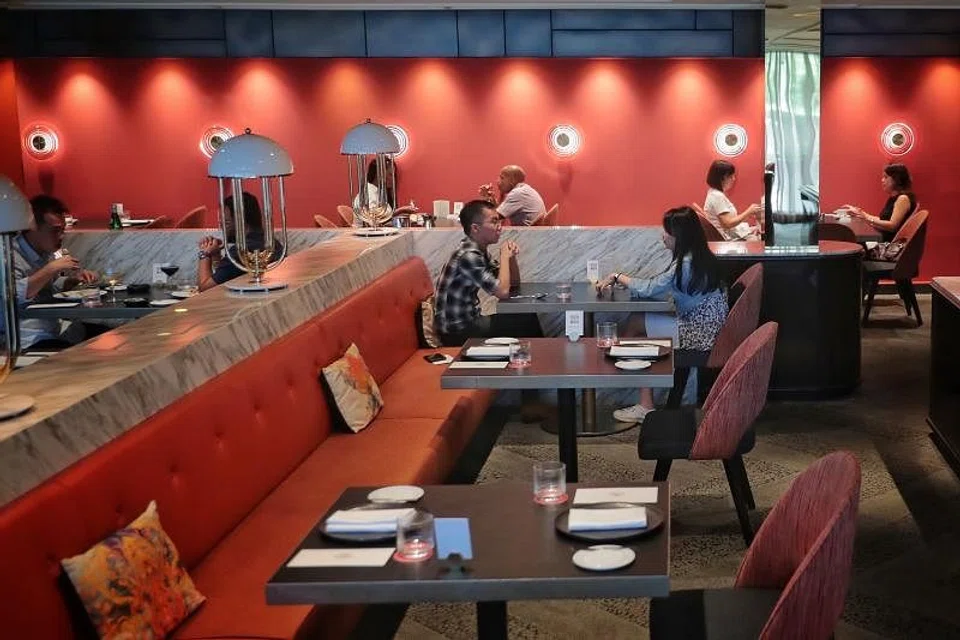
DESPITE challenges faced by Singapore's food and beverage (F&B) sector, the industry continued to see a large number of entrants in 2020 and even in the first 8 months of this year. But observers are questioning if that is an effective use of resources, given the low productivity in the sector.
According to information compiled by data platform Handshakes, entries into F&B continue to outpace exits. In 2020, a total of 3,349 eateries entered into the F&B sector, while 2,028 exited. In comparison, in 2019, 3,072 eateries entered and 2,317 exited. In the first 8 months of 2021, 2,660 eateries entered the sector, while 1,603 exited.
CIMB economist Song Seng Wun said that from a strictly macroeconomic perspective where businesses are competing for scarce resources, the increase in supply of F&B services may be regarded as an inefficient use of resources.
Going by CIMB's estimates based on available retail sales data, he noted that the average daily takings in F&B is about S$21 million a day in 2020, from about S$29 million a day in 2019.
"At the end of the day, who can tell people where to invest their money? The government can give grants for innovation and influence the sector, but resource allocation is up to market forces," said Song.
Labour productivity in the F&B services sector, as measured by real value-added (VA) per actual hour worked, has fallen 17.7 per cent in 2020. Since 2009, the VA per actual hour worked for the F&B sector has been hovering at between S$9.05 and S$11.17 -- the lowest among all industries tracked by the Department of Statistics' Data Series. For comparison, the VA per actual hour worked for manufacturing rose from S$45.36 to S$100.78 for the same period. The same metric for wholesale trade climbed from S$58.21 to S$90.19.
Senior research adviser NUS Business School, Dr Toh Mun Heng said: "The field is going to get crowded, eroding profit margins, and the ultimate consolidation is unavoidable though it might be delayed."
The growth potential for a successful tech company can be many times more than a F&B entity, noted senior lecturer of the marketing programme at Singapore University of Social Sciences, Dr Lau Kong Cheen. "Most of them are able to create a strong ripple effect with the business ecosystem that they build - creating more jobs and revenue for other businesses that "live" on their ecosystem."
Despite the low productivity performance of the F&B sector, Dr Lau said it still offers employment opportunities, especially for unskilled workers. The sector is also an "area that may improve its productivity" when food tech and digital innovation are injected. As of June 2021, total employment in the sector stood at about 217,000, according to the Manpower Ministry's Q2 Labour Market Report (up from 199,300 in June 2020).
CIMB's Song noted that continued growth in the number of new eateries is a reflection of a healthy economy.
"People are gainfully employed, and willing to spend money on F&B, so there is demand," he added. "But players should know the risks, such as the difficulty in hiring foreign workers. Eateries must use technology to make their business efficient or they run a high chance of failing."
The challenges in the industry are well documented: lack of willing locals to participate as service or kitchen staff, quota caps in foreign worker hiring and, with Covid-19, border restrictions that clip the flow of incoming workers.
Even before the pandemic struck, the sector has struggled with profitability.
According to source data from the Accounting and Corporate Regulatory Authority (Acra), 1,541 F&B establishments filed their annual returns in 2020. Collectively, they recorded a total revenue of S$5.5 billion, down from the total of S$8.4 billion revenue recorded by the 1,705 entities in 2019.
From among these companies that posted their annual returns in 2019, 37.3 per cent or 636 of them were profitable. In 2020, 40.4 per cent or 623 entities were profitable.
The positive net creation in business entities may also be the result of opportunistic bets, as new or existing F&B players are drawn to falling retail rents. According to data from the Urban Redevelopment Authority, retail rents have seen consecutive cuts for 7 consecutive quarters. In the first nine months of this year, the retail rental index has fallen some 7.4 per cent.
Dr Toh said that some F&B entrepreneurs may have also rediscovered "grandma recipes" to capitalise on and set up shop. The year also saw some pubs, night clubs and karaoke businesses pivoting to F&B, added Dr Toh.
As an indication of rising interest in kitchen work, Nanyang Polytechnic's Asian Culinary Institute Singapore has received six times more queries from the public to pick up F&B skills as compared to pre-Covid.
"Call it the pandemic effect, we are all doing more cooking, baking," said the institute's director Charlene Ang. "But among these individuals, anecdotally we are also hearing stories from individuals who say they are taking stock of their lives and aspirations. They want to realise their dream of opening a small F&B business." Yet she acknowledged that the field is highly competitive, and "burn and churn rates are high".
Sherri Kimes, a visiting professor of analytics & operations at the National University of Singapore's business school, posits that new entrepreneurship is still relevant for F&B.
She said: "While there's a push for digital innovation and deep tech investments in Singapore, technology-related entrepreneurship and F&B entrepreneurship are not necessarily mutually exclusive. F&B is in the midst of a digital transformation and most definitely in need of innovative and robust technological solutions."
This study is part of a series by The Business Times (BT) and Handshakes, called the BT-Handshakes Data Series. It is a regular project collaboration to give insights on various business sectors of Singapore, using data from Acra.
Read more:
TRENDING NOW

He built the Vingroup empire. Now South-east Asia’s richest man is handing some key roles to his sons

Floods compound Philippine growth woes from public-works scandal

Tokyo reverses baby bust with AI matchmaking and generous subsidies
More interest in ETFs, low-cost funds but Singapore still lacks pressure to further lower fund fees

