

French fry shortage shows need to develop local supply chains: experts

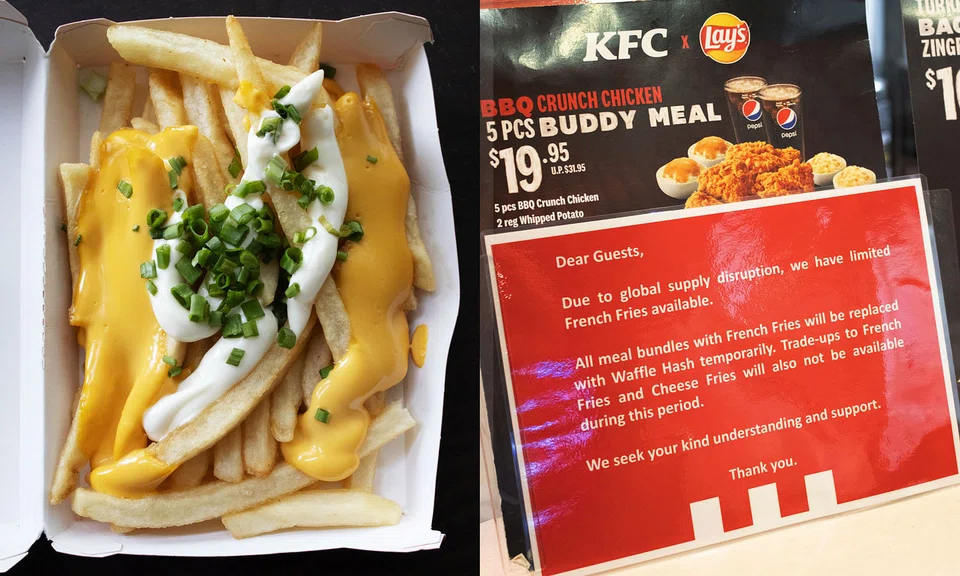
THE french fry shortage has hit Singapore's shores, as Kentucky Fried Chicken (KFC) Singapore last week removed the fast food staple from its set meals and replaced it with waffle hash.
Potato sourcing has been a problem in many other countries due to crop issues and pandemic-linked shipping bottlenecks. Companies have been at work on alternative supplies, but experts suggest a need to develop better or more localised supply chains.
At KFC outlets in Singapore, signs have been posted about a "global supply disruption" resulting in limited amounts of french fries. Upsizes for fries and cheese fries will not be available, the chain said, without giving a possible date for their return.
In an email to The Business Times, KFC Singapore, the local branch of the fried chicken specialist that is under American food corporation Yum! Brands' umbrella, said its sales of french fries have been hit by worldwide supply chain disruptions.
"We do have some stock of crispy fries in our restaurants, but they are limited," a KFC Singapore spokesperson said, adding that customers can still order a la carte fries and cheese fries at all KFC Singapore outlets.
The fast food company, which sources its fries from the United States and Europe, added that supply chain uncertainties make it "difficult to determine" when sales will normalise at their outlets.
The spokesperson also noted that "the current supply chain issues are not unique to Singapore".
KFC Singapore is operated by QSR Brands, which also operates KFC restaurants across Malaysia, Cambodia and Brunei, as well as Pizza Hut outlets in Malaysia and Singapore.
Fast food chain Burger King Singapore also said it had been facing shipping delays due to the pandemic since late last year, although it has not removed fries from its menu.
Marketing director Irene Tay said the local chain's supply of thick-cut fries, sourced from Holland and France, was affected during the 2022 Chinese New Year festive period. The company managed to mitigate this by engaging with several suppliers on alternative cuts from other parts of the world, including the US.
Tay added that sales of fries saw "minimal impact" due to Burger King's range of sides, which include onion rings. She did not observe any supply chain disruptions to the restaurant's other potato-based offerings, such as its hashbrowns and veggie burgers.
To further mitigate these disruptions, Tay said the company has started working with brand owner Restaurant Brands International to secure alternative suppliers that can still meet the burger brand's ingredients code.
McDonald's Singapore, another popular fast food chain, declined to comment.
Supply chain woes
Potato-related shortages have been reported around the world.
In late-December 2021, McDonald's Japan had removed medium- and large-sized portions of fries from its menus for a week. This was followed by a second sales suspension in January 2022, this time for a month.
Around the same time, KFC Kenya removed fries from its menu because it could not import its preferred sliced potatoes from Egypt - due to delays in shipping amid Covid-19 - despite them being commonly grown in the country. Instead, customers were offered alternatives including Kenyan staple ugali, or maize meal.
Asia-Pacific chief economist at IHS Markit, Rajiv Biswas, told BT fast food chains could be vulnerable to supply chain disruption because most use global sourcing for various products.
"Some fast food multinationals that rely on North American supply chains for sourcing potatoes are facing supply difficulties for some of their global operations. This has also impacted potato supplies for various multinational fast food chains in Asian countries, including Japan, Singapore and Indonesia," the economist said.
He listed factors such as the weather and shipping delays potentially causing problems, with the latter arising from port shipping delays in North America. Burger King's Tay had also noted a lack of shipping containers in the source country as an issue.
Diseases in crops may also add to supply troubles. IHS Markit's Biswas noted companies that source potatoes from North America may face difficulties as a potato wart disease in Canadian potatoes was discovered in late 2021 and early 2022, leading to Canada suspending exports of potatoes to the US from potato-growing province Prince Edward Island.
Other countries facing spud setbacks include Canada, Australia and South Africa, according to Biswas.
Need to source domestically
On the subject of supply issues, GlobalData consumer analyst Bobby Verghese said: "Food and beverage companies need to localise their supply chains to a greater extent to ensure business continuity and long-term survival amid the crisis."
This comes as conventional supply chains are pushed towards their breaking points, Verghese said in a January 2022 note. He highlighted factors such as labour shortages and logistical challenges from new Covid-19 variants, crop cultivators coming under stress from climate change, and food service and hotel industries facing changing restrictions and waning customer footfall.
To illustrate the point, he compared McDonald's Japan's prolonged potato issues with its domestic rival Freshness Burger. As the latter procures its stock from Hokkaido, it was reportedly able to roll out a special "We've Got Potatoes" promotion to capitalise on McDonald's fries scarcity.
In KFC Kenya's case, the brand had reportedly snubbed local farmers - saying Kenyan potatoes were "not meeting its standards". This outraged consumers, who saw it as a failure to support domestic supply. KFC Kenya has now promised to source its potatoes locally, according to local paper The Standard.
IHS Markit's Biswas, however, sees a downside to the diversification of supply chains to local or regional potato suppliers. He believes it would be a more "protracted" procedure to establish local procurement, processing and packaging and to maintain quality standards.
READ MORE: French fry shortages go global on supply chain disruption
TRENDING NOW

Grab CEO’s wife Chloe Tong on life with Anthony Tan and finding her purpose

Hwa Seng Builder, two China companies win S$1.2 billion Tuas Road Viaduct phase two contracts

Deal between tycoon friends sparks scrutiny of Philippine power sector

Canada is upping oil flows to Asia, but South-east Asia’s refineries aren’t ready to handle them yet

