

Listed F&B players find new recipes beyond dine-in business
Fresh product lines and acquisitions have increased income streams for companies like Tung Lok, Jumbo and Kimly
Claudia Tan HS
Singapore
GROUPS of five are expected to be allowed to dine together at food and beverage (F&B) outlets from next week, and the Singapore government has indicated plans to relax social gathering restrictions once more people are vaccinated later this year.
Investors in Singapore Exchange-listed F&B stocks should, therefore, have reason to cheer.
But analysts and market watchers are expecting the recovery to be selective, and favouring companies that have done the most to position themselves for the post-pandemic reality.
Travel lockdowns are still in place and restrictions on dining out are likely to persist for the next few months, said Phillip Securities Research senior analyst Terence Chua. This means the sector's recovery to pre-pandemic levels will be protracted, he said.
Indeed, data from the Singapore Department of Statistics (SingStat) showed that total F&B sales in May were up 46.4 per cent on a year-on-year basis, but down 14.1 per cent on a month-on-month, seasonally adjusted basis.
The year-on-year data was stronger as it was compared with the low base in May 2020, when the "circuit breaker" to curb the spread of Covid-19 was in place.
Month-on-month sales figures, however, were affected by the introduction of Phase 2 (Heightened Alert) measures, which included a ban on dining out.
Furthermore, when compared with pre-Covid data from May 2019, F&B sales were 27.9 per cent lower.
Groups of two have been able to dine together at F&B outlets since June 21.
Finance Minister Lawrence Wong said in Parliament on Monday that the government expects to raise this maximum group size to five from July 12.
Analysts are positive that the sector will see year-on-year earnings improvement after a tough 2020.
DBS analyst Alfie Yeo forecasts F&B spending to recover to pre-pandemic levels by around the end of the year.
RHB analyst Jarick Seet said the recovery will speed up if Singapore is able to get a majority of its population vaccinated and partial lockdowns are no longer required.
But investors looking for winners should pay attention to what the companies have been doing over the past year.
For instance, market watchers said F&B payers that have adopted digital platforms to offer delivery and takeaway options have been able to thrive better in the current environment.
To withstand the challenges of unexpected tightening of dine-in restrictions, given the unpredictable nature of the pandemic, it is "pertinent for F&B (players) to beef up their delivery order infrastructure and generate extensive online awareness", said Lau Kong Cheen, senior marketing lecturer of the School of Business at the Singapore University of Social Sciences (SUSS).
Online sales accounted for 38.8 per cent of F&B services' takings in May, up from 24.6 per cent in April, as more people ordered food online during the Phase 2 (Heightened Alert) period, SingStat data indicated.
With tourists no longer serving as a viable source of revenue, F&B business models also need to diversify their sources of revenue.
Prof Lau said: "We see higher-end restaurants that are better known resort to expanding their distributions via supermarket, specialty retailers or online platforms."
540 , for instance, is selling some of its signature dim sum and dishes in frozen form via e-commerce platforms.
Sales of its ready-to-eat frozen food increased by S$1.2 million in FY2021 ended March amid a S$17.1 million fall in contributions from existing outlets due to Covid-related closures and capacity adjustments.
Brands with a niche following or which serve unique foods, and are able to maintain the same standards for takeout orders will also fare better, said RHB's Mr Seet.
Prior to the Covid-19 pandemic, 42R had mainly focused on its restaurant business. The group has since found ways to make its concepts more appealing for takeaways and deliveries.
This includes its first online brand, Hack It Seafood. This is a home-delivery service for seafood in a bag, which can be poured on and polished off a lined dining table.
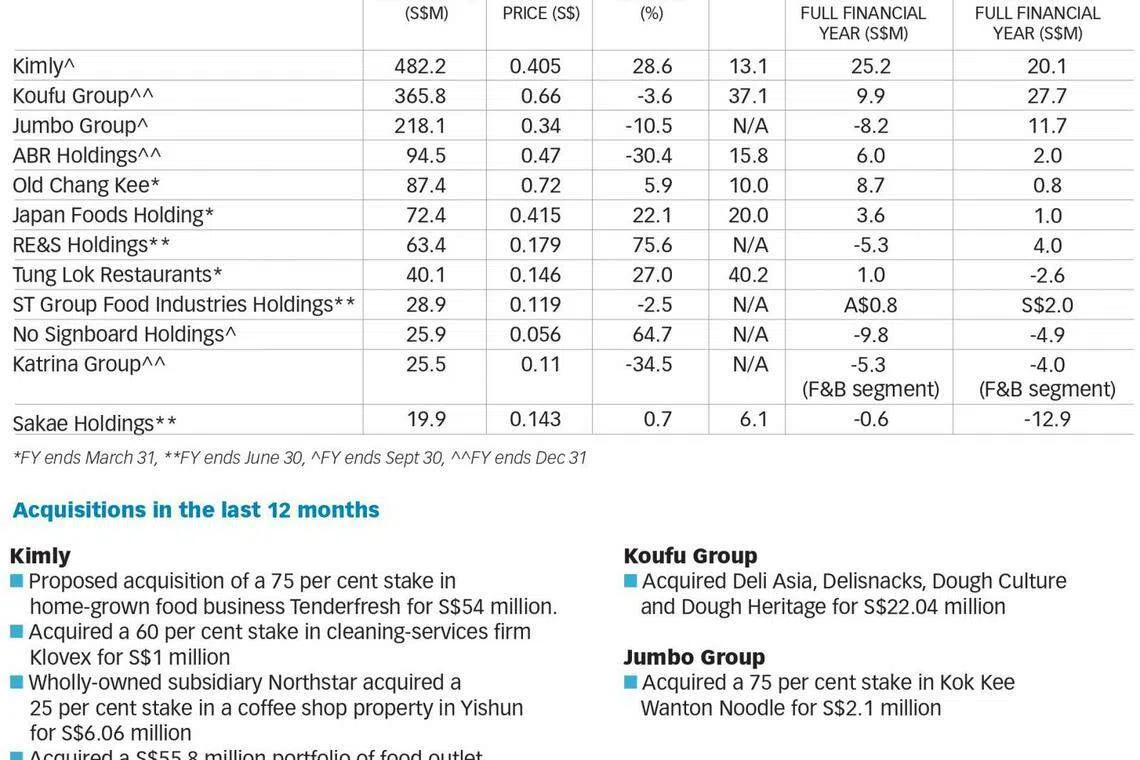
Jumbo also bought a 75-per-cent stake in a wonton noodle brand, with the intention of diversifying beyond restaurants.
That said, it is still possible for restaurant concepts to thrive.
KGI analyst Joel Ng is bullish on the growth prospects of 5OI .
The company's portfolio of Japanese restaurants includes Ajisen Ramen and dumpling specialist Osaka Ohsho; Mr Ng said this diversity of brands would enable the company to stay fresh and constantly bring in new concepts.
Japan Foods recently announced its first halal-certified restaurant under the Tokyo Shokudo brand, which Mr Ng said has high growth potential, given the growing demand for halal food.
Phillip Securities Research's Mr Chua said: "F&B players that provide healthy food offerings have also seen a stronger demand as consumers today have become more health conscious."
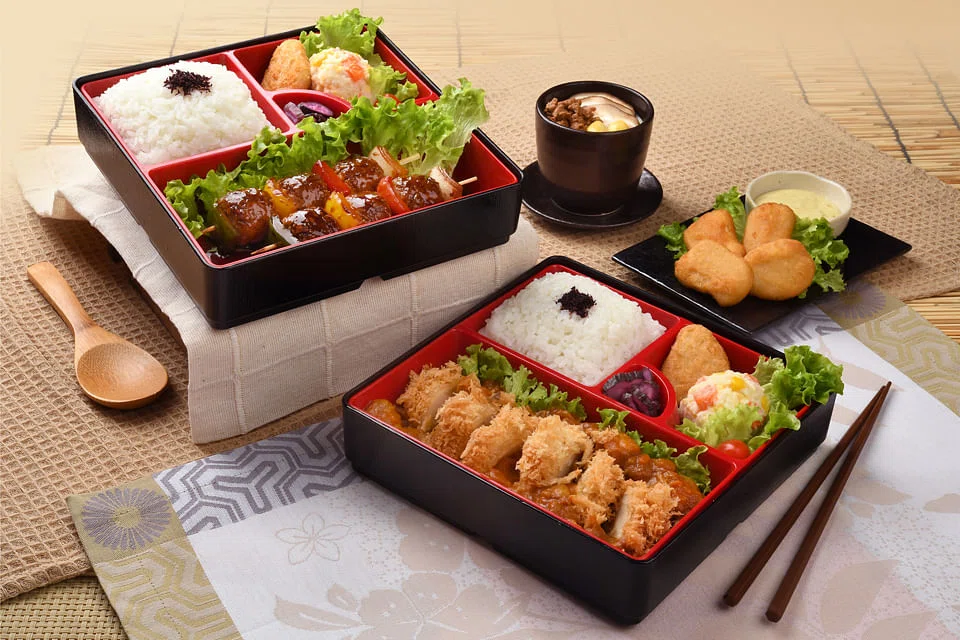
1G1 , the best performer among the locally listed F&B stocks this year, is currently offering healthy food options via its takeaway food kiosk, Ichiban Bento. The company's website describes these bento sets as being rich in nutrients, dietary fibre and high-quality protein.
The strategic location of operations plays a part too.
Prof Lau said F&B players should minimise rentals, which can account for 25 per cent of overall business costs in F&B. Minimising rentals could entail moving food outlets to less-expensive areas such as the heartlands, adopting concepts without seating areas or operating out of a cloud kitchen - a cooking facility set up for the preparation of delivery-only meals.
The cloud-kitchen concept provided a lifeline for some F&B businesses that could not operate during the initial phases of the "circuit breaker" last year, said Prof Lau.
Meanwhile, Phillip Securities Research's Mr Chua said F&B players in heartland areas have fared better than their counterparts in downtown areas this past year.
1D0 , for instance, has a strong presence in heartland areas; its website lists the locations of its 83 outlets and drinks stalls. The company has been a beneficiary of the shift towards a hybrid work-from-home model, which boosted footfall at its heartland outlets.
It is among the top picks of analysts covering the F&B sector.
CGS-CIMB analysts said in a report that Kimly enjoys resilient demand from mass-market consumers even in times of economic uncertainty.
The company has outperformed most of its peers in both profitability and share price returns (see table), and has announced a string of corporate moves to enlarge its business. These include an expansion into cleaning services and into the halal market.
READ MORE:
TRENDING NOW

What role can Japan play in Asean’s future?

IOI Properties and CapitaLand Investment closer to acquiring One Raffles Place in joint bid

AI bubble may burst soon amid financing concentration, rising rates: Ray Dalio

OCBC sheds S$8 billion in value as shares close nearly 6% down; analysts cautious on banks

