Luxury car sales race back into the fast lane
THEY say good things come in threes, but so do pandemic-affected car buying periods. Published data from the Land Transport Authority show three distinct phases of activity in Singapore's car market in the first nine months of the year. (October figures are released in mid-November.)
It was business as usual for the motor trade between January and March, before the industry shut down for three months over the circuit-breaker period. Showrooms reopened in July, and since then, car companies have scrambled to make up for lost time.
But while analysts expect the economic fallout from the pandemic to put a major dent in global car sales this year, no one seems to have told the industry's luxury brands.
Statista, a market data company, forecasts 60 million global passenger car sales in 2020, a drop from 74.9 million last year. But the high-end market is proving remarkably resilient in Singapore and elsewhere; many brands are shrugging off the recession and seeing sales go back to pre-pandemic levels.
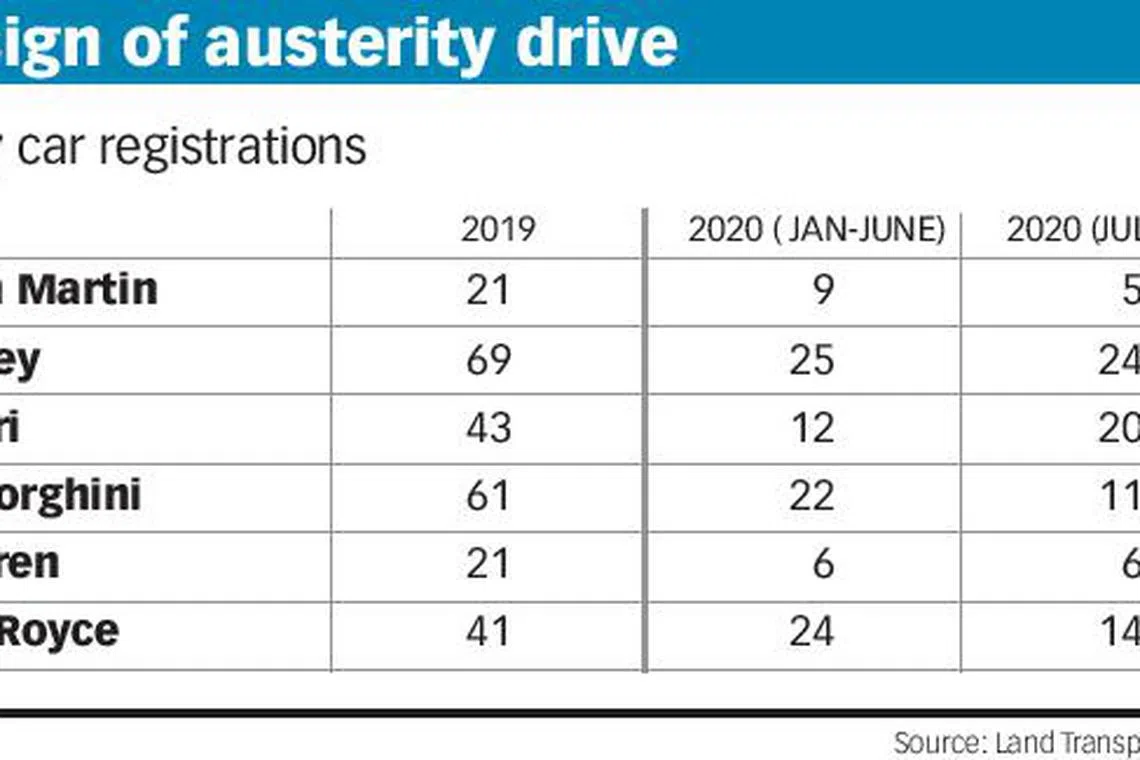
Six luxury labels representing the most glamorous British and Italian carmakers - Aston Martin, Bentley, Ferrari, Lamborghini, McLaren and Rolls-Royce - collectively put 178 cars on the road here in the first nine months of the year, compared to 256 cars for all of 2019.
That looks like a dip, but adjusted for the shutdown between April and June, it means the brands put roughly 30 cars a month on the road here, versus 21 cars a month last year.
Bernd Pichler, regional director for the Asia-Pacific for Bentley Motors, said: "Sales have been picking up since reopening and we attribute that to customer confidence coming back.
"Bentley Motors recorded a strong finish to the first eight months of the year in the Asia-Pacific, with year-on-year sales performance being closely matched to that of the previous year."
The fabled British brand put 25 cars on the road in the first half of the year, and added 24 in the three months after showrooms reopened.
The numbers at McLaren Singapore have been just as symmetrical, with six registrations in the first six months, and another six in the three months since July. "Sales for McLaren Singapore have been positive in the sense that customer orders continued to accumulate; all six orders taken during the circuit breaker were fulfilled despite the pandemic," general manager Chong Kah Wei said.
Being able to see cars in the flesh again has helped, Mr Pichler told The Business Times. "Though Covid-19 has propelled the use of digital media - you have seen virtual showrooms and communications via different online platforms - customers are now able to view the cars, aiding reaffirmation before making a purchase decision," he said.
Sales have varied by brand, however. Business at Ferrari came roaring back after showrooms reopened, with 20 registrations in the July-to-September period, compared to 12 in the first half of the year. For bitter rival Lamborghini, the story is flipped, with 22 cars registered in the first half of the year and just 11 since showrooms reopened. (Both companies declined to comment for this report.)
Likewise, Aston Martin put more cars on the road in the first half of 2020 (nine) than in the three months post-reopening (five).
Yet, it is worth pointing out that for the high-end market, registrations are a lagging indicator. Built in low volumes and often heavily personalised, such cars are booked months or sometimes more than a year ahead of delivery. Dealers often fly in cars for customers to view before their actual launch, and bookings taken then take a long time to fulfil.
That lag means that registration figures could conceal how well a luxury car brand is actually doing.
For example, Ferrari showed the Roma, its latest grand tourer, to customers here in July, but even the first buyers will have to wait until 2021 to finally drive theirs home. Similarly, cheques have been written for a S$1.6 million McLaren that will not be delivered until next year. "When we launched the limited-production 765LT in September, we were ecstatic to collect more orders again," McLaren Singapore's Mr Chong said. Eight people have placed a booking for the car, a significant number relative to McLaren's sales.
If pent-up demand spurred buying in July and beyond, however, there are signs that it has petered off. Market response has "more or less normalised", said Mr Chong.
In Mr Pichler's view, the pandemic has made Bentley buyers more circumspect, if anything. "Our target audience, the ultra-high net worth individuals, are successful life achievers such as business owners or creators, and are responsible to many others. So, for sure, the market and economic conditions affect their decision making process in some way, and it might take a bit longer than before," he said.
It helps, of course, if car brands give buyers something to make a decision about in the first place. Next month, Rolls-Royce will show customers here the new Ghost, and the entry-level model and traditional best-seller should help drive sales during the pandemic. With 38 cars on the road in the first nine months of 2020, the brand is only three cars down on 2019's total tally. (A Rolls-Royce spokesperson did not reply to BT's queries in time for publication.)
Bentley is planning to launch a redesign of the Bentayga, a large Sport Utility Vehicle, as well as a more affordable version of its Flying Spur. Both cars account for the bulk of the brand's sales. "We have the most exciting model line-up," Mr Pichler said, adding that he expects the new cars to give business a boost.
If so, that would give other high-end brands a playbook for Covid-19: Keep the new models coming, because the best way to win buyers during a pandemic could be to distract them from it.
READ MORE: They came, they saw, but didn't shop much in Sept
Decoding Asia newsletter: your guide to navigating Asia in a new global order. Sign up here to get Decoding Asia newsletter. Delivered to your inbox. Free.
Share with us your feedback on BT's products and services