

Newer strata malls fail to deliver
So far, they've delivered lower-than-expected rents, footfall and occupancy, disappointing their investors
Singapore
MR TAN Meng Khiang invested in a 187 sq ft strata retail unit at mixed development One Dusun Residences a few years ago, thinking it would be a good Balestier neighbourhood mall for the nearby condos.
But the returns are not yet what he had hoped for, after its completion in 2016.
For now, he is getting a 1.6 per cent rental yield, rather than the four per cent he expected. He estimates that about 50 of 77 shops are occupied.
Investors in recently-built strata malls have so far seen lower-than-expected rents, occupancy and footfall, they and various experts told The Business Times.
Such strata malls saw brisk transactions earlier this decade as property investors here saw opportunity in various commercial and industrial assets, as the Government ramped up cooling measures in the private residential market.
Singapore Management University (SMU) adjunct faculty Ku Swee Yong, who watches this market, estimates that occupancy of around 10 strata malls completed in the last five years years is below 80 per cent.
That compares to an occupancy rate of 92.4 per cent for retail space islandwide, as of the third quarter this year.
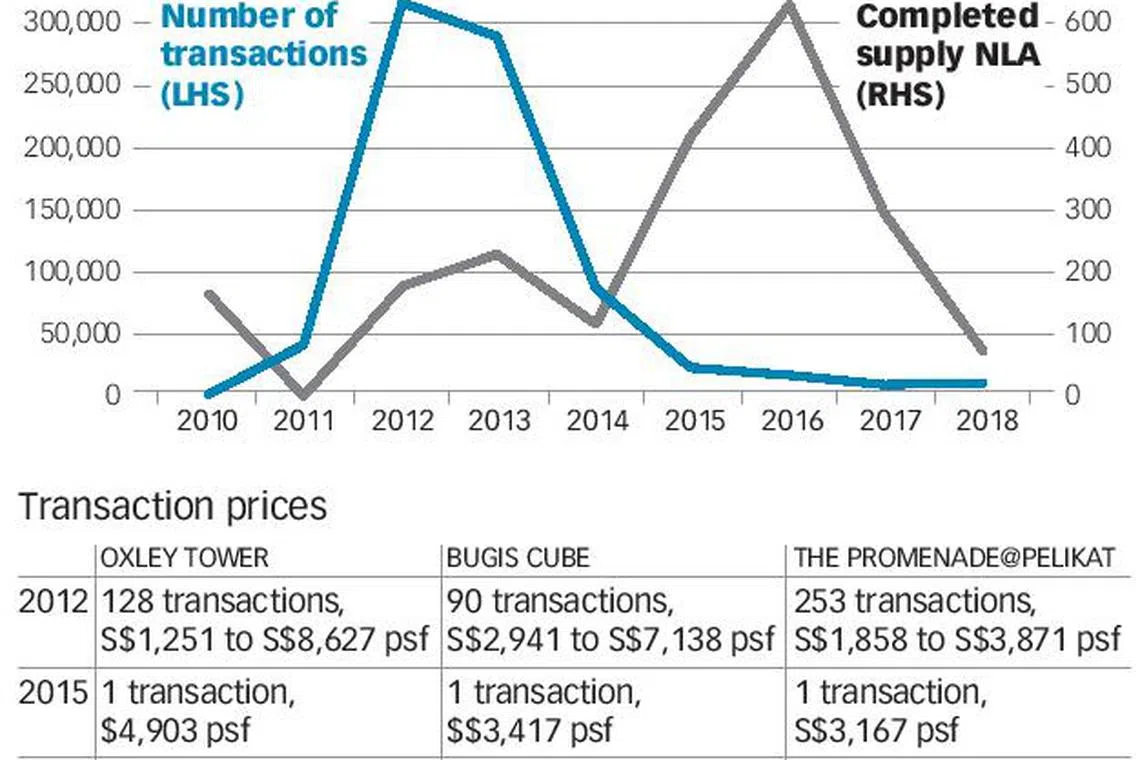
Transaction volume for strata retail units completed in the past 10 years slid from 635 in 2012 to 19 last year, according to an analysis by Edmund Tie & Company.
Prices have also eased for these newer strata malls. As an example, the 270-unit The Promenade @ Pelikat this year saw three transactions, between S$1,781 and S$2,029 psf. That's down from the 253 transactions at S$1,858 to S$3,871 psf in 2012.
"The implementation of the Total Debt Servicing Ratio (in 2013) and the policy affecting the minimum retail unit size affected transaction volumes and prices in the strata retail market," Ong Choon Fah of Edmund Tie & Company told BT.
"There was also rising operating costs due to the tight labour supply conditions, and growing competition from online retailing, affecting rental returns."
'Dead' malls?
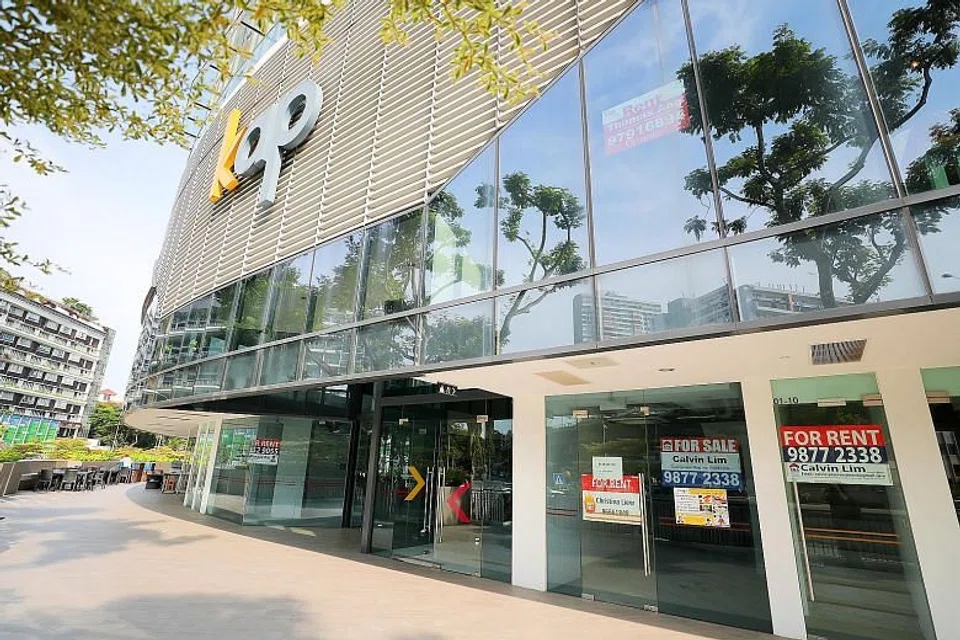
One example is KAP Residences Mall. It has seen rents fall from an anticipated S$15 psf when the development was completed in 2016, to S$6 psf as of late November, and occupancy till then was under 50 per cent.
"Owners had units for two over years with zero rental income; it's very frustrating for them," Lisa Theng, co-owner of EagleWings Group which rents and owns there, told BT in November.
Serena Gan, who bought her 215 sq ft freehold Icon @ Changi unit for around S$500,000 in 2011, currently rents it out for about S$1,000 a month. Icon @ Changi, which also has offices and residences, was completed in end-2012. "The mall is very quiet," she said. "There are owners whose units have not opened their business at all."
Mr Tan said of One Dusun: "Some of the owners are deep-pocketed so they do not want to rent out if they don't get the rental yield. They'd rather leave it vacant."
At One Dusun, Mr Tan said his logistics-focused tenant does not depend on footfall, and neither do some other tenants like salons and interior decorating firms.
Besides One Dusun, Mr Tan also owns a 240 sq ft F&B unit at CT Hub 2, completed in 2015.
He said because the developer is managing the mall, occupancy is better and he is getting a rental yield of about 2.5 per cent. "That unit almost pays for itself now."
Strata retail difficulties
Experts say these new malls face the challenges of size, location and lack of unity among owners.
"With disparate ownership... there is no pooling together of resources to market the mall in terms of ad or promotional budget or positioning of the mall," said Alan Cheong, Savills Singapore senior director for research and consultancy.
Footfall is also low because these malls often are small, with small unit sizes, which cannot easily attract crowds, and many are not located close to MRT stations, he added.
Another problem is that retail is a tricky business, and a good mall requires deep thought and planning into factors like tenant mix, zoning, promotion and marketing of the mall and the movement of shoppers.
"On the developer side, they may have designed small units to optimise returns, but a successful mall is not just about bricks and mortar," said Ong Choon Fah, chief executive of Edmund Tie & Company.
"On the buyer side, they may not understand what they need to bring crowds in and it's not enough to have a good location unit since retail is all about detail."
Colliers International said in a recent statement: "In most strata-titled malls, developers would typically sell retail units to individual investors and leave them to rent out the space as they deem fit. This approach could potentially lead to a sub-par tenant-mix as there is no centre management to oversee the leasing process. The absence of a central body to coordinate advertising and promotion efforts may also hamper sales and footfall."
Is strata retail still relevant?
However, Ms Ong added that strata malls can be attractive to tenants who have their own clientele and who prefer more independence outside of a tight mall management. Entrepreneurs and small businesses also tend to like renting in strata malls.
Ms Gan, for instance, rents out her space to an e-commerce fashion business.
Mr Ku of SMU is concerned is that if owners continue to have trouble attracting tenants, they may become "desperate enough" to accept unwholesome tenants. In the long run, the redevelopment of the building may become more difficult.
On top of the disparate ownership, people who bought at high prices may have higher expectations for a potential sale and may resist it.
Nicholas Mak, executive director for ZACD Group, said there have been fewer strata title malls under the Government Land Sales (GLS).
"The main source for new developments is now through en blocs of commercial buildings," he said.
Supply of strata retail space completed each year fell from an eight-year high of over 315,000 sq ft in net lettable area (NLA) in 2016, to over 37,000 sq ft as of the third quarter this year, according to Edmund Tie & Company.
The long game
Property Enterprises Development (Singapore), developer of the mixed- use Stars of Kovan this year appointed Colliers to curate the strata retail component's offerings and advertise the mall ahead of its 2019 completion. It also promised investors a guaranteed rental return after three years, and cash back after deposit and before completion, as seen in a recent ad. Colliers and the developer declined to comment.
Some strata owners are taking matters into their own hands to revive their malls. There were previous media reports of owners at Bugis Cube banding together to grow footfall and spruce up the building. Its occupancy rate rose to over 90 per cent as of end-2017.
This year, the MCST of KAP Residences Mall created a theme for the mall and hunted for tenants. This month, EagleWings Group and its partners opened a cinema and other lifestyle shops at KAP to bring the occupancy to close to 80 per cent. New tenants like LiHo will also come in.
Mr Tan said One Dusun owners are in talks with a real estate company to see if they can help come up with a plan for the mall.
Ms Ong said strata malls usually take a longer time to succeed as the diverse tenants means the mall may need time to evolve organically.
Some older ones succeed: Queensway Shopping Centre is known for its discount sportswear.
Mr Tan said that at One Dusun, there are quite a few interior decorating shops, so the mall might develop a theme of its own.
He and Ms Gan believe their investment will pay off in the long-term.
He said he believes the mall will mature and the economy will get better.
"Slowly but surely we will have a theme... it will pan out for us, maybe in 5 to 10 years. At least it's a freehold development so there's time on our side."
TRENDING NOW

Singapore expects all parties to honour commitments, says PM Wong after Indonesia cuts gas exports

Gas Supply may pursue remedies if contract breached following Indonesia’s export cuts: Tan See Leng

SoftBank’s Son plans US$50 billion Malaysia tech outlay: Anwar Ibrahim

Is Manila Asia’s new dining hot spot?

