

One restaurant's shutdown story shows how recession spreads
The ripple effect is felt down the line by growers, distributors and truckers
Washington
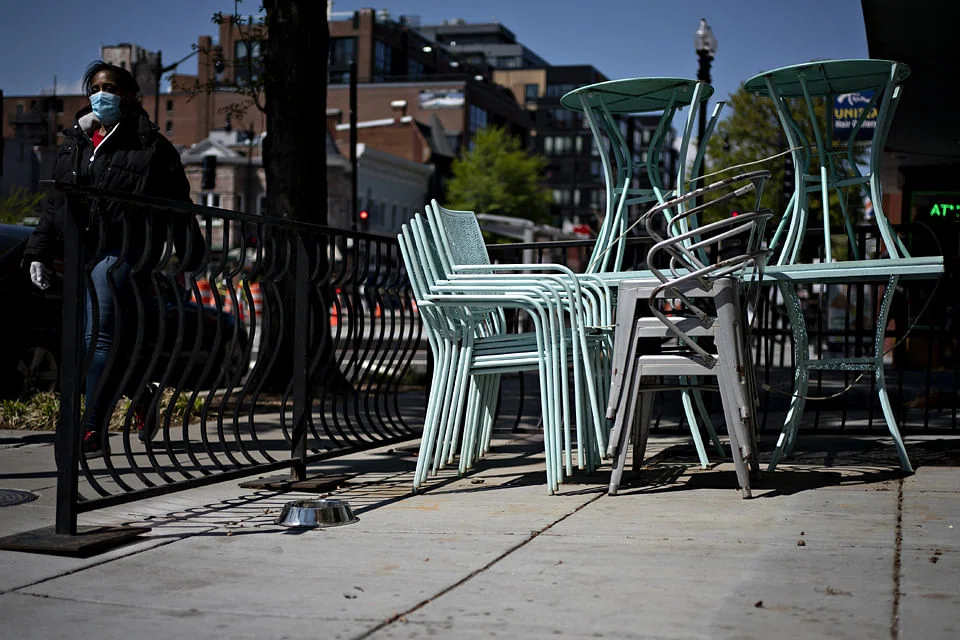
LARRY La never even turned the lights off for almost two decades. Now he's had to shut the whole restaurant down.
Meiwah was a local favourite in the Maryland suburb of Chevy Chase, just a few kilometres north of the White House and Congress, where US leaders are battling to cushion the economic blow from the novel coronavirus. It served Chinese food to a crowd that often included political big-shots, like ex-president Bill Clinton.
In the past month, Mr La has had to shut his doors because of the epidemic, lay off a staff of three dozen, negotiate to defer his rent, and figure out if the government's small-business rescue plan could help him.
But the closure also set off a supply-chain reaction that stretched far beyond the US capital. Multiplied by thousands, it helps show how a pandemic has triggered the worst recession for almost a century, as initial blows to people and businesses ripple out to others.
The restaurateur
"I was born and grew up in a war zone," Mr La - who's of Chinese descent - says of his childhood in Vietnam. He was surrounded by dangers, but at least they were the kind you could see and avoid. Unlike the novel coronavirus. "This is a totally different war zone."
Mr La and his family fled, first to a Malaysian refugee camp - and eventually to Erwin, Tennessee, a town of 6,000 near the border with North Carolina. He was 20. "I was the only one who looked different, talked different." He moved to Washington after a brother-in-law heard there was a restaurant job there, and eventually opened his own place.
"The restaurant business, if you think about it, is really very complex," says Mr La. It could also be fun and glamorous. Photos on the Meiwah website show him with the Rolling Stones. He says Mr Clinton used to order crispy beef, then pared back to chicken and broccoli, and for the past five years or so has stuck to tofu and vegetable sushi.
"Our neon lights have never been off for 18 years," says Mr La. "In my life in the restaurant business, for 31 years, it's the first time that we have to close down for anything."
He reckons Meiwah can withstand another two or three months of closure. "I have a lot of confidence in this country. I think we'll survive. But this is a very unpredictable time that we're in now. So it's nothing for sure."
The distributor
Charlie Chan, the general manager of SBC Food Corporation, got a call from Meiwah on a Monday in March cancelling an order. It was just another blow for SBC, whose business - distributing vegetables, rice and other produce - has shrunk about 80 per cent in the past month.
"It just keeps getting worse," says Mr Chan, who counts Mr La as a longtime family friend and customer. His warehouse in north-east Washington usually supplies dozens of Chinese restaurants in the area, a business established by his parents 40 years ago.
"It's a ripple effect," he says. "If the restaurants aren't selling anything, then they're not purchasing as much from us. And then we're not purchasing as much from the farms or other distributors."
"We've had to throw away a lot of meat, a lot of produce. Because it just got stuck."
How much? "Dumpster-loads". "We're trying to cut costs," says Mr Chan. They're running three trucks instead of the usual 10 - making 10 deliveries a day instead of 50 - with a staff of five, down from a dozen. "It's pretty much just the family now."
The grower
Fortune Growers, based in Elgin, Illinois, usually produces 1.4 million kilos of broccoli a week. Last week it was only one million.
Demand from restaurants, usually the bulk of sales, has disappeared - though retailers like Walmart and Kroger are buying more.
When Mark Sato at Fortune got the call from Mr Chan cancelling SBC's order, it forced him into the kind of quick rethink that's been a feature of recent weeks.
"Margins are slim and so you have to make sure you're maximising everything," he says. "We had a fill for this truck. Then at the last minute we had to cancel SBC's order, cancel the truck that we had, and reconfigure."
When the virus first hit hard in the US in late March, says Mr Sato, orders to restaurants fell off a cliff and Fortune halted all packaging for a week.
In Mexico, where the broccoli is grown and packed, hundreds of workers were told to stay home - and acres of vegetables were left in the fields to rot.
Since then, says Mr Sato, they've scaled back planting by about 10 per cent - but nobody can be sure that's the right figure. "We put things in the ground that we plan on harvesting three months out," he says. "At that point, what is the likelihood - since it's so variable - of us being back online with everything? What is the likelihood of us still being sheltered in place? Or being closed down? No one has an answer."
The trucker
Fortune's broccoli is carried across America by truckers like Yosmell Lemus, who's been on the road since October, which is when he last saw his wife and three kids in Las Vegas.
He owns a refrigerated truck or "reefer" for perishable goods, which would usually command higher rates, but not at the moment.
"It's pretty cheap in the market right now, we don't make much, it doesn't even cover the fuel," he says. Mr Lemus is on the way from Dallas to McAllen on the Mexican border, where he'll pick up another load - just his second in a week.
His truck is empty for the 805-km journey, which would be unthinkable in normal times, when he'd put out a call and pick up some cargo en route. So the petrol money is coming out of his own pocket.
"Transportation, it goes with the market," he says. But, "you have to pay the same mortgage, the same bills". And those are all down to him now.
Mr Lemus and his wife decided she should quit her job as a housekeeper at the Aria Hotel in Las Vegas, because of the risk of getting infected.
He worries about that in his own work too. He wears a mask and gloves every time he leaves the truck. Loading or unloading can take six hours now, because of new protocols at the firms where he delivers and collects.
Then when he gets back in the truck, which has a sleeping berth, a microwave oven and a fridge full of beans and rice, he uses alcohol wipes to clean every surface.
"The truck drivers, we're right now on the front line," he says. "You try to keep safe all the time, but you don't know when you're going to get sick. And the compensation that we have - for the work we're doing right now - we need to get paid better." BLOOMBERG
Decoding Asia newsletter: your guide to navigating Asia in a new global order. Sign up here to get Decoding Asia newsletter. Delivered to your inbox. Free.
Share with us your feedback on BT's products and services
TRENDING NOW

Good Class Bungalow market activity picks up pace on ‘realistic’ pricing
Indonesia imposes US$116 million in fines over manipulation of Sinar Mas, Prajogo-linked stocks
Singapore identifies 7 firms responsible for haze fires, notices issued urging action: Grace Fu

Once staunchly pro-China, Malaysian Chinese businesses are now distancing themselves from Beijing

