

How much of a threat are EVs to oil giants and neighbourhood mechanics?

Singapore
WHILE the impending wave of electric vehicles (EVs) heralds opportunities for many sectors, it threatens to disrupt others - among them, the retail fuel industry and your neighbourhood car mechanic.
In recent years, global retail fuel companies have been pivoting to tap the growing EV charging market and carve out an income stream from non-fuel sales.
Shell, for instance, has been shifting its positioning from a traditional fuels retailer to a mobility retailer. It set up its first City Solutions Living Lab in Singapore two years ago to focus on developing mobility solutions for sustainable cities.
The Netherlands-headquartered oil giant has also worked with Singapore's Energy Market Authority in awarding a research grant to a local consortium looking to develop the city-state's first series of service stations integrated with smart energy management solutions.
Shell, which bought the NewMotion charging network in 2017, plans to grow its global EV charging network from the current 60,000 charge points to around 500,000 by 2025. It wants to become a net-zero emissions business by 2050.
"(This) means that we are reducing emissions from our operations and from the fuels and other energy products we sell to our customers," Aarti Nagarajan, general manager for Shell Mobility Singapore, told The Business Times (BT).
In supercharging its drive to electric, British rival BP has acquired UK charging company Chargemaster, enabling it to establish a foothold in the UK's EV market.
In China, BP has also partnered ride-sharing giant Didi to scale up the charging network in the world's largest EV market.
BP's senior vice-president of future mobility and solutions Richard Bartlett has said that it is moving from an "international oil company" to an "integrated energy company". Like Shell, it has committed to becoming a net-zero-emissions company by 2050 or sooner.
Urban transport economist Walter Theseira of the Singapore University of Social Sciences noted that in countries where long-distance travel is common, the retail fuel network has shifted to place more emphasis on "related services" like food, retail and entertainment to cater to motorists during charging stops, which would likely be longer than typical refuelling stops. "In Singapore, what I expect is that a small number of retail fuel stations will remain for quite some time servicing needs that may be more difficult to transition to EV use, such as heavy goods vehicles. But I expect that overall, the retail fuel industry will shrink dramatically," he noted.
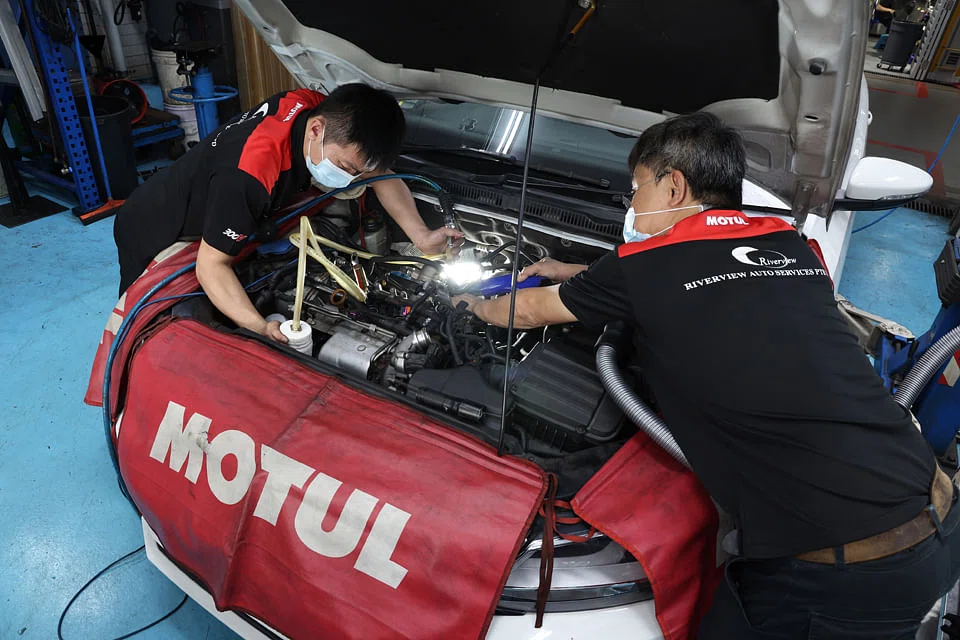
Automotive maintenance and repair is another industry that will be increasingly impacted, Dr Theseira said.
Unlike petrol-powered engines, electric engines do not require oil changes and have fewer moving parts. EVs are often serviced using parts purchased online or fixed remotely through over-the-air updates.
"Generally, there we would expect to see upskilling required, as the number of tasks that require just basic mechanical proficiency will decrease over time, in favour of tasks that require familiarity with software systems and electronics," he said.
In December 2020, the Singapore Motor Workshop Association set up a new training facility to equip motor workshop technicians with skills related to servicing electric and hybrid vehicles. About 1,000 of the 10,000 technicians in Singapore will be trained over the next three years.
There are about 3,000 registered auto repair companies in Singapore.
Nicholas Wong, the association's honorary secretary, told BT that response has been "healthy" so far.
"The rising wave of EVs will indeed have an impact on the future of the auto industry. But the industry is diverse enough to support the needs of EVs," he said, noting that technicians can still help with spray painting, panel beating, or servicing tyres and braking systems for EVs.
Vincent Mong, managing director of Riverview Auto Services, does not share the optimism. "EVs experience less wear and tear, which means cars don't have to go into the workshops anymore," he said. Mr Mong also believes that authorised EV distributors are likely to offer longer periods of warranty. "This means the future is very bleak for independent auto workshops."
READ MORE:
TRENDING NOW

Philippine power giant First Gen rebuffs foreign offers, plans up to US$2.6 billion in expansion

Cliff Tan has 7 million followers and a 4-month waitlist. Why won’t he expand his business?

Could stablecoins be the future of money?
From finance aspirant to Asean CEO: TUV SUD’s Jonas Strahberger on finding people who believe in you

