Singapore sets 2030 target for sustainable energy supply
It aims for solar energy to make up about 10% of peak daily electricity demand by then
Janice Heng
Singapore
IN ITS bid to build energy supplies in a "sustainable, reliable and affordable" way for the next 50 years, Singapore aims to deploy at least two gigawatt-peak (GWp) of solar energy, or roughly 10 per cent of peak daily electricity demand, by 2030.
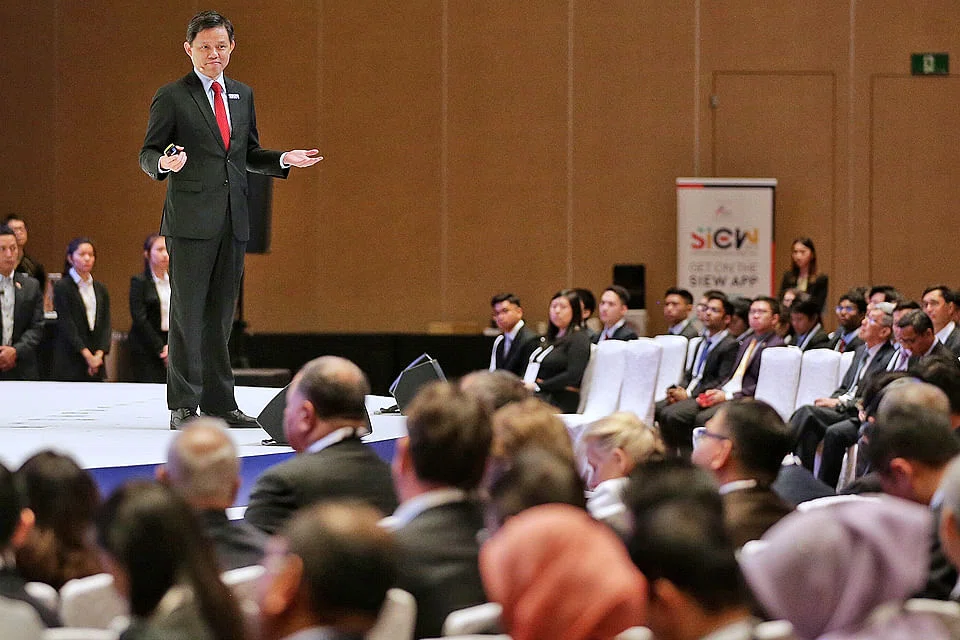
This is up from the current target of 350 megawatt-peak (MWp) by 2020, which Singapore is on track to meet, said Minister for Trade and Industry Chan Chun Sing at the opening of the Singapore International Energy Week on Tuesday. One gigawatt is equal to 1,000 megawatts.
Drawing a parallel with the "Water Story" of the last 50 years, he said: "Our Singapore Energy Story will depend on four switches for the next 50 years." Solar energy is one of these, alongside natural gas, regional power grids and low-carbon alternatives.
Without geothermal and wind power, and with hardly any tidal power, "solar power is our only renewable energy", he said.
The government will continue to support the adoption of solar solutions via streamlining regulations, its SolarNova tender programme, and solar panels on rooftops, with the Housing Board aiming to have solar panels on half of HDB rooftops in the coming years.
To achieve the "stretch target" of two GWp, more solar panels will be needed everywhere, from reservoirs and the sea to roofs and even vertical surfaces of buildings, said Mr Chan.
But for solar energy to take off, energy storage solutions are key. The government aims to deploy about 200 megawatts (MW) of energy storage solutions beyond 2025.
This will help to manage the stability and resilience of the energy grid, as well as to "shave off the difference between the peak and trough within the daily demand cycle".
This difference can be as much as 30 per cent, with extra capacity needed to cater to peak demand. "But if we can use energy storage solutions to better balance the peak and the trough demand, then that will save on the infrastructure cost."
Such solutions could benefit other countries, he added.
"So energy storage solutions are something that we would certainly like to develop further, with our partners both in the private sector and in other countries."
The Energy Market Authority and the Korea Institute of Energy Technology Evaluation and Planning will jointly award a research grant to promising Singaporean-Korean firms on the management and safety of distributed energy storage solutions.
Less than one MW of energy storage systems have been installed here.
On the other "switches", Mr Chan said that Singapore will still rely on natural gas for a substantial part of its energy needs for the next 50 years.
But it will keep diversifying sources, improving the efficiency of power generation technology, and growing as a liquefied natural gas trading hub.
On the possibility of a regional power grid, he noted that some other South-east Asian countries have an abundance of hydropower and other renewables, adding: "If we can connect the regional grid, it will provide greater resilience and stability for the entire system."
This is already done in Europe, where countries with excess power sell some to neighbours.
On low-carbon alternatives, Singapore is looking at areas such as carbon capture, utilisation and storage, which involves capturing carbon dioxide from industries and power plants, and converting it into products such as building materials, chemicals and synthetic fuels.
Besides improving its energy supply, Singapore must manage energy demand, particularly for cooling, said Mr Chan. This involves better design at every stage from urban planning to individual buildings.