SP Group unveils blockchain-powered green energy platform
Singapore
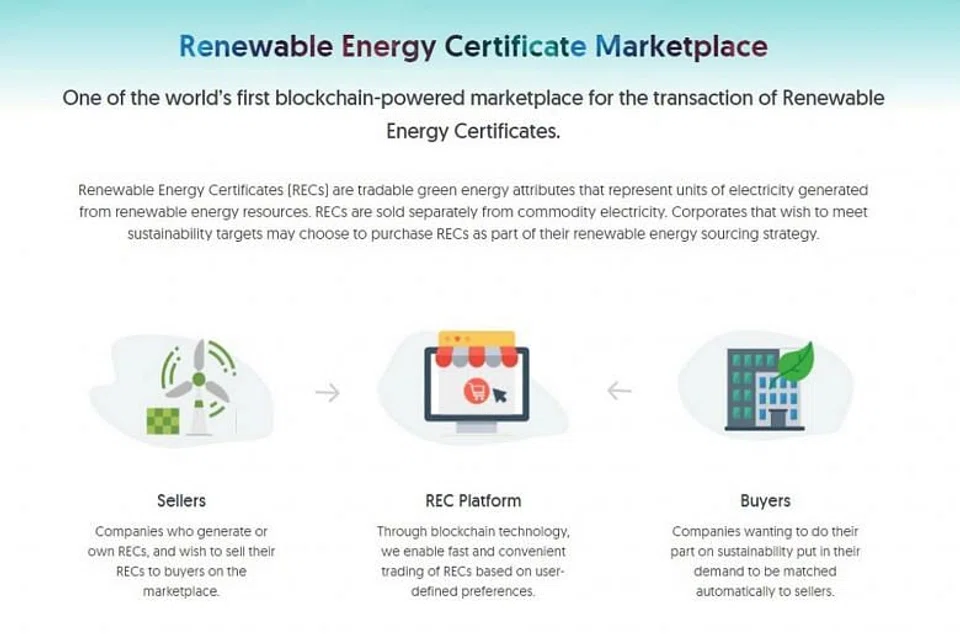
SP Group launched on Monday a new blockchain-powered marketplace for renewable energy certificates (RECs).
The move is expected to speed up the expansion of REC trades, which have gained traction here since the ratification of the Paris climate change accord in 2015.
SP's chief digital officer, Samuel Tan, said this new platform that is backed by blockchain technology, enables companies to trade RECs "conveniently, seamlessly and securely".
Two REC buyers, real estate group City Developments Limited (CDL) and DBS Group, and three sellers active in the solar energy space, Cleantech Solar Asia, LYS Energy Solutions and Katoen Natie Singapore, have come on board this new REC marketplace. RECs are tradable certificates or proofs of electricity generated by renewable sources.
REC trades in Singapore have climbed since the ratification of the Paris accord in 2015 . Total volume of RECs on Singapore's main registry, APX TIGR, has risen to 65,824 megawatt-hour (MWh) of solar energy generated in 2017, up from 7,456 MWh for 2015.
RECs can be used to displace carbon-intense energy so businesses have turned to trading these non-tangible commodities to reduce their carbon footprints.
Take the example of CDL - chief sustainability officer, Esther An said that by 2030, the real estate group aims to slash 59 per cent of its carbon emissions as compared to 2007 levels. To achieve this aggressive target, CDL seeks to use renewable energy to displace conventional electricity in its core operations.
The group first started participating in the REC marketplace last year, a step up from its incremental efforts to embrace solar power in its projects since the early 2000s.
At the other end of the spectrum, Katoen Natie Singapore, which is developing a rooftop solar power project in Singapore, said the REC marketplace provides solar energy producers access to an alternative revenue stream from the sale of unused output to those seeking green energy credits.
But observers also noted difficulties in tracking and verifying RECs and this is where blockchain can play a part to facilitate trades of these non-tangible commodities.
Blockchain is an encrypted decentralised ledger that allows market players to simultaneously and securely read, write and validate transactions. Reed Smith's partner, Bree Miechel pointed out that the use of blockchain can enhance transparency of trades and reduce double-counting of RECs.
What blockchain can potentially do is to remove the need for otherwise costly audits of RECs; residential and other small solar energy producers may find SP's blockchain-powered REC more accessible.
Solar is the most viable renewable energy source for Singapore. Singapore aims to ramp up its solar energy adoption to 350 MWp (megawatt peak) by 2020 and 1 GWp (gigawatt peak beyond 2020).
READ MORE: Getting the green light to mitigate impact of climate change