All statutory boards to publish sustainability disclosures from FY2024: DPM Heng
Industry players say the move could have trade, jobs benefits

Sharanya Pillai
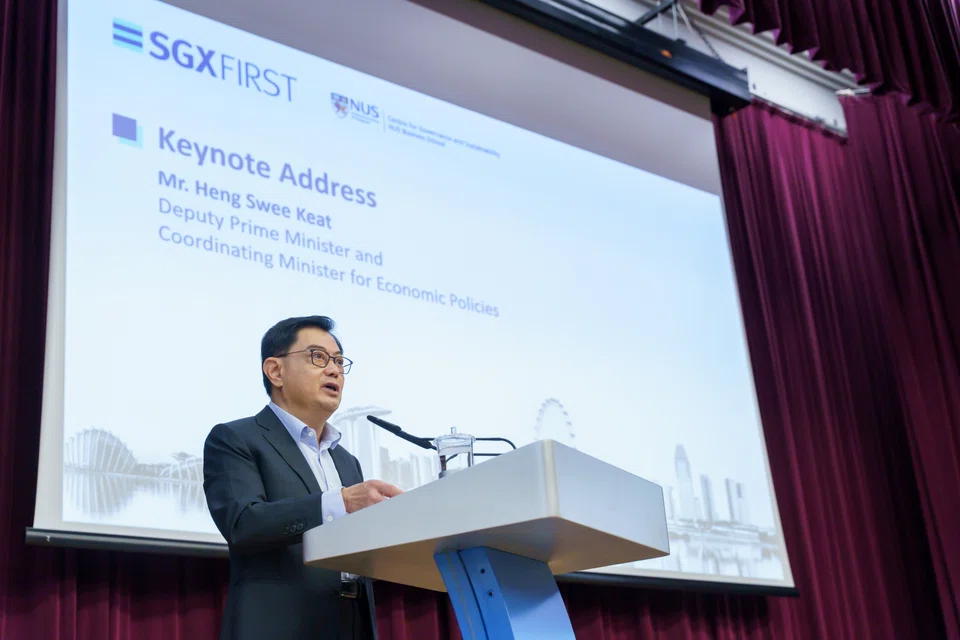
STATUTORY boards in Singapore will be required to publish annual sustainability disclosures for financial years that begin Apr 1, 2024 onwards, Deputy Prime Minister Heng Swee Keat announced on Thursday (Nov 23).
The government will also publish an annual report from fiscal 2023 that tracks the public sector’s efforts, progress and plans in rolling out its sustainability initiatives. FY2023 for the government ends on Mar 31, 2024.
It is important for the country to measure and disclose its progress on sustainability, said DPM Heng, who was speaking at the National University of Singapore for the launch of a study on sustainability reports.
“As the saying goes, ‘what gets measured, gets done’. Good disclosures help decision-makers allocate resources to entities and projects that show strong commitment and progress,” he said.
Some agencies – such as the Monetary Authority of Singapore, the Maritime and Port Authority and the National Environment Agency – have already been publishing sustainability reports in recent years.
The government’s latest efforts to boost such disclosures comes on the back of Singapore’s target to hit net-zero emissions by 2050. The public sector has committed to achieving net-zero emissions five years ahead of the national target.
The public sector also aims to reduce energy and water use by 10 per cent by 2030, while reducing the amount of waste disposed by 30 per cent.
Needle mover
Industry observers welcomed the announcement. Cherine Fok, a partner at KPMG in Singapore, said that the government’s moves could yield trade benefits for Singapore, “as the country will be seen favourably as trade partners with other green nations or blocs, such as the European Union”.
Calling the announcement a “needle mover”, she noted that having the public sector take the lead will drive other organisations in the private sector to emulate best practices.
“There will also be economic and job uplifts as we will see new green skills, capabilities and talents acquired to meet the rising demand,” Fok said.
Praveen Tekchandani, partner for climate change and sustainability services at EY, similarly sees positive knock-on effects in statutory boards providing sustainability disclosures.
He noted that there is growing focus on managing carbon emissions across the value chain, by monitoring Scope 3 emissions.
“We could see higher expectations from statutory boards in the coming years as they seek emissions data from key or material suppliers, leading to organisations working with statutory boards to measure and report the emissions data as well,” he said.
That said, there is the question of whether Singapore has enough skilled talent to meet the higher demand for sustainability reporting. Tekchandani noted that upskilling will be needed.
KPMG’s Fok thinks that the country may see a short-term crunch in sustainability talent and expertise, but believes it will still ultimately be able to attract the best minds and expertise.
“Already, many schools have incorporated environmental, social and governance (topics) into their core curriculum, and we expect efforts from both the public and private sectors to ramp up further. Technology will also enable efficient, large-scale adoption of reporting mechanisms,” she said.
In his speech, Heng said that the government is “leading by example” in reporting how it incorporates sustainability in decision-making and risk management.
“Sustainability is core to Singapore’s future development and the green economy will be a key pillar in driving our next round of growth. But achieving this transition will require effort and collaboration across different quarters,” he said.
“The government is committed to developing and aligning the entire ecosystem to pursue a greener and more sustainable future.”