

CapitaLand Development and green group launch Singapore’s first carbon footprint benchmark for concrete
It aims to provide industry players in the value chain the data to identify and choose lower-carbon options

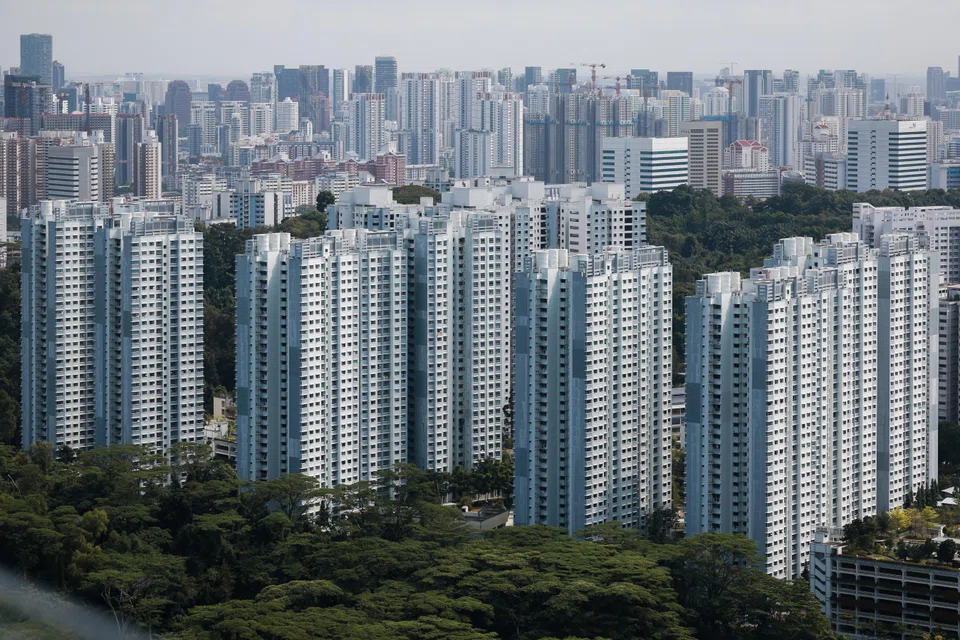
[SINGAPORE] CapitaLand Development, the development arm of property company CapitaLand, and environmental organisation Climate Group have launched a market-wide benchmark that measures the embodied carbon of concrete in Singapore.
Embodied carbon refers to the emissions released in the manufacturing, transportation, installation and maintenance process of buildings before they become operational.
The benchmark, the first in Singapore, aims to establish a credible baseline for the embodied carbon intensity of concrete supplied in the city-state, and provide industry players in the value chain the data to identify and choose lower-carbon options, said both entities in a joint statement on Thursday (Feb 26).
CapitaLand Development decided to be part of this project as it would bring different stakeholders and perspectives in creating a common definition of low-carbon concrete, said Giovanni Cossu, the company’s head of sustainability.
Developed through the collection and analysis of verified environmental data from concrete suppliers, the benchmark represents a weighted average of embodied carbon performance in commonly used concrete mixes.
They added that it provides transparency, which will empower demand and supply-side industry stakeholders to make informed decisions. The benchmark would also provide policymakers with the additional data to support standards in public and private projects.
The statement said: “By equipping developers, suppliers, regulators and financiers with a common reference point, the benchmark accelerates the transition from isolated pilot projects to systematic market adoption, reducing embodied carbon in construction at scale.”
Speaking to The Business Times at the launch event, Cossu said the most valuable outcome of this benchmark is that stakeholders from different domains can “speak with the same language”.
For example, concrete buyers can spot opportunities to reduce embodied carbon, and use concrete specification and procurement processes to shift demand towards lower carbon materials.




Suppliers could use the benchmark to find ways to improve their products, said a report released on the same day, which explained further how the market benchmark works.
Regulators could use it as a baseline reference for developing a road map to decarbonise the concrete sector, and financial institutions may be able to assess the climate impact of their investment opportunities in lower-carbon concrete.
Cossu said that while the benchmark is still new, it can help the company in specifying the materials used in constructing buildings. This may then flow into its procurement guidelines and then its contractual requirements with suppliers.
“We have to see the pace of adoption (by the market). What is clear now is that products are available in the market. There are different types of low-carbon concrete that you can choose from. Suppliers are already supplying those products. So it’s a way of identifying the right balance between, obviously, your economics and your decarbonisation objectives.”
A market benchmark can help Singapore track progress over time and assess the effectiveness of concrete decarbonisation interventions, said the report.
“It may also help identify performance gaps and highlight areas where the largest carbon savings can be achieved,” it added.
The establishment of a robust demand signal for lower-carbon products could catalyse innovation and investment in lower-carbon concrete supply in the rest of South-east Asia.
The report also suggested overlaying the market benchmark against a certification scheme for green buildings developed by the Singapore Green Building Council, which ranks the embodied carbon of concrete based on a four-tick tiered system. This could support concrete users in identifying which rating levels are the most effective in reducing the embodied carbon of concrete over time.
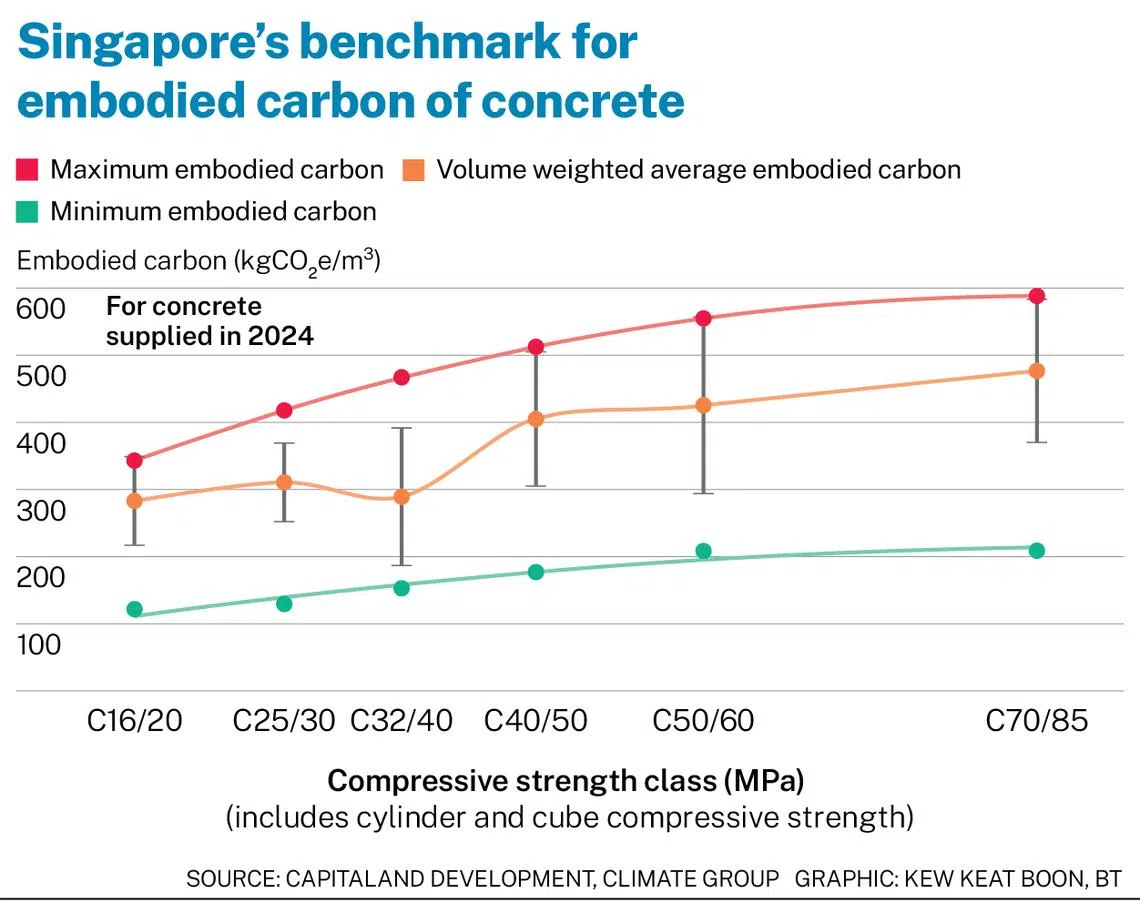
Data from the benchmark indicates that the volume-weighted average embodied carbon in Singapore lies closer to the upper range.
The report said: “The wide spread in the data reflects the varying pace at which different stakeholders are transitioning to lower embodied carbon of concrete.
“This highlights significant opportunities for accelerating sector-wide improvement, particularly by encouraging the broad middle players to adopt lower embodied carbon solutions, driving down the average values.”
It added that Singapore’s urban and geographic context means there is high per-capita concrete consumption, at over 11 million cubic metres or 1.9 cubic metres per capita each year.
Singapore’s upstream concrete emissions is estimated at 3.7 million tonnes of carbon dioxide equivalent, which is about 6 per cent of the country’s national emissions.
Decoding Asia newsletter: your guide to navigating Asia in a new global order. Sign up here to get Decoding Asia newsletter. Delivered to your inbox. Free.
Copyright SPH Media. All rights reserved.
TRENDING NOW

Once staunchly pro-China, Malaysian Chinese businesses are now distancing themselves from Beijing

Britain’s mansion tax shows the difficulty of targeting wealth

Three hats, one goal: How Ng Kian Swan runs sustainability at NUHS

COE review: The gap between luxury and mass-market cars isn’t the only one worth bridging

