

CapitaLand Investment’s 2023 emissions have risen, but energy efficiency improving: CSO
The company is ramping up renewable energy and efforts to track value-chain emissions


EVEN as CapitaLand Investment’s (CLI) carbon emissions rose last year – in terms of direct operations and power usage – the real asset manager has been improving energy efficiency.
“The overall direction (on emissions) needs to keep going down, surely. But year-on-year, you may have years where it may increase as well,” CLI’s chief sustainability officer, Vinamra Srivastava, told The Business Times.
Hence, the journey in cutting emissions “will not be linear”, he said.
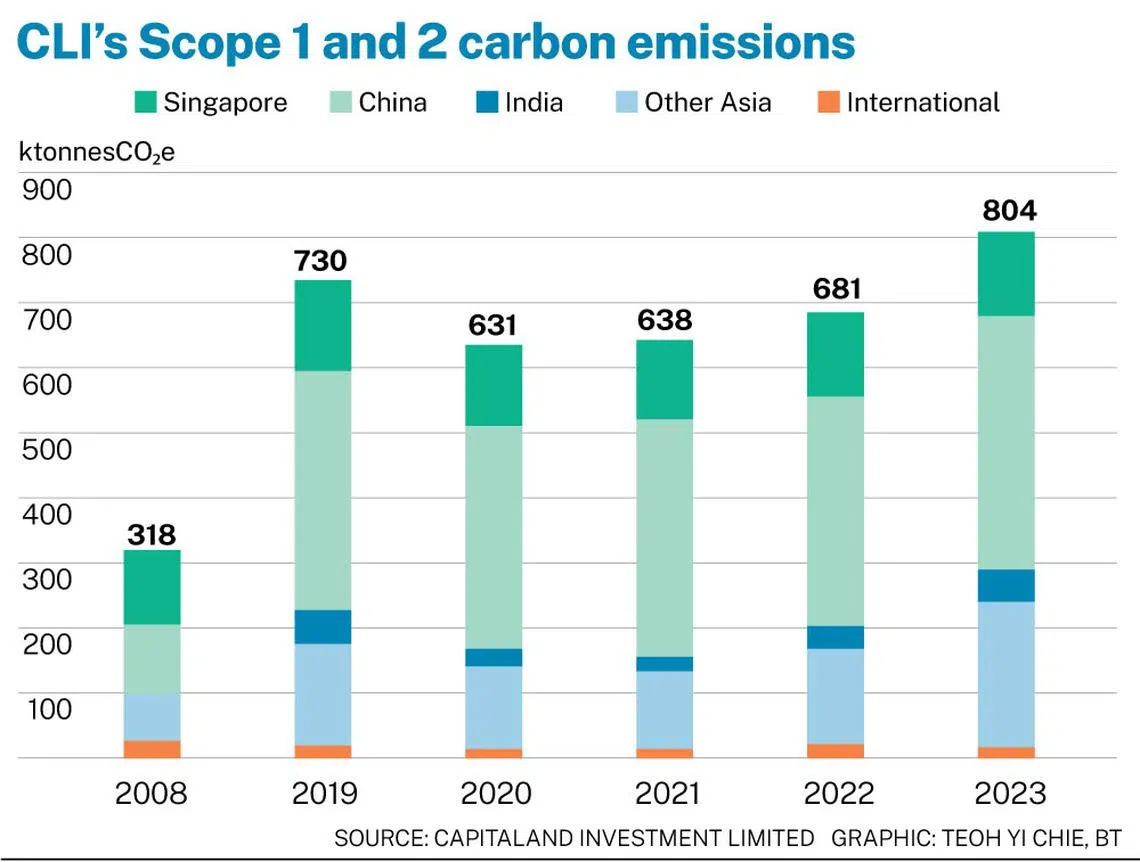
In 2023, CLI’s Scope 1 and 2 emissions rose 10.1 per cent from the baseline year of 2019, indicated its latest sustainability report.
Scope 1 covers CLI’s direct emissions and accounted for 2 per cent of its 2023 carbon footprint. Scope 2 emissions – associated with the company’s energy consumption – made up 30 per cent of its carbon footprint.
Last year’s emissions rise was driven by CLI’s portfolio expansion – from 353 operational properties in 2019, to 497 in 2023.
The emissions rise has to be taken in the context that business has expanded. “While our portfolio that we operate and manage grew 40 per cent, our emissions only grew 10 per cent. That shows that we have been growing our business in a more energy-efficient manner,” Srivastava said.
On a like-for-like, same-store basis, CLI’s Scope 1 and 2 emissions have fallen 14.4 per cent from 2019, Srivastava highlighted. Its carbon emissions intensity has also fallen 13.2 per cent over the same period.
2030 target
The real asset manager is just six years away from a major target: to record a 46 per cent drop in Scope 1 and 2 emissions by 2030, compared to 2019. It then wants to achieve net zero on both emission scopes by 2050.
Meeting such targets is important for companies like CLI, as this can affect their access to green finance, inclusion in climate indices and attractiveness to institutional investors.
CLI is now focused on two strategies to “balance business growth with continuing to keep absolute emissions down”, Srivastava said.
One is to keep improving energy efficiency with tech upgrades and green asset enhancements. The other is to ramp up renewable energy, with new power purchase agreements (PPAs) to add on to existing ones.
Ramping up renewables
Created in 2021 as part of the restructuring of CapitaLand, Singapore-listed CLI has a portfolio of more than 1,000 properties across 40 countries, in sectors such as retail, office, lodging and data centres.
It has six listed real estate investment trusts (Reits) and business trusts – such as CapitaLand Ascendas Reit and CapitaLand India Trust (Clint) – and over 30 private vehicles.
For a property player like CLI, the key to lowering Scope 2 emissions is switching to renewable energy to power buildings.
The company has invested heavily in solar power, with rooftop panel installations in markets such as Singapore and China. In India, Clint recently set up its first captive solar plant to power two million square feet equivalent of office space.
It also has several renewable energy PPAs, in markets such as in China, where it purchased more than 2,000 megawatt hours (MWh) in green energy, and Japan, where it procured 2,700 MWh of energy.
However, CLI’s overall renewables usage is still low. In 2023, only 5.2 per cent of its total electricity consumption was powered by renewable sources. Its target is to raise this to 45 per cent by 2030.
Adding more renewable PPAs is key to achieving this target. Such agreements “will come in bulk and allow us to procure in larger quantities than rooftop (solar), which is more fragmented,” said Srivastava.
The company is also exploring group-buy agreements, where power purchasers aggregate their needs.
“In many markets where we may not have enough scale on our own, we are trying to assess (if) we can get together into group-buy procurement schemes, where like us, there may be many other small-scale buyers,” said Srivastava.
He acknowledged the possibility that even if CLI maximises energy efficiency and renewables, it may still face a gap in meeting its 2030 targets. In this case, CLI will assess “last-mile solutions”, which could include renewable energy certificates or carbon offsets.
Tackling Scope 3 emissions
While cutting Scope 1 and 2 emissions is important, the bulk of its emissions – 68 per cent in 2023 – fall under Scope 3. This refers to carbon emitted from upstream and downstream activities in its value chain.
In its latest sustainability report, CLI enhanced its Scope 3 reporting with three new categories: purchased goods and operations; fuel and energy-related activities; and upstream transportation and distribution. It is now working towards developing Scope 3 emission goals.
Meanwhile, CLI is also working with tenants on decarbonisation. Last year, almost half of its Scope 3 emissions came from its downstream leased assets.
CLI sees green leases as a “key instrument” to engage tenants. Such leases could specify what type of lighting, air-conditioning or materials the tenant should use in their fit-outs. Or it could be more focused on sustainability data sharing and training, especially for tenants who are only starting to look into such issues.
“Not every customer will be a Fortune 500 multinational that already is advanced in their net zero journey… A large part of our portfolio has SMEs as tenants, and these SMEs have probably not even started their Scope 1 and 2 journey. So with these SMEs, we have to handhold them,” he said.
CLI already has a “good coverage” of green leases in Singapore and China, and wants to expand this to other markets, he added.
Engaging suppliers, another source of Scope 3 emissions, is similarly important. Last year, CLI identified more than 500 of its most critical suppliers and worked with an external partner to come up with a scorecard measuring them on environmental, social and governance (ESG) factors.
Not zero-sum
Companies’ emphasis on climate targets may deter investors who are mainly returns-focused, especially if sustainability objectives affect returns negatively. For example, property players like CLI may face a dilemma over whether to sell off an unsustainable, or “brown” asset that still has commercial value.
Srivastava said such a decision would still rely on a multitude of factors.
“Say if an asset is brown enough, and you can never make it green… will I sell it? I can’t say, it really depends on all these other aspects: what is the strategic value of the asset? Can it be compensated with something else?” he said.
In addition, selling a brown asset may also just pass on the problem to someone else, he noted.
Srivastava emphasised that ultimately, sustainability should not be seen as a “zero-sum” game.
“It is not a trade-off – that I can either be green or make money. I strongly believe they both can go hand-in-hand in the mid to long run,” he said.






