Climate Impact X defends validity of voluntary carbon credits from world’s most intact forests

Wong Pei Ting
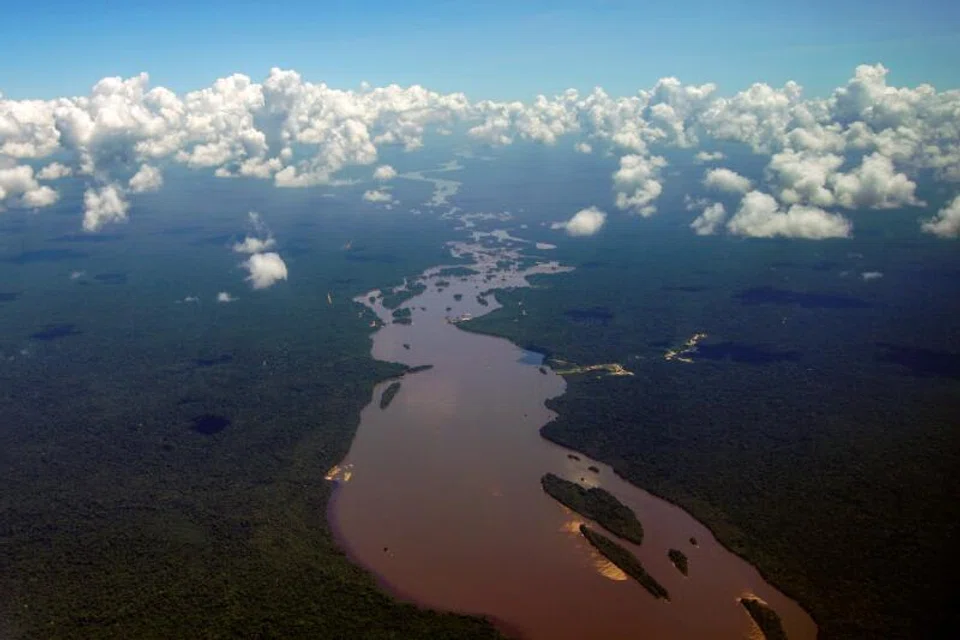
SINGAPORE-BASED carbon marketplace Climate Impact X (CIX) has stepped out to defend the validity of voluntary carbon credits generated from the world’s most intact forests, as the first of such credits were issued from Guyana, a country in South America, on Dec 1.
These forests spanning close to a billion hectares (ha) were thought of as protected anyway, with or without funding, making it problematic to justify credits issued from related projects as being “additional” – a quality required of carbon credits.
But in a guidance paper co-published with four other organisations, CIX argued that without carbon credits as a prospective source of finance, the high forest, low deforestation (HFLD) jurisdictions would encounter a “financing cliff” in which they become victims of their own success.
“Without carbon credits as a prospective source of finance, HFLD jurisdictions have a perverse incentive to allow deforestation to tick up again and undermine the permanence of past efforts to preserve a jurisdiction’s remaining forests,” the paper stated.
Rather than writing off the ability of these jurisdictions to issue credits, it is important to provide a pathway for them to continue participating in the monitoring, reporting and verification of their efforts, it added. Conservation International, Emergent Climate, Natural Climate Solutions Alliance and Wildlife Conservation Society are the paper’s other authors.
The paper went on to justify that credits from HFLD jurisdictions are, in fact, additional, pointing out that there is “ample evidence” that many forests in HFLD jurisdictions are at risk, one being that about 12 per cent of intact forest landscapes were lost from 2000 to 2020.
“If the losses continue at this pace, half of the world’s most intact forests will be cleared, degraded or fragmented by 2100,” the paper noted, adding that five countries had lost HFLD status from 2010 to 2019 due to increased deforestation rates or a drop in total forest cover. The five are Cambodia, Laos, Samoa, Sao Tome and Principe, and Zambia.
The only areas in South-east Asia that still qualify as HFLD zones are in Indonesia – Papua and Papua Barat – CIX commercial director Bryan McCann told The Business Times.
In 2021, Papua Barat, which has about 90 million ha of forest, lost 203,000 ha, while Papua, which has 24 million ha of forest, lost 16,600 ha, McCann said, citing data from forest monitoring platform Global Forest Watch.
Meanwhile, he noted that Papua New Guinea, which has observer status to Asean, has 35.9 million ha in forest cover, and lost 73,000 ha of natural forest in 2021. It is unclear if Papua or Papua Barat will pursue deforestation reduction, but Papua New Guinea is among five jurisdictions that have begun the crediting process by submitting a concept note to the Architecture for REDD+ Transactions (ART), McCann said.
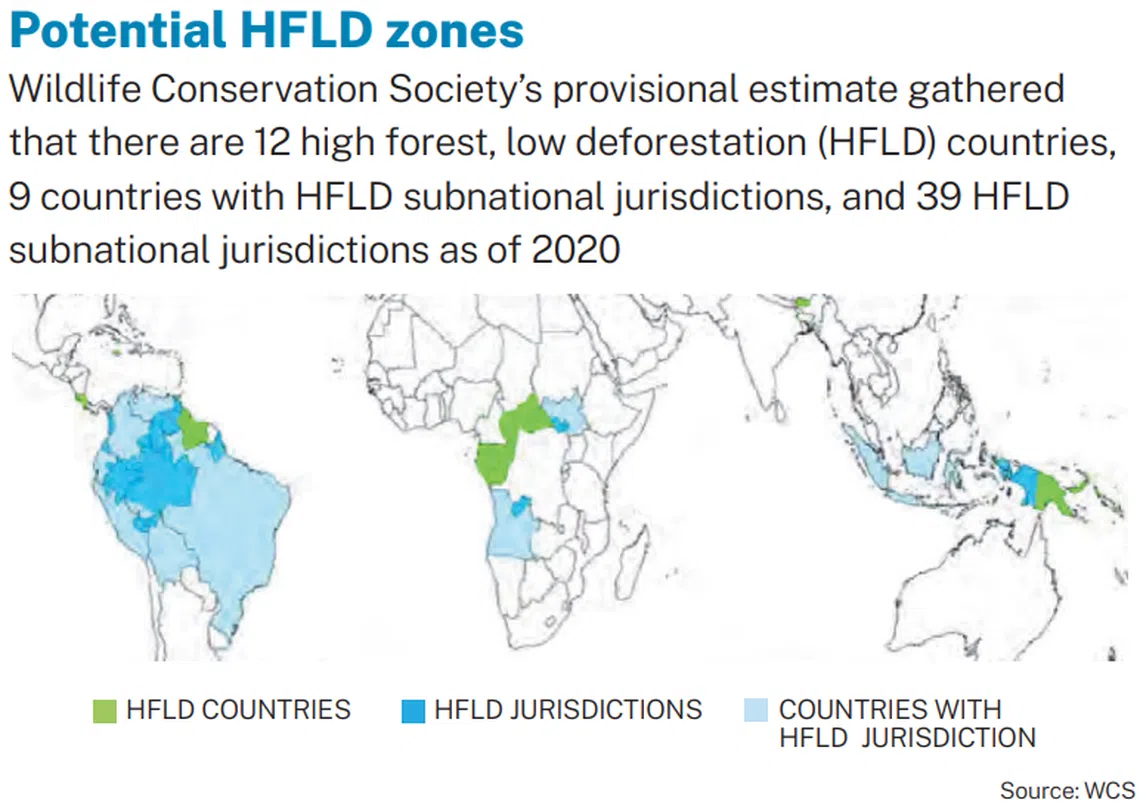
The paper further pointed to bespoke mechanisms that can ensure that only certain places can be considered a HFLD jurisdiction, and that these jurisdictions do not over-claim on their forest carbon stock at risk.
In so saying, the paper endorsed ART’s The REDD+ Environmental Excellence Standard (TREES), which assigns credits based on a “conservative estimate”, such that even for a high-forest cover country like Guyana, the approach yields a very limited number of credits.
It also has a selective eligibility criteria, which allows only jurisdictions that are successful in keeping deforestation very low to use its crediting approach – their HFLD score, computed by multiplying the percentage of forest cover with deforestation rate, must be greater than 0.5 for each year of the reference period.
McCann said TREES is a “robust methodology” that is by no means an arbitrary assessment. Pointing out that the HFLD crediting level is developed by adding together two numbers – the five-year historic rate of emissions and the HFLD score multiplied by 0.05 per cent of the countries standing carbon forest stock – this effectively translates to 0.02 to 0.04 per cent of the standing carbon forest stock, he said.
For Guyana, whose average HFLD score is 0.79, the final factor becomes 0.79 times 0.05 per cent, which translates to 0.04 per cent of its carbon stock. This is close to seven million tonnes of carbon dioxide equivalent, equivalent to 5,646 ha, or roughly the area that would be deforested by less than 2.5 average soya farms – tiny compared to total area of forest in the TREES accounting area of over 18 million ha.
In simple terms, this also means that should jurisdictions exceed their historic rate of deforestation, the number of credits they can issue will consequently be reduced under the mechanism, McCann said. And if they exceed their historic rate of deforestation by too much, they will not be eligible to issue any credits at all, he added.
McCann, meanwhile, said CIX expects credits from HFLD jurisdictions to trade in line with other types of quality carbon credits. He, however, noted that pricing ranges widely in the market today, even within the category of nature-based carbon credits, and is fast evolving.
He also said the supply from anticipated HFLD issuances is too small to upset prices of nature-based credits, reiterating that the baseline for quantifying the number of issuable credits is conservative.
He added that issuances will be staggered as jurisdictions complete the validation and verification process at different times. Of the five HFLD jurisdictions that have submitted concept notes to ART, only Guyana has progressed to issuing credits so far, he said.
ART, in a Dec 1 statement on the world’s first TREES credit issuance, said 33.47 million TREES credits were issued to Guyana for the five-year period from 2016 to 2020, following an independent validation and verification process and approval by the ART board of directors.
The serialised credits, listed on ART’s public registry, are available to buyers on the global carbon market, including for use by airlines for compliance with the International Civil Aviation Organization’s global emission reduction programme, Corsia, and for use towards voluntary corporate climate commitments, it said.