

Empowering young designers to design for good
The Asia Young Designer Awards (AYDA) started by Nippon Paint aims to motivate young designers to improve the lives of people

Vivienne Tay
Singapore
TRANSFORMING war-torn spaces in Syria into children's playgrounds and making education and culture accessible to kids in remote mountainous regions in Vietnam - these are two of the award-winning projects at this year's Asia Young Designer Awards (AYDA).
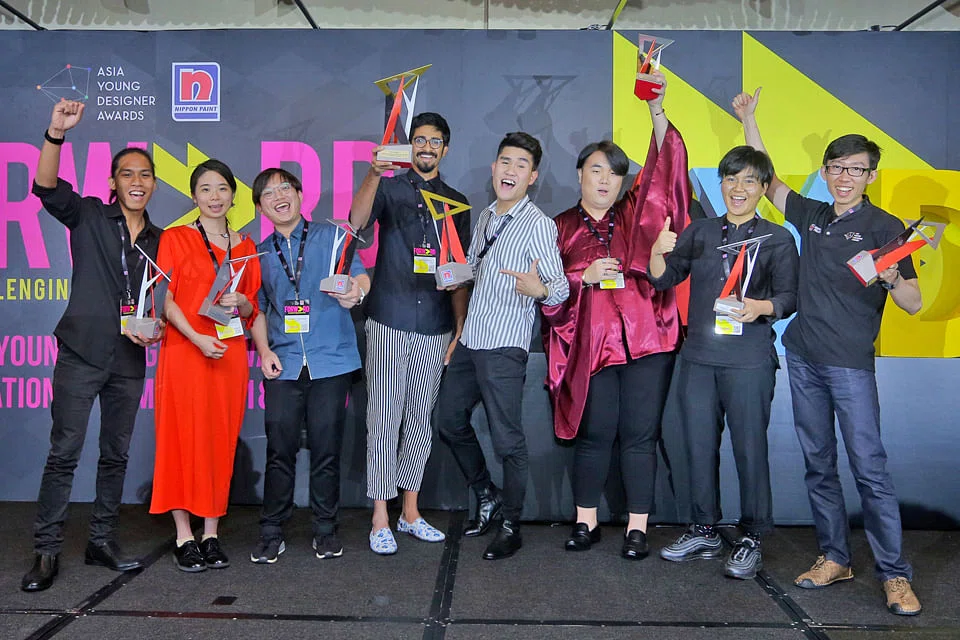
The first, Children Uprooted, won its designer Tanay Narendra Bothara of India the Winner of the Asia Young Designer of the Year 2018/19 prize in the architecture category. The project design proposes turning existing large building basements in Syria into playground to help children there recover their lost childhood.
"I believe that art and architecture is a tool which can revolutionise society," Mr Bothara said. "However, recognition seems to go to designers who prioritise formal or sculptural form, instead of looking at the impact on the users of the space."
He added that although he has never been to Syria, he was motivated to work on this project after watching a heartrending Facebook video about Syrian children in 2017, as well as other books he read and documentaries watched.
Mr Bothara hopes to "use what he's learnt in school, to help these kids recover their lost childhood and put smiles on their faces".
The second winning project, Future-Forward, Culturom, secured Dang Huu Trong of Vietnam the award in the Winner of the Interior Design category.
Mr Trong said: "Many ethnic minorities living in the country's (Vietnam's) mountainous regions face obstacles in accessing culture and education, as they live over 10km away from schools. With the cultural houses, my idea is to bring the schools to the children. It would include classrooms, libraries and computer labs to facilitate learning, as well as community areas for ethnic minorities to celebrate their culture and identity. The cultural houses help them gain knowledge as well as understand their indigenous culture and values."
He intends to build small huts on top of these supporting structures for tourists to attend workshops held by residents to learn more about Vietnamese culture.
The design will incorporate sustainable elements - like the use of bamboo as construction material, and the use of natural light and wind for solar energy to run the houses - adaptable for other uneven terrains found globally.
AYDA was started by Nippon Paint in Malaysia in 2008. Later it expanded to include Singapore, Vietnam and Thailand, reaching out to over 987 universities. AYDA has engaged over 117,000 students across 15 geographical locations.
The event was held on March 22, 2019, and both winners - among over 8,400 contestents - walked away with US$10,000 worth of prizes, including the opportunity to apply for a fully-funded six-week Harvard Design Discovery programme.
As more companies turn their attention towards putting sustainability on the business agenda, Nippon Paint is determined to evolve with the times while retaining the importance the paint manufacturer has always placed on education and skills-upgrading.
On top of the various skills-upgrading initiatives it runs in Malaysia and Indonesia for low-income communities, Nippon Paint has quietly worked with young designers for the past 11 years, empowering them to design with the motivation to "better the lives of people".
AYDA aims to "bridge the gap" between skills the youth and the unemployed have and the skills sought by private sector companies, by enlisting the help of industry professionals to participate as judges and mentors to participants. "Designers often design based on the briefs given to them and many of such briefs are driven by commercial purposes. As such, the mindset of wanting to design for good has taken a backseat," Wee Siew Kim, CEO of NIPSEA Group, which owns Nippon Paint across Asia, told The Business Times.
AYDA has a different theme each year. This year it was all about sustainability, because of the rising need for urbanisation and housing solutions due to continuing global population growth.
"We need to start thinking about how to balance the needs of urbanisation and sustainability," Mr Wee said.






