

Exploring the link between sustainable investments and financial returns
Incorporating sustainability factors into investment decisions may steer capital towards companies with the potential to thrive in future

THE most-often-cited barrier to adopting a sustainable investment approach is concern over sacrificing financial returns.
There is little conclusive evidence for whether sustainable strategies generally outperform or underperform their more traditional peers, given the challenges around classifying sustainability and comparatively short track records.
In our experience, however, the journey may be different, but the long-term outcome is likely to be similar.
We believe, at the same time, that incorporating sustainability factors into investment decisions may get around the risks associated with areas of environmental and social controversy, while also steering capital towards companies with the potential to thrive in the future. Both factors may support financial returns over the long term.
When considering financial implications for any investment strategy, there are other factors to consider beyond exclusions, such as where the capital is allocated instead.
Exclusions
For many, an important aspect of investing sustainably is the desire to avoid profiting from or investing in harmful sectors.
Some investors believe that excluding certain parts of the market may result in lower financial returns. This topic has been hotly debated by many investors in the context of fossil fuel divestment over the past few years.
There is no denying that exclusions can, at times, produce uncomfortable results in the short term, and require investors to hold their nerve. Short-term movements need to be seen in the broader context, though.
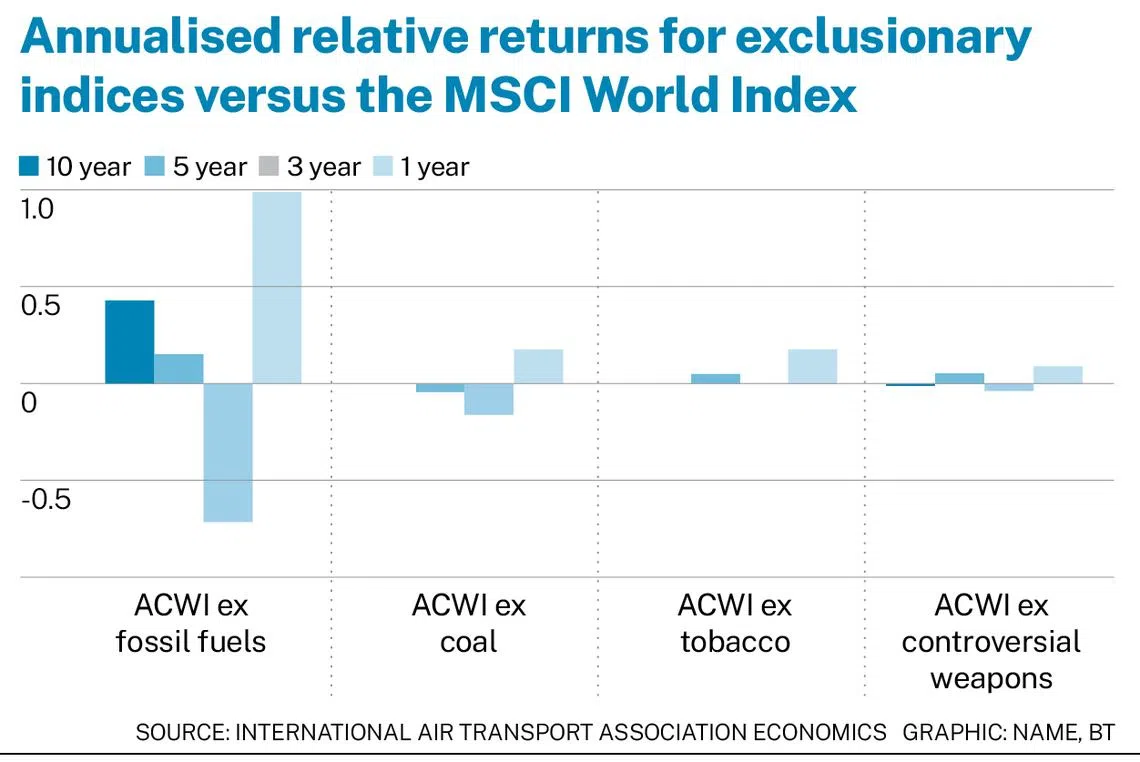
For example: Even allowing for the spike in energy prices following Russia’s invasion of Ukraine, which has led to bumper profits for energy companies over the last two years, the MSCI All Countries World Index ex-Fossil Fuel Index (which excludes fossil fuel companies) has outperformed the unrestricted MSCI ACWI over one, five and 10 years to end-December 2023. It is only over a three-year period that the unrestricted indices have outperformed.
This is illustrated in the chart below, alongside the impact on the financial returns of other common areas of exclusion such as coal, tobacco and controversial weapons, over different time periods.
The effect on financial returns has been negligible whether including or excluding any of these sectors from the global equity universe over the medium and longer term.
Engagement
As well as deciding where we will and won’t invest our clients’ money, investing sustainably is also about how we act as shareholders, and use our influence to encourage the companies we invest in to make progress.
Active ownership and engagement can be an effective way of driving real-world change, as well as, in some cases, enhancing a company’s share price over the long term.
Recent research by Schroders on whether engagement can affect financial returns has found that companies with committed and sustained engagement have better financial returns than peers for nearly two years from the start of engagement.
This suggests an effective active-ownership strategy can also enhance financial returns.
Materiality
When analysing sustainable investment strategies, it can be helpful to consider thematic materiality. Materiality in this context refers to the extent to which a theme or topic affects financial performance and sustainability outcomes.
Some sectors are more sensitive to themes than others. When assessing thematic materiality, we look at a range of factors, including the scale and scope of the issues involved, potential financial implications, the level of stakeholder interest, regulatory developments and the potential for innovation.
The energy sector is clearly important for investors concerned with climate change, for example, given high carbon emissions and the risk of carbon taxes, and other policy changes resulting in stranded assets.
Human rights are important in the healthcare sector, given the requirement for responsible marketing and disclosure, and access to medicines and healthcare services.
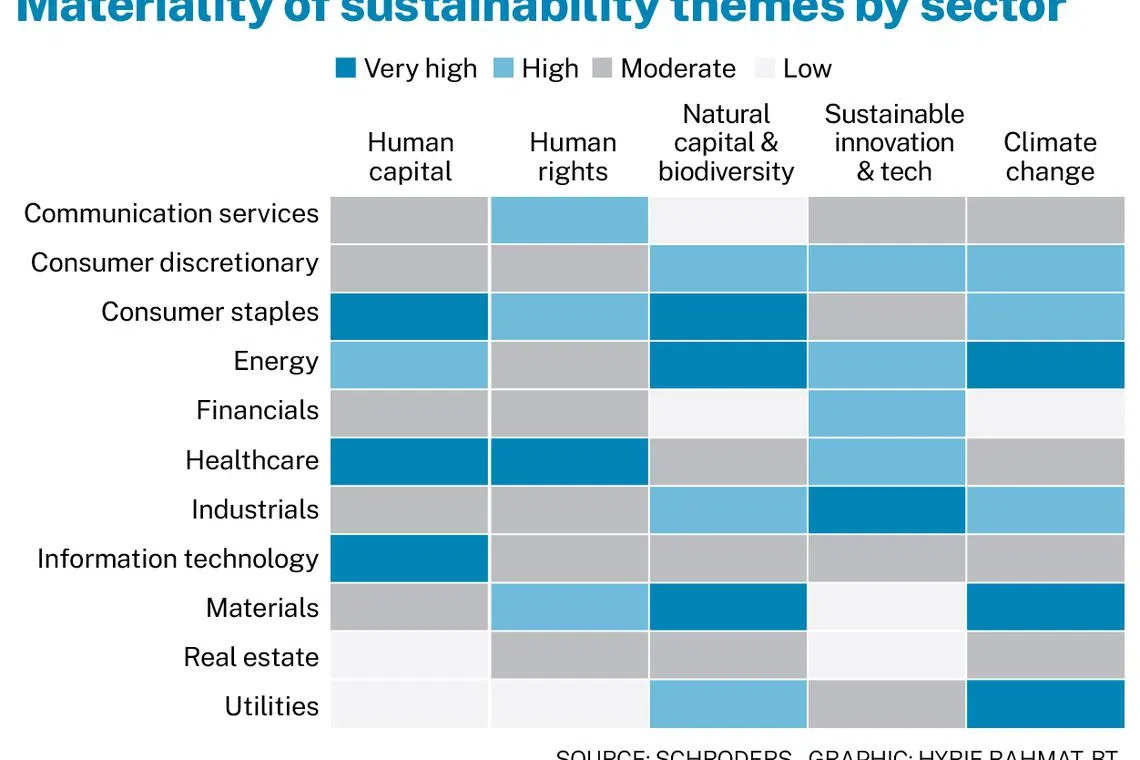
By understanding thematic materiality, we can focus our efforts and resources on sectors and companies that are most exposed to or influenced by these themes.
This can help source sustainable investment opportunities, illustrate how resilient a company may be, as well as help target our engagements where the themes are most material.
While there is still a concern among some investors that adopting a sustainable approach may result in lower financial returns, that has not been our experience.
We use sustainable investment research and tools such as engagement, with the aim of identifying risks and enhancing returns, as well as seeking positive outcomes.
The writer is a portfolio director at asset manager Schroders






