

Forest offsets with carbon leakage safeguards are preferred but could still be flawed
NUS study finds wide variations in deforestation baselines among calculation methods in use
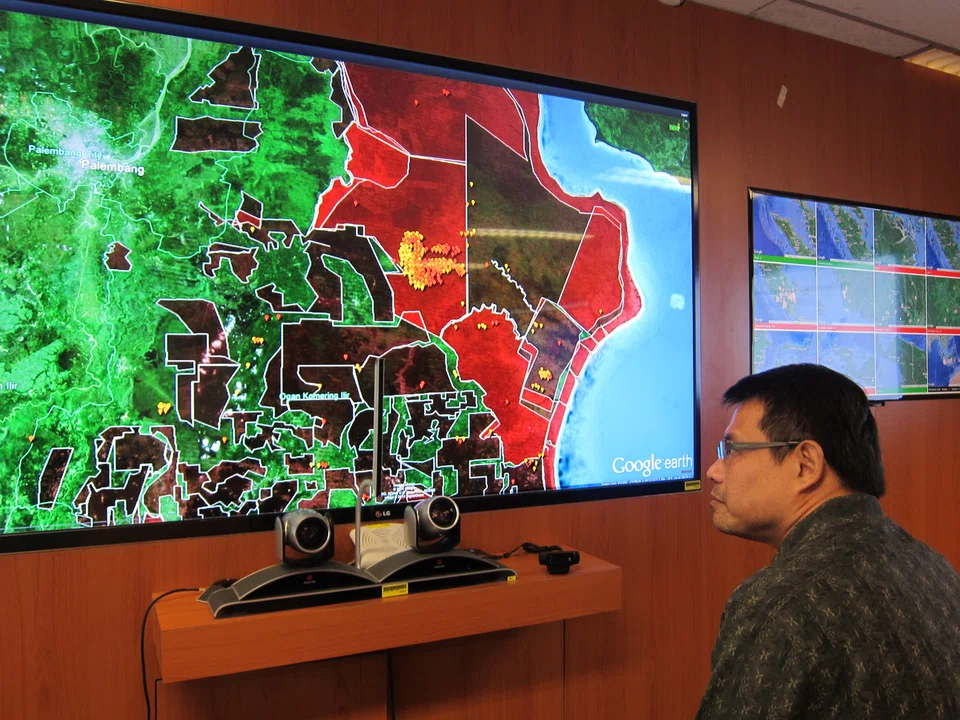
THE Singapore government is prepared to accept forest conservation carbon offsets that consider deforestation across an entire jurisdiction as it addresses carbon leakage risk, but a study has uncovered that this project type is not without its flaws.
While the jurisdictional approach might be favoured over carbon credits generated from projects that consider deforestation on a project level – where deforestation can simply “move” from within a project to an unmonitored area – it could still lead to an overgeneration of credits, researchers found.
Overgeneration is when credits that do not represent genuine carbon reductions are created. Such credits had been referred to as “phantom” credits.
This could be a result of overstated deforestation baselines. Such baselines are the basis for how the class of forest conservation credits known as Redd+ – short for Reducing Emissions from Deforestation and Forest Degradation – are generated. Redd+ credits are typically issued based on the difference between an area’s historical deforestation data and the actual deforestation observed.
The study was conducted by a team of researchers from the National University of Singapore’s Centre for Nature-based Climate Solutions, who recently published their findings in the scientific journal, Nature Communications.
The problem, as highlighted, lies in the flexibility granted for project developers to pick their preferred method of calculating deforestation baselines. The baseline figures that the different methods out there present vary widely – by 171 per cent on average.
So, while the baseline calculation options are intended to allow project developers to cater to unique local circumstances, it can make baseline setting “a matter of political judgement”, the research team, led by climate and ecosystem scientist Teo Hoong Chen, said.
This “opens up carbon market participants to potential credibility and reputational risks should these baselines later be independently assessed to be flawed” – not dissimilar to the project-based approach – they wrote.
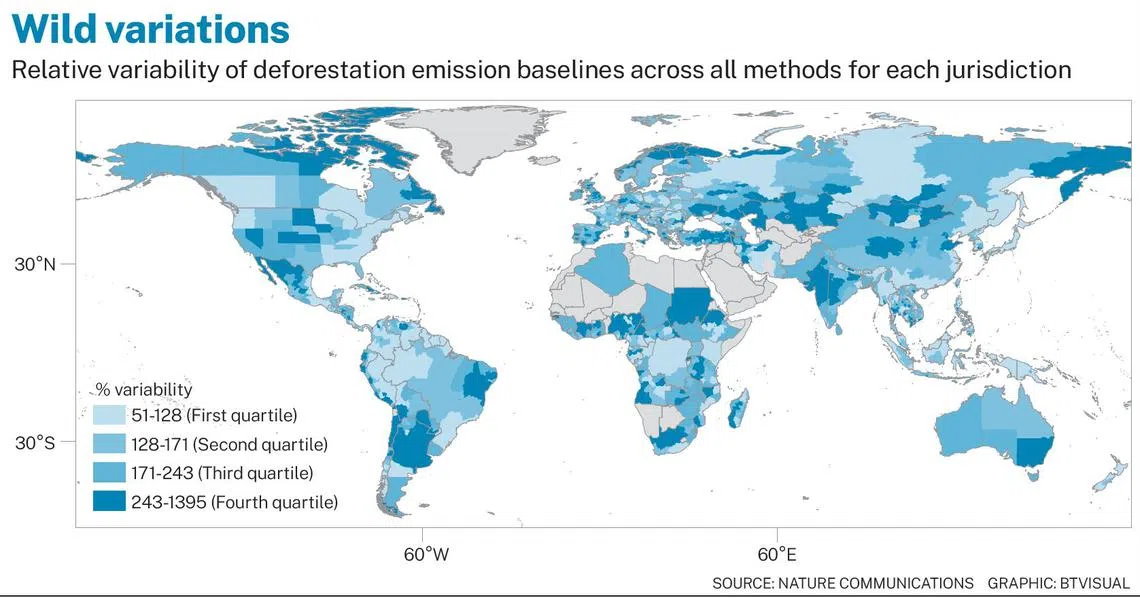
Voluntary carbon market standards typically require projects with more than 15 per cent overall uncertainty to apply for a discount. In some instances, such projects may even be prohibited from getting listed.
The study, however, found that a median 28 per cent of carbon estimation methods used in each jurisdiction exceed the 15 per cent threshold. A median 52.9 per cent of deforestation projection methods also exceed the threshold.
Among those named causing the largest swings in baseline estimates include the “historical average” or “time function” methods. Redd+ developers had reached for these simpler ways more readily than linear regression models, which the study said were “seldom used” but are found superior as they generate the least variable results.
The researchers said linear regression models could more accurately predict deforestation rates for the future as they could incorporate relevant driving factors, such as socio-economic and biophysical environmental factors.
In contrast, the more commonly used historical average and time-function models do not take such driving factors into account.
Despite highlighting the flaws of jurisdictional Redd+, the researchers said carbon markets play a critical role in financing such nature-based climate solutions. These solutions have the potential to provide up to one-third of cost-effective climate mitigation to meet the Paris Agreement target of limiting global warming to well below 2 degrees Celsius, they noted.
The purpose of the research is to scrutinise factors that could help to boost the environmental integrity of jurisdictional Redd+ approaches, they added.
With this understanding, project developers could be prevented from cherry-picking data sets and methods that could allow them to sell more credits. National or corporate credit sourcing strategies could shape themselves to buy only from developers that use robust data sets, for instance.
Country differences
Singapore signalled its openness to jurisdictional Redd+ projects last October when the government unveiled the eligibility criteria of its International Carbon Credit (ICC) framework.
The ICC framework allows companies subject to Singapore’s carbon tax to offset up to 5 per cent of their taxable emissions by buying credits from voluntary carbon markets. Credits are however only usable if they are from countries where Singapore has a carbon credit transfer agreement with. There is only such a deal currently with Papua New Guinea.
When the government made known the eligible methodologies for the Oceanic country last month, the list included those using the jurisdictional and nested Redd+ framework under Verra’s Verified Carbon Standard (VCS) programme. Verra is the world’s largest carbon credit certifier.
Asked what the results of the NUS study is for Papua New Guinea, Teo told The Business Times that the country’s variability in baselines was 110 per cent, lower than the median jurisdiction’s 171 per cent. Close to 2,800 jurisdictions were analysed as part of the study.
A lower variability means that the country’s baselines are relatively less sensitive to methodological choices, making its jurisdictional Redd+ credits less risky for companies.
The baselines could be less sensitive to the choice of methods due to fewer differences between different forest and carbon datasets for these countries, and deforestation trends which affect how variable the future projections can be, Teo said.
That said, Teo pointed out that it is hard to say what level of variability is acceptable. He added: “I think that even 110 per cent is quite high, if someone is determined to inflate their baseline by that amount.”
The variabilities of the four other countries where Singapore is close to wrapping up agreements with – Ghana, Vietnam, Paraguay and Bhutan – are 245 per cent, 219 per cent, 258 per cent and 156 per cent respectively, Teo shared.
Where variabilities are high, the potential to overinflate the baseline by deliberate methodological choices are also high, he said.
“If Singapore wishes to improve the reliability of credits from these countries we have signed implementation agreements with, we can also focus on improving and harmonising forest and carbon data from these countries,” Teo said.
For instance, many global datasets have satellite coverage but lack sufficient “ground truth data” – information collected on-site – for tropical countries. With more accurate ground truth data, these datasets can be improved, he pointed out.
Meanwhile, Teo said global carbon standards can also use the study as guidance to examine how to tighten up the methodological leeway offered to project developers.
And should methods still differ, Teo said the standard bodies could get the developers to justify their methodological choice, by demonstrating that the choice does not lead to a large baseline inflation, for instance.
“The key is to prevent deliberate overinflation by improving how the methods are designed in the first place, and also to prevent accusations of overinflation by being able to transparently justify the methods and data,” he said.
TRENDING NOW
Two Singapore-listed palm oil firms named in Greenpeace report on Indonesian plantation fires

Singapore Airlines flight returns to San Francisco after ‘unruly’ passenger incident
Singapore looking into which companies responsible for haze-causing fires: PM Wong
Deluge IPO 3.86 times subscribed ahead of SGX debut

