Emerging tech is making green buildings and sustainable construction more viable
Developers, landlords and tenants alike are also more willing to pay a premium for environmentally friendly features
Lee Kim Siang


UILDINGS and their construction account for 40 per cent of global greenhouse gas emissions, which means companies in this industry have a significant opportunity to make a positive impact on the environment.
Advances in technology have made green buildings increasingly economically viable on top of the positive environmental impact they can make.
“We have observed, post-Covid, several notable trends that are accelerating the adoption of sustainability in the built environment sector,” says Jasper Wong, head of real estate & hospitality and construction & infrastructure at UOB.
These trends include advances in construction methods and materials science to reduce construction costs and wastage, as well as the availability and affordability of digital solutions for better environmental data tracking.
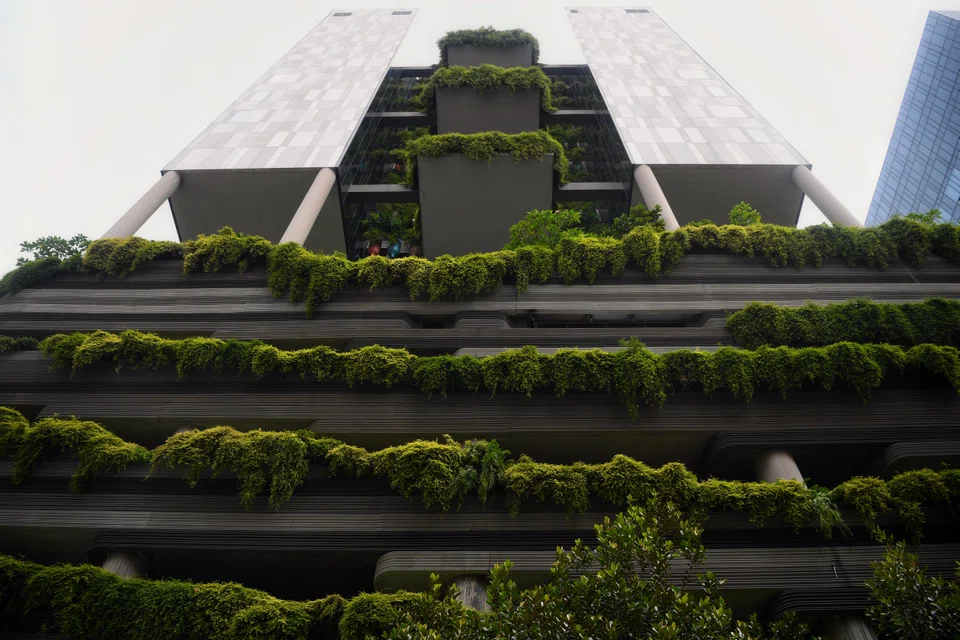
An example of such advances can be found at Parkroyal on Pickering, built by UOB’s sister company, UOL Group.
The hotel was built with Cobiax slabs, which are concrete slabs that contain recycled plastic.
The slabs are lighter, which supports increased productivity during construction. They also use less concrete without affecting the structural integrity of a building.
“All of these developments allow for the advancement of mitigation efforts – increasing energy efficiency of buildings as well as potentially reducing greenhouse gas emissions from the upstream value chain by reducing embodied carbon in building materials,” says Melissa Moi, head of sustainable business at UOB.
Besides helping companies save on money, time and manpower at the point of construction, green buildings can also generate better returns.





Regional governments are pushing companies towards better disclosures and environmental, social and governance (ESG) or sustainability reporting, says Wong.
This means developers, landlords and tenants alike are more concerned about their carbon footprint, and are more willing to pay a premium for environmentally friendly features.
“The growth in demand for a more sustainable building and a better workplace environment will drive the need for greater investments by the landlord to focus on reducing negative impacts on the environment,” Wong says.
In-demand sustainable features in the design and construction process include features to reduce energy, water and material consumption: employing energy-efficient equipment, and using renewable energy sources and eco-friendly materials during operations.
“When searching for new office space to lease, sophisticated and ESG-focused tenants are asking for sustainability features as a minimum requirement as part of their overall lease budgeting assessment,” Wong adds.
“Such features include green building certifications and prioritisation of resource conservation, such as energy and waste reduction.”
Moi believes the momentum in favour of green buildings will only strengthen.
“Sustainability-conscious individuals as employees and consumers will also increasingly demand sustainable work and retail environments. Energy inefficiency and wasteful consumption will increasingly not be tolerated,” she says.
Banking solutions for builders and building owners
As a bank committed to sustainability, UOB has rolled out multiple solutions to support companies in the built environment that want to build on the green trend.
“We are committed to supporting our clients in their decarbonisation journey – integrating our unique position in Asean focused on connectivity to support clients of all sizes, from large multinationals and corporates to small and medium enterprises,” says Moi.
“To this end, we have launched a suite of sustainable finance frameworks, ecosystem solutions to support easier access to sustainable financing, trade finance solutions to support greening value chains, and education and recognition tools to support our clients at every stage of the journey.”
Examples of such initiatives include:
UOB Transition Finance Framework – Helps companies in carbon-intensive, hard-to-abate sectors – project owners, contractors, suppliers, buyers and users – access financing for their energy transition plans.
U-Build – UOB’s sustainable financing programme for the built environment sector. Building owners can potentially enjoy zero upfront payments for retrofit projects. Clients can also tap U-Build partners that can offer advice on greening a building while improving returns.
UOB Sustainability Compass – A capacity-building tool for SMEs. SMEs complete a short questionnaire to receive a customised, step-by-step guide on how to set up sustainable business models and practices. They will also receive information on regulations, standards and certifications that affect their sectors, as well as sustainable financing solutions to take their businesses to the next stage of growth.
UOB FinLab’s The Greentech Accelerator – Supports high-growth greentech solution providers by connecting them to SMEs and corporates to solve problem statements in the areas of energy efficiency, zero-waste supply chains, and carbon management and reporting.
Accelerating the pace of change
Having committed to achieving net zero in financed emissions by 2050, UOB recognises it must partner clients and other stakeholders to create an enabling environment for decarbonisation.
“It is a whole-of-economy and ecosystem approach that must remain pragmatic in support of real economy decarbonisation,” Moi says.
Much still needs to be done for Singapore and the region to hit emissions targets, though, and government policy will play a big role in pushing companies in the right direction.
“Governments setting the right incentives, grants and penalties for failure to act can provide the carrots and sticks to drive a just transition approach and to encourage corporates to kickstart their sustainability journey,” Wong says.
He points to the Singapore Green Building Masterplan 2030 and its 80-80-80 target as a “great example of the government driving efforts towards a low carbon environment in the built environment sector”.
The 80-80-80 target intends for 80 per cent of Singapore’s buildings to be green, 80 per cent of new buildings to be super low energy, and best-in-class green buildings to see an 80 per cent improvement in energy efficiency over 2005 levels.
“Other hurdles for greater adoption are the awareness of the tangible benefits of adopting green buildings, how to calculate the payback period, the effect on rental yield and asset valuation, how to get started on the sustainability retrofitting journey, whom can building owners approach to select the right consultant or service providers, and the availability of financing schemes,” Wong adds.
Governments also need to foster an environment that supports innovation and technology development.
“This can help ensure we are able to maximise efficiency in buildings and materials for buildings,” Moi says, while adding that low-tech solutions such as efficient design should not be ignored.
Lowering carbon emissions is just one part of the picture, of course.
Moi says buildings must also be constructed or retrofitted with extreme weather resilience in mind, accounting for the likes of flooding and heat stress.
“There also needs to be consideration of nature and biodiversity-related dependencies and impacts across the entire built environment ecosystem,” she adds.
How developments impact flora and fauna, where we source materials, and the use of water in buildings – all are important considerations for building a better future.

Decoding Asia newsletter: your guide to navigating Asia in a new global order. Sign up here to get Decoding Asia newsletter. Delivered to your inbox. Free.
Share with us your feedback on BT's products and services