Global task force finalises framework for nature-related disclosures
Following feedback, guidelines’ authors strengthen requirements on at-risk locations, value chains and local stakeholders
A GLOBAL task force has finalised a framework for nature-related financial disclosures after strengthening requirements on ecologically sensitive locations, value chains and engagement with local stakeholders.
The framework, released on Tuesday (Sep 19) by the Taskforce on Nature-related Financial Disclosures (TNFD), lays out the ground rules that standard setters and companies can use to report on dependencies, impacts, risks and opportunities that pertain to ecosystems and biodiversity.
The task force comprises 40 senior executives from global corporates, including Singapore Exchange (SGX) head of sustainability and sustainable finance Herry Cho.
The final framework comes after a fourth public consultation process that began in March. With the feedback, TNFD firmed up three additional disclosure requirements that build on climate disclosure frameworks already in use:
- On governance, a description of the organisation’s human rights policies, engagement activities and oversight with respect to indigenous and local stakeholders;
- On strategy, a list of priority locations of assets and activities in the organisation’s direct – and where available, indirect – operations; and
- On risk and impact management, a description of processes for identifying, assessing and prioritising nature-related dependencies, impacts, risks and opportunities throughout the organisation’s value chain.
Latest tweaks to these requirements mean that companies must assess and prioritise nature-related matters, instead of merely identifying them. Corporates must also go beyond discussing nature-based indicators purely in the context of business, strategy and financial planning, to also consider impact on transition plans.
TNFD on Tuesday also issued guidance for financial institutions, which stated that they should describe standards and policies covering forestry, fisheries, palm oil or mining, if they impose limits or other due diligence standards on investment, lending or insurance activities around these.
The task force further proposed two core sector disclosure metrics to support the disclosure of their exposure to sectors with material nature-related dependencies and impacts, and exposure to sensitive locations. More specifically, banks should release their absolute amount or percentage of lending volume related to these exposures.
The guidance provided a list of priority sectors to consider. They include oil, gas and consumable fuels, construction materials, containers and packaging, metals and mining, paper and forest products, automobiles, food and beverage products, semiconductors and utilities.
Sensitive locations, it noted, are those where the assets and activities in an organisation’s operations interface with nature in areas important for biodiversity, and areas of high ecosystem integrity, rapid decline in ecosystem integrity, and high physical water risks. They also cover areas of importance for ecosystem service provision, including benefits to indigenous people and local stakeholders.
TNFD executive director Tony Goldner told reporters that an important aspect of the framework is that it includes disclosures about positive impacts.
“If we want to shift the flow of capital to potentially positive outcomes, we have to help businesses and investors see the positive impacts (that are) possible… Having less-negative impacts needs to be identified separately from positive impacts. We think this is really important from a transparency reporting perspective,” he said.
The inclusion of positive impact traits, in turn, “lights up” some of the transformation business models that people are getting excited about, such as the circular economy and regenerative agriculture, he added.
Addressing concerns about greenwashing, Goldner said the task force had sought an approach that is “robust in drawing on the best available science” and “practical to use”.
Speaking to The Business Times (BT) ahead of the framework’s release, Joe Phelan, executive director for Asia-Pacific at the World Business Council for Sustainable Development, said the food and agriculture, built environment, and energy sectors will be most impacted by the framework.
Pointing out that the systems supporting these industries account for 90 per cent of the pressure on biodiversity and nature globally, he said: “If you’re in those sectors, this is probably already a priority. And if it isn’t, then the scrutiny and accountability (are) going to increase.”
In the built environment sector, for instance, Phelan said nature-related disclosures could push developers to pursue more reuse and refurbishment projects, rather than new builds, as well as redevelop land that was already converted or cleared. He noted that companies might also be more discerning about building materials.
Phelan pointed out that food and agribusiness giant Olam Group and property group City Developments Ltd are Singapore-listed companies that have started looking into nature-based reporting. His organisation leads a consultation group tasked with gathering South-east Asian perspectives on TNFD’s beta framework.
As for the speed of adoption, Phelan said companies can expect the framework to make its way into compliance quicker than climate-related disclosures did, since jurisdictions and regulators are already familiar with the Task Force on Climate-Related Financial Disclosures (TCFD).
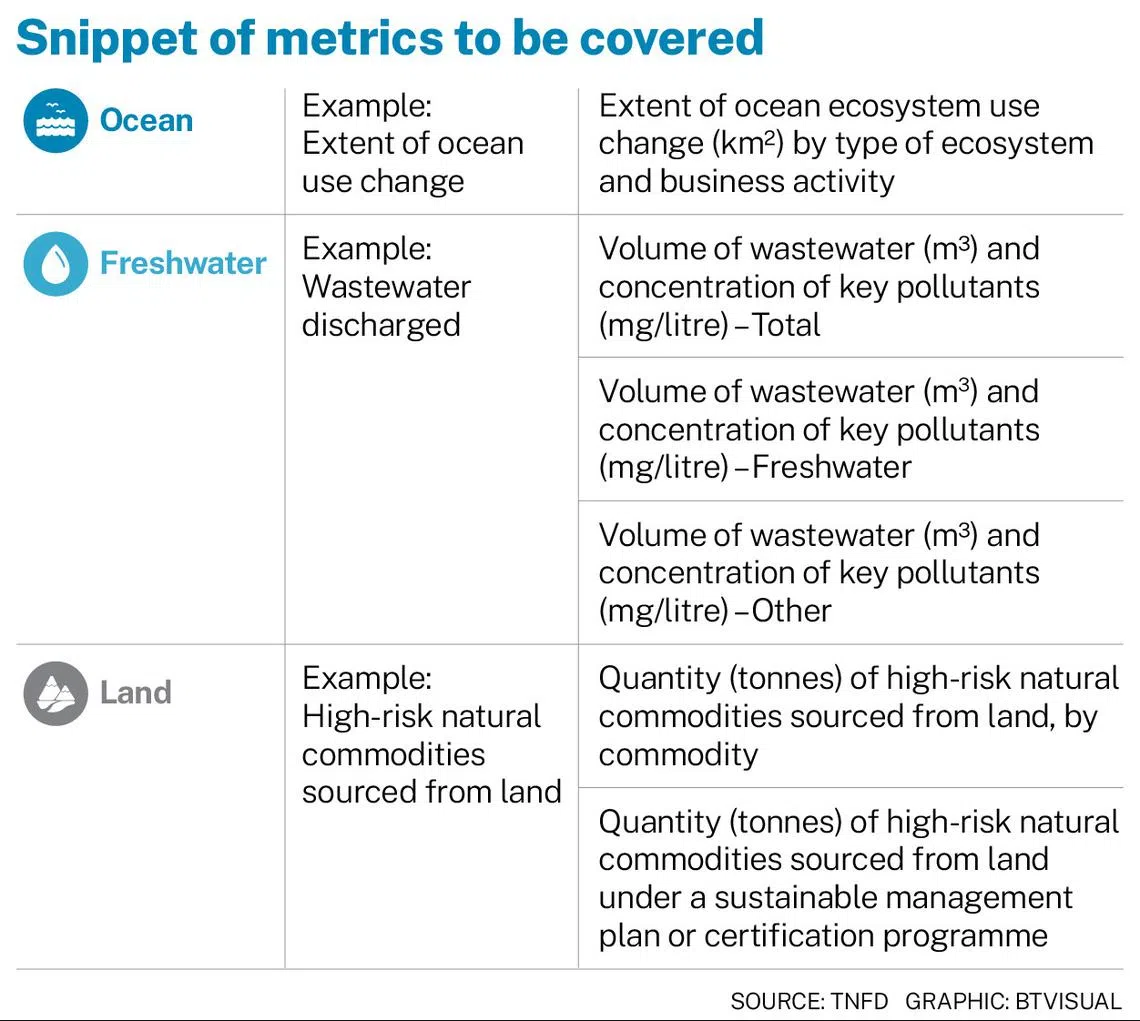
TNFD’s work builds on that of TCFD, which forms the backbone of companies’ climate reporting. Sustainability reporting requirements related to plastics in the oceanic food chain, loss of soil fertility, non-greenhouse gas air pollutants, waste and water use are understood to fall under the scope of the TNFD framework.
SGX declined to comment on its plans for now when BT asked if it would incorporate TNFD’s recommendations into listcos’ reporting requirements.
In a statement on Tuesday, TNFD said its initiative has drawn on the support and active input of market and non-market stakeholders from almost 60 countries around the world.
TNFD also said the recommendations are consistent with the global sustainability standards of the International Sustainability Standards Board and the impact materiality approach used by the Global Reporting Initiative. They have also been incorporated into the new European Sustainability Reporting Standards.
Following TCFD’s example, TNFD will also track voluntary market adoption on an annual basis through an annual status update report beginning in 2024, it said.
Companies that have announced their intentions to adopt the recommendations include British multinational pharmaceutical and biotechnology company GSK. The company said it will publish its first TNFD disclosures from 2026, based on 2025 data.
David Craig, TNFD’s co-chair and former chief executive of Refinitiv, said: “Nature loss is accelerating, and businesses today are inadequately accounting for nature-related dependencies, impacts, risks and opportunities.
“Nature risk is sitting in company cash flows and capital portfolios today. The costs of inaction are mounting quickly. Businesses and financial institutions now have the tools they need to take action.”