Integrity disclosures improve among South-east Asia listcos, but Singapore loses ground on regional leaders


ANTI-CORRUPTION disclosures among the largest listed companies in South-east Asia continued to improve in 2022, with Thailand and Malaysia extending their lead over the rest of the region, a business integrity study has found.
Dragged by a weaker performance in disclosures about external commitments to anti-corruption, Singapore’s overall performance remained in third place in the assessment, according to the study, which was released on Tuesday (Oct 11). The study was jointly carried out by the Securities Investor Association (Singapore) (Sias), the National University of Singapore’s (NUS) Centre for Governance and Sustainability (CGS) and the Asean CSR Network.
The study looked at public disclosures from the 50 largest companies by market capitalisation as at end-June on each of the stock exchanges of Indonesia, Malaysia, Philippines, Singapore and Thailand. The disclosures were assessed on three categories, comprising how well they demonstrated each company’s internal and external commitments to anti-corruption, and the reporting and monitoring of business integrity issues such as whistleblowing.
The overall average disclosure level for the five countries in the region improved to 69 per cent from 63 per cent in 2020, when the study was last conducted.
“I believe it is due to the broader setting of these countries,” CGS director Professor Lawrence Loh told The Business Times. “Sometimes when there are more concerns on anti-corruption, companies take more effort to disclose. It’s an irony.”
Thailand displaced Malaysia to come out tops in terms of overall disclosures, booking the largest increase to hit 83 per cent in 2022 from 71 per cent in 2020. The country also attained the highest levels of disclosures in all three categories.
Malaysia, which was the top performer in 2020, came in second in 2022, with overall disclosures up to 81 per cent from 74 per cent.
Singapore retained the third spot, with overall disclosures rising to 69 per cent in 2022 from 64 per cent in 2020. Singapore’s overall score was weighed down by its performance on external commitments to anti-corruption, which was rated 53 per cent, below the regional average of 56 per cent. Singapore also fared the worst in terms of the level of disclosures about whether codes of conduct or anti-corruption policies explicitly applied to all employees and directors. Prof Loh explained that this could be due to Singapore companies not clearly disclosing such practices even if they were in place.
Singapore also booked a “significant decrease” in terms of disclosures for policies on gifts, hospitality and expenses.
SEE ALSO


Indonesia was the only country where its overall score fell, to 44 per cent from 52 per cent. The study attributed the decline in Indonesia’s score to low levels of disclosure about internal commitments and about reporting and monitoring.
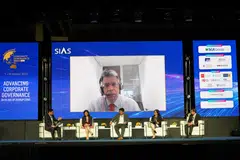
In a panel discussion to discuss the study’s findings on Tuesday, Prof Loh said that one thing for investors to bear in mind is the reliability of information that companies disclose.
He said it is in the nature of companies to “always put their best foot forward”, but he warned that some companies could misrepresent information, or provide fake or fraudulent information.
Prof Loh noted that retail investors, in particular, rely heavily on information provided by companies as they typically do not have access to the resources that institutional investors do.
But copious amounts of data is not necessarily a good thing, he stressed. Rather than putting up “piecemeal” disclosures, companies should focus on purposeful information that is accurate and helpful for investors.
Lam Chee Kin, head of legal and compliance at DBS, added that there needs to be some consensus around the “definitions of standards” across companies for disclosures.
Lam suggested converging ESG (environmental, social and governance) data, an area that has “quite heavy” information on the likes of financial crime and bribery, with corruption disclosures. This is one move that could cut the legwork for companies, and help to eliminate “redundancies” for investors.
Decoding Asia newsletter: your guide to navigating Asia in a new global order. Sign up here to get Decoding Asia newsletter. Delivered to your inbox. Free.
Copyright SPH Media. All rights reserved.