Policies, attitudes must change if Singapore is to have an equitable corporate society


THE contribution of women to the corporate world – in particular, its upper echelons – has grown. But, if we, as a society, were to pat ourselves on the back for having reached this stage, and stop there, we’d be doing ourselves a grave disservice.
Female participation in these positions is still short of levels one would expect in a market as developed as ours; and, issues such as gender pay disparity and inequitable labour policies remain.
We need changes that will influence attitudes and approaches – with the end goal being not just support and encouragement for women on their journey, but also equity on a broader scale.
Where we are
Recent data has been encouraging. Research, published in appreciation of International Women’s Day on Mar 8, shows the participation of women on boards, and in senior management and leadership positions, has increased.
But the research also says that the proportion of women in these positions is much smaller than that entering the workforce. Fewer women rise through the ranks.
In Singapore, for example, women’s participation on the boards of the 100 largest listed companies rose to 21.5 per cent at the end of 2022 – up from 18.9 per cent at end-2021 and 15.2 per cent at end-2018. For the broader pool of all Singapore-listed companies, women’s participation on boards improved to 14.6 per cent at end-2022 – from 13.5 per cent a year earlier.
This is according to latest figures compiled and published last week by the Council for Board Diversity (CBD) in Singapore.
The increase sounds encouraging, until one also considers the number of women coming through the workforce. CBD’s data showed women make up 49 per cent of all university graduates, but only 33 per cent of senior management positions and the aforementioned 21.5 per cent of board seats.
Such dips are seen elsewhere – even in markets that have mandated gender diversity on boards, such as Norway.
Women are also still earning less than men.
A BofA Global Securities report, published on Monday (Mar 6), said females in Asia earn 83 cents to every dollar that males earn, on average, in Asia.
The Philippines, New Zealand and Malaysia exhibit the smallest gender pay disparity in the region, while India, South Korea and China have the greatest. Singapore is just ahead of the regional average.
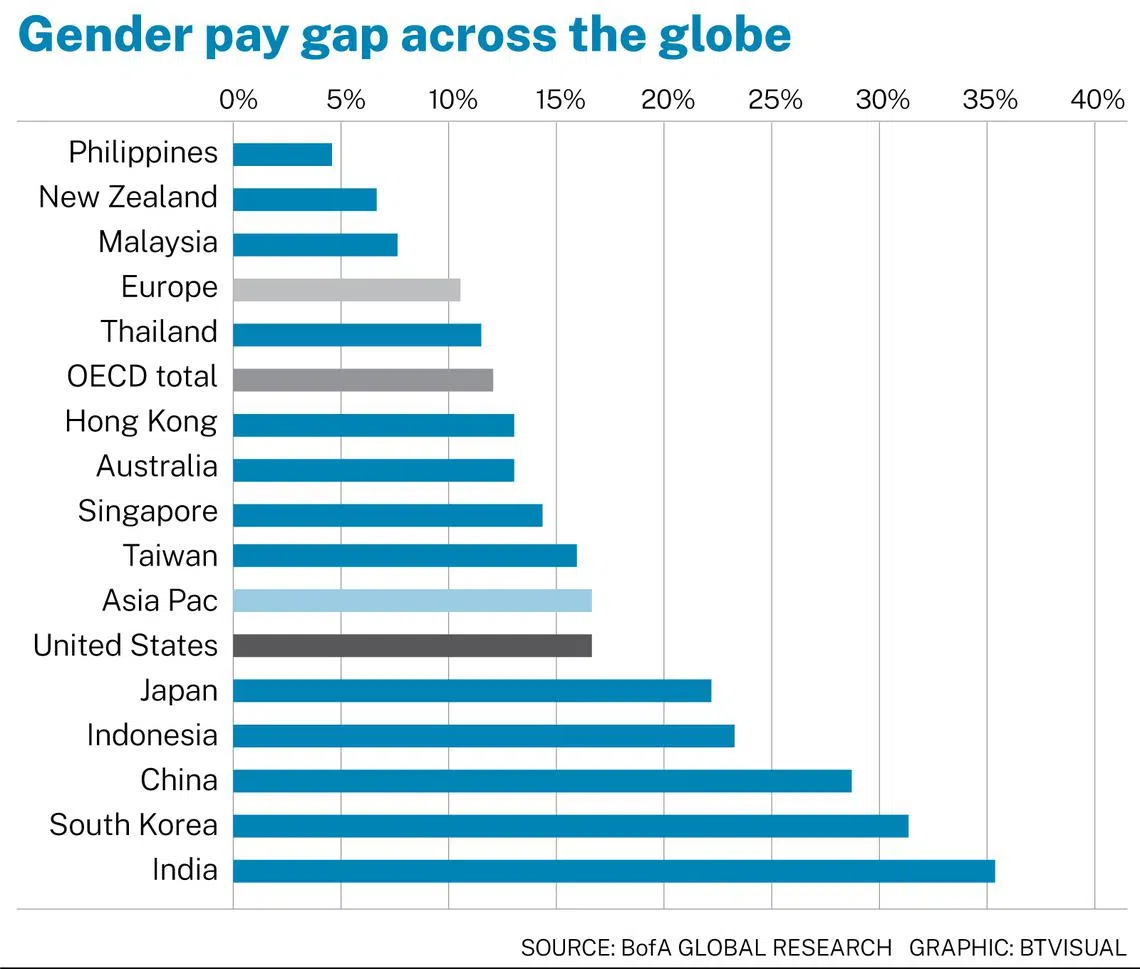
Asia is on par with the United States in terms of gender pay gap progress. But it lags Europe, and is also behind the average for OECD (Organisation for Economic Co-operation and Development) nations.
Even more concerning is the limited disclosure of such information in Asia. BofA’s report said that 79 per cent of corporates report gender diversity on their boards, but less than 13 per cent report pay by gender. This compares with 35 per cent in Europe and almost 20 per cent in the US.
Only 24 per cent of companies in Asia disclose information on the gender diversity of their management teams.
This lack of transparency obscures the market’s understanding of the situation, as well as its ability to act or vote on such matters to effect change.
What we need to do
The work put in to bring about the changes we have seen is laudable, but we need to build on these developments.
Companies need to be creative and innovative in enticing the best talent. This should not be a stretch for many that have already been compelled to do so by the recent pandemic, which has changed the work expectations of many – especially the young.
That same creativity is needed to keep and nurture talent. Employees have to be given opportunities to succeed and grow. This should be so even for those who choose less traditional paths, who want greater work-life balance or flexibility.
The public and private sectors ought to come together to ensure labour policies – whether pay, leave, rewards and so on – are equitable across demographic groups.
A case in point is parenting leave. Women in Singapore are given up to four months’ maternity leave, while men are given two weeks. This creates a massive imbalance in terms of how employers view these two demographic groups, and sets up biases that will persist through parenthood.
Some would argue there are parenting tasks that are unique to women and can only be fulfilled by them. But I would argue that the overall responsibility of parenting can be split equitably, with this decision left to the parents themselves. Companies could consider dividing total leave entitlement equally between father and mother, while offering the flexibility to tweak the apportionment according to their needs.
At the board level – and this has been said time and again, but bears repeating – organisations must work harder and cast their nets wider to find suitable directors. They need to stop relying only on word-of-mouth recommendations or picking “diverse” candidates merely to tick that box. They need to make a concerted effort to look for the best complement of directors they can.
Boards also need to track the success of such appointments. Few boards, if any, measure how a particular complement of directors adds to performance. Effort needs to be made to monitor how board discussions and interactions are either enriched or impoverished by the personalities on it.
Above all, these policies and approaches should be well-disclosed – not so much that organisations can be judged, but so that the broader society can learn from their examples.