How sustainability can modernise rice farming
Olam Agri’s Better Rice Initiative Asia focuses on reduced reliance on chemical inputs and more efficient water management

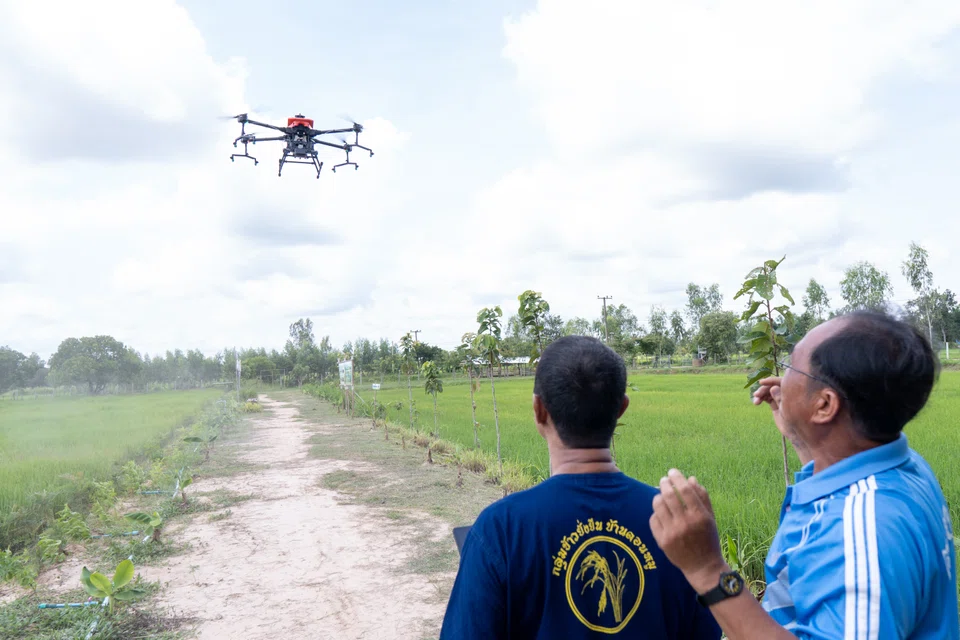
[SINGAPORE] Thai farmer Khun Thanu has two new “employees” – a drone and a direct-seeding machine.
The drone can apply fertiliser to plants in minutes, not only saving hours of work for the 57-year-old, but also reducing damage to crops.
Meanwhile, the direct-seeding machine speeds up the planting process and eliminates the need for heavy flooding, which is traditionally done for rice crops to control the growth of weeds. As a result, Thanu’s seed usage per rai – a land measurement unit in Thailand – has been reduced from about 10 kg to just 3.5 kg.
Besides being environmentally friendly, these methods have helped the farmer to lower his costs. He has doubled his yield to three tonnes per hectare and earns a net profit of 140,000 baht (S$5,550) annually. This amount is higher than the local average of around 100,000 baht, a 2024 report by agribusiness Olam showed.
Thanu, based in Ubon Ratchathani province, is among more than 20,000 farmers – as at end-2024 – in the country working with Olam Agri on an initiative to promote sustainable growth in the rice industry.
The Better Rice Initiative Asia has been active in Thailand since 2016. It expanded to other countries, such as Vietnam, through the Market Oriented Smallholder Value Chain programme – a sustainable rice project that 10,000 farmers have joined between 2019 and 2022.
“Through the partnership, we have been able to adopt more advanced techniques that have transformed our farming practices,” said Thanu through a translator, citing the shift to the Sustainable Rice Platform standards as a notable change.
These standards focus on “reducing our reliance on chemical inputs and managing water more efficiently, by using alternate wetting and drying (AWD) techniques. These help to lower our operating costs and increase market demand for the rice we produce”, the farmer added.
Olam Agri vice-president Paul Nicholson said that although rice is a staple food for half of the world’s population – Singapore imported US$288.8 million worth of the crop in 2023, amounting to more than 411 million kg, according to World Bank data – it is also one of the largest greenhouse gas emitters in the agriculture sector.
United Nations data from 2021 showed that methane from livestock rearing and rice cultivation accounted for 35 per cent of food-system greenhouse gas emissions. But Nicholson pointed out that the AWD technique can reduce the amount of methane emitted into the atmosphere.
Of course, more natural methods such as “employing” ducks to eliminate pests such as apple snails can also be utilised. By trampling rice stubble – what is left after the rice has been harvested – and fertilising the soil with their manure as they wade through the fields, these animals reduce the need for fertilisers by up to 30 per cent, based on the 2024 data by the company.
With a presence across key rice producer markets and the means to reach more than 45,000 smallholder rice farmers, Olam Agri recognised the importance of aligning sustainable practices with farmer profitability across the value chain.
The company engages farmers in upskilling, moving them up tiers in programmes such as the Inclusive Sustainable Rice Landscapes in Thailand (ISRL). The project partners include German development agency GIZ, Thailand’s Rice Department and Ministry of Agriculture and Cooperatives, and Vietnam’s Ministry of Agriculture and Rural Development.
On its website, GIZ says that the ISRL seeks to transform the rice sector into a sustainable agricultural system. Through collaborations between government agencies, the private sector, research institutes and farmers, the project advances an integrated landscape management approach, with the aim of moving away from conventional rice farming systems to more environmentally resilient production methods.
Olam’s Nicholson said the initiative traces its roots back to 2004 in Nigeria.
“By helping farmers grow more on the same land – like how Olam Agri supports rice farmers with better seeds, climate-smart agriculture, and sustainable rice farming programmes – we don’t need to source from a wider area, because the current plots are managed and used efficiently,” he said.
“This keeps our supply chain more efficient and responsive to customer needs, while ensuring farmers benefit from higher productivity.”
He added that meeting customer needs can include moving with changing market demands for rice types such as long-grain white, jasmine (or hom mali), parboiled, medium grain, and broken.
Surplus and diversity
Recent events have also brought home the importance of such a project. For example, in July 2023, the Indian government banned exports of non-basmati white rice. The restriction was lifted just last October.
Such bans were in place because countries were facing inflationary effects from production deficits, so their surpluses were declining, said Nicholson. In addition, there was just too much demand from the global market.
“So, we’re hoping that by engaging in sustainability, we maintain surplus production,” he added.
Through education, farmers such as Thanu are diversifying their crop rotations – in turn increasing soil fertility and productivity.
Beyond rice, Thanu has started growing crops such as lime, mangoes and guava as well. “These ventures provide steady income, especially when weather or market prices are unpredictable,” he said.
Nicholson highlighted the importance of speaking to farmers on a personal level to get them on board the programme. Using ESG – environmental, social and governance – terms can make the initiative more difficult to understand, and “it becomes a different conversation”.
Therefore, “we explain to them the personal impact on their lives, like the cost savings or the improvements in their own health and safety – so they’re around longer to enjoy their families”, he added.
Among the metrics for determining the success of the programme is whether the volume of water used goes down.
“We’ve seen that water can be reduced by about 30 to 40 per cent if we bring in modern irrigation… and even more – about 80 per cent – when we work with certain irrigation groups,” said Nicholson.
Testing water quality is another method. “We want the water quality improving with time, and that’s something you see with (fewer chemicals), especially less fertiliser,” he said.
Besides seeing improvements in the quality of his crops, Thanu noted a renewed interest among the younger generation in farming – especially as it becomes more innovative and lucrative.
Modern tools and techniques, such as drones and automated machinery, make the work less labour-intensive and more appealing.
Plus, programmes that highlight sustainability and profitability – such as the partnership with Olam Agri – show that farming can be a viable career in the years to come.
Thanu said: “Young farmers here are starting to lease land from their families and managing larger-scale operations efficiently. With more initiatives emphasising sustainable practices, the younger generation sees farming not only as a way to earn, but also as a meaningful contribution to environmental conservation and boosting food security in the region.”