Issue 145: South-east Asia’s sunburn; favourable market greets Singapore green bond auction

This week in ESG: US unveils solar tariffs on Cambodia, Malaysia, Thailand and Vietnam; Singapore to offer S$1.8 billion of 30-year green bonds
Renewable energy
Ain’t no sunshine when tariffs come
Newly announced US tariffs on solar imports from four South-east Asian countries will hit exporters there, but could bring short-term benefits for solar buyers elsewhere in the world.
The US has set tariffs from 34 per cent to as high as 3,521 per cent on solar imports from Cambodia, Malaysia, Thailand and Vietnam. The duties are aimed at offsetting what the US deems to be unfair subsidies provided to these countries’ solar manufacturers, which allow them to undercut US solar manufacturers.
The tariffs could have a wide-reaching impact, although not everyone will feel it the same way.
There’s no real silver lining for the solar exporters in Cambodia, Malaysia, Thailand and Vietnam, who sold about US$12.9 billion of solar equipment to the US in 2024, accounting for almost four-fifths of US solar module imports, according to BloombergNEF.
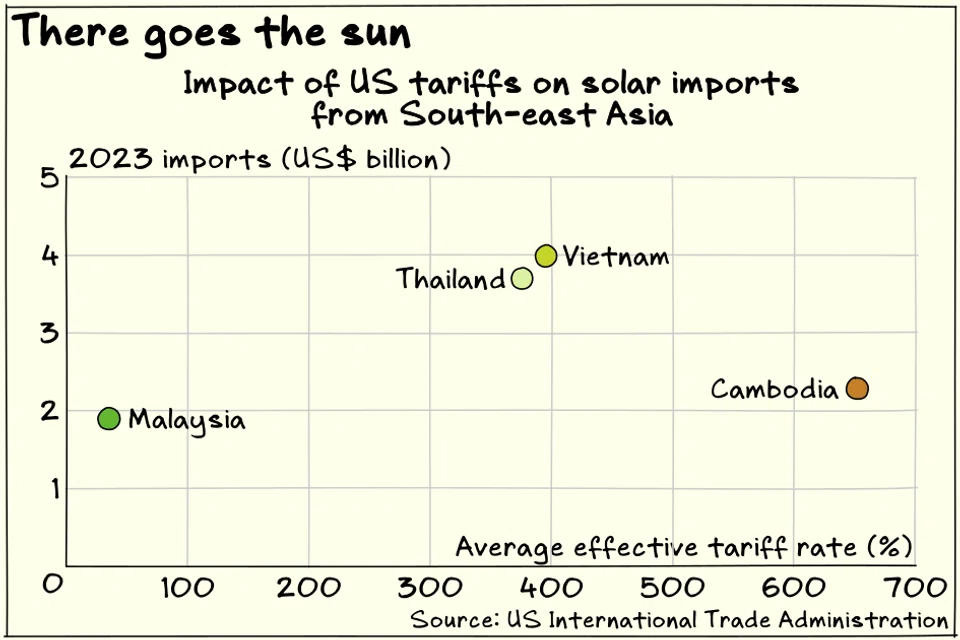
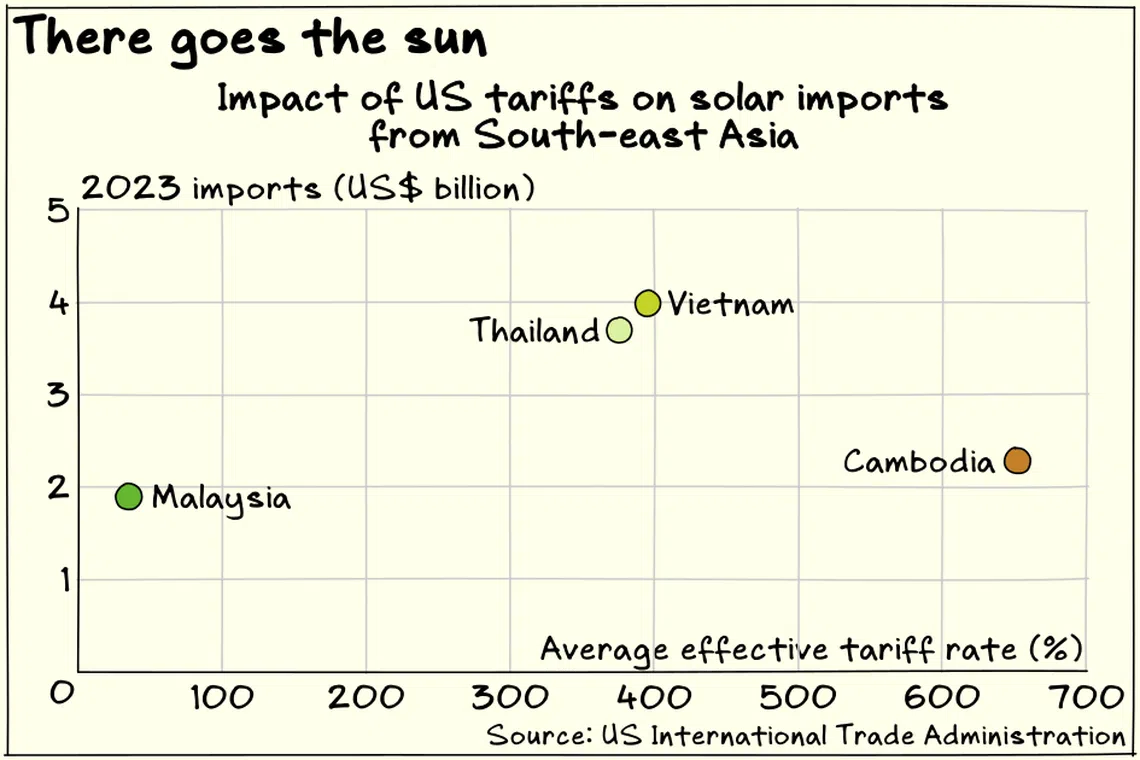
Malaysia’s countrywide base rate is the lowest at 34.4 per cent, while Thailand and Vietnam face country-level tariff rates of more than 375 per cent. Cambodia’s country tariff is the highest at 652 per cent, a result of the country declining to take part in US investigations. Specific firms within those countries could face higher tariffs.
While the level at which the tariffs were set has raised eyebrows, the decision to impose the penalties did not come as a surprise. The Biden administration began investigating solar pricing and subsidies from these countries a year ago, and the industry has already anticipated some form of tariffs.
Comments from industry players and analysts suggest that some manufacturing has already begun to shift out of those countries. This means that even if the affected countries’ solar sectors can find non-US buyers for their products, the amount of production and investment taking place there may already be on the decline.
While finding non-US buyers is possible in theory, it won’t be easy to replace US demand. The four countries exported about 37 gigawatts (GW) of solar capacity to the US in 2023, according to US trade figures. The International Energy Agency estimated in 2024 that the US could grow its capacity by 500 GW by 2030, behind only China and the European Union.
That projection was made before the Trump administration dismantled key US renewables policies, which means that actual global solar demand will probably be lower than expected in any case.
The US findings that led to the tariffs could also lead to similar penalties by other countries that want to protect their domestic solar manufacturers. In 2012, the US announced solar tariffs on China over similar issues – tariffs that eventually led to Chinese manufacturers shifting production to South-east Asia. A year later, the European Union pursued a similar strategy.
A trade deal could yet be struck. For example, both sides could agree on minimum prices for solar equipment. But while a minimum price could improve profitability for the manufacturers, it could hurt margins.
In the meantime, South-east Asian solar manufacturers will need to look elsewhere to sell their products. That supply dynamic could nudge prices favourably for buyers outside of the US in the short term. This could be positive for the energy transition in developing Asia, where the cost of decarbonisation can stretch budgets.
In the medium to long term, solar manufacturers – like all good manufacturers – will find ways to evade the tariffs if there’s enough demand in the US. It’s the same drive that sent the solar supply chain through South-east Asia over the same decade, although this time it probably means capital flowing out of the four countries.
What could be of greater concern for the solar industry as a whole is the direction of solar demand under the Trump administration, which is likely to pursue policies that support fossil fuels and discourage renewable energy.
Sustainable finance
To market, to market to reopen a green bond
Singapore will come to the market again with a S$1.8 billion reopening of its 30-year green bonds through an auction that could lower the nation’s blended cost of financing its long-term decarbonisation strategy.
The Monetary Authority of Singapore announced this week that it will reopen the 3.25 per cent Green Singapore Government Securities (Infrastructure) due 2054 via an auction on Apr 28.
The current S$2.5 billion outstanding principal amount of the bonds was sold a year ago at a yield of 3.3 per cent. The bonds currently trade at a yield of about 2.7 per cent. If the new bonds are priced at that level, the blended yield that Singapore will be paying for this series of bonds will be about 3.05 per cent.
Singapore has sold about S$9.2 billion of sovereign green bonds so far, including about S$6.7 billion of 50-year bonds. The new offering will take that total to S$11 billion. The blended yield on the completed sovereign green bond deals so far is about 3.04 per cent, and the new offering could lower that to about 2.99 per cent at the current market price.
Those are remarkably low yields to pay for 30 and 50 years. They help Singapore reduce the costs of building green infrastructure, including mass rapid transit lines, and in turn allow the country to be more ambitious on decarbonisation.
The low yields largely reflect the strength of Singapore’s balance sheet, but also some fortunate market dynamics.
A low-rate environment pushes investors towards the higher yields offered by longer maturities. It has been noted that the Singapore yield curve is now the steepest in about three years, which means that long-dated bonds like the ones coming up offer relatively more attractive yields for investors than shorter-dated ones. The expectation is that this could drive strong demand from yield-hungry investors in the coming auction.
The current economic turmoil created by US tariffs has also pushed investors towards safe havens like Singapore sovereign debt.
Taken together, expectations are high for the coming auction.
Other ESG reads
- Greater Asean integration could prevent tariff-induced slowdown in energy transition: observers
- Why sustainable equity investors should pay attention to Singapore
- US imposes new duties on solar imports from South-east Asia
- CDL’s AGM: Minority support for five IDs seeking re-election a litmus test of governance perceptions
- World leaders from China to EU hold climate meeting without US
- Don’t panic, planet earth is better off than we think