

Issue 57: Temasek’s emissions problem is Singapore’s emissions problem; Asia’s protein transition

In this issue: Divestment of some carbon-intensive portfolio companies is not an option for Temasek, while Asia’s decarbonisation diet must cut down on meat.
Singapore
Temasek, Singapore joined at hip for climate goals
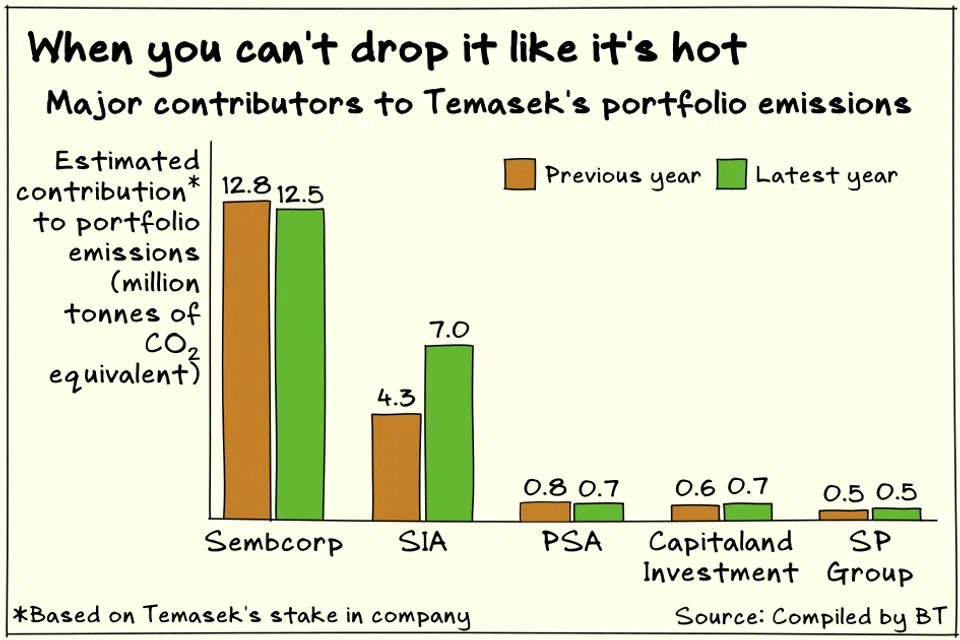
Singapore state-owned investor Temasek’s total portfolio emissions rose slightly to 27 million tonnes of carbon dioxide equivalent for the year ended March 2023, from 26 million tonnes the previous year.
The main culprit? Singapore Airlines (SIA), which saw group passenger capacity recover to 79 per cent of pre-pandemic levels as global air travel restarted.
Speaking to reporters, Temasek chief executive Dilhan Pillay said much of Temasek’s ability to hit its decarbonisation targets hinges on the national airline’s success in reducing its carbon footprint. Temasek aims to halve its greenhouse gas emissions from 2010 levels by 2030, and to achieve net zero emissions by 2050.
Indeed, SIA is a particularly challenging portfolio company for Temasek from a climate perspective because of how difficult it is for an airline to achieve net zero.
SIA has been renewing its aircraft to operate a more fuel-efficient fleet, but that strategy is far too limited to take the airline to net zero. SIA already operates one of the youngest fleets globally with an average aircraft age of six years and nine months, much younger than the worldwide average of 15 years and eight months. Yet, SIA’s fiscal 2023 Scope 1 and 2 emissions jumped 64 per cent as air travel resumed. Scope 1 emissions are directly caused by SIA’s operations, including fuel used in its aircraft. Scope 2 emissions are produced through SIA’s power consumption.
Getting to net zero will ultimately require SIA to switch to sustainable aviation fuel (SAF). SAF, however, is still prohibitively expensive for airlines to be willing to switch of their own accord. The Sustainable Markets Initiative estimates that SAF is still about two to nine times the price of fossil fuel-based jet fuel.
But perhaps the bigger obstacle for Temasek isn’t so much that SIA and its decarbonisation challenges sit in the portfolio, but that they can’t be removed from the portfolio.
Most asset managers have a rather simple solution to decarbonising their portfolios by 2050. Whatever can’t be decarbonised when the deadline begins to approach can simply be sold. Disposal immediately removes the problematic company and its emissions from the portfolio. Easy peasy.
Temasek, however, has said it does not believe in divesting or excluding carbon-intensive companies, and would prefer to work with them to decarbonise.
What is unsaid is that there are some companies in Temasek’s portfolio that have strategic value to Singapore, and selling is not an option. Those companies were placed under Temasek’s umbrella to ensure not only that they are run on sound commercial principles, but also that the Singapore government could maintain some control over them. So, no, Temasek can’t sell the national airline, or the national port operator, or the national telco, or the national zoo just to decarbonise its portfolio.
A look through the sustainability reports of some of these companies shows SIA is among the largest contributors to Temasek’s portfolio emissions. But Sembcorp Industries is the largest, along with other companies that came from the industrials and maritime complex, such as PSA International, Keppel Corp and Seatrium. Property giant Capitaland Investment is also a major source of portfolio emissions, as is public transport provider SMRT Corp.
While SIA could well have the toughest decarbonisation journey ahead, it is not the only one facing challenges. Capitaland and SMRT’s latest set of combined Scope 1 and 2 emissions also showed increases over the previous year.
Given the instrumental role many of those Temasek portfolio companies play in Singapore’s economy, Temasek’s decarbonisation journey could well be tied to that of Singapore as a country. It would be extremely difficult for Temasek to hit its targets if Singapore misses its national goals, and vice versa. It seems that when it comes to greenhouse gas emissions, as the country goes, so goes Temasek.
Other Singapore reads
- SGX listcos make limited progress on climate disclosures: EY, CPA report
- Seatrium secures 720 million euro green trade finance facility from OCBC
South-east Asia
Alternative ways to meat climate goals
Come on, tofu, show us what you’ve got. A fresh study by sustainability-focused consultancy Asia Research and Engagement has suggested that Asia will not be able to reach net zero by 2050 without a significant shift away from meat, towards alternative proteins.
The study figured this out by looking at “best-case” scenarios in which the region’s largest meat-consuming markets are able to green their protein supply chains. This means meat production is able to achieve zero deforestation and limit industrial production well before 2050. The study found the emissions reduction under these best-case scenarios would not be enough to close the gap between business-as-usual and a pathway consistent with limiting global warming to 1.5 deg C above pre-industrial levels.
That leftover gap must therefore be addressed by switching to alternative proteins, the study argued.
Significant investment therefore needs to be made in alternative protein solutions for the region to improve adoption rates.
Other South-east Asia reads
- LeapFrog plans US$500 million investment in Asian, African climate transition firms
- Asia’s co-firing ambitions may produce more carbon emissions
Other good reads
TRENDING NOW

Singapore identifies 7 firms responsible for haze fires, notices issued urging action: Grace Fu

Philippine power giant First Gen rebuffs foreign offers, plans up to US$2.6 billion in expansion
DBS remains analysts’ pick ahead of Q3 earnings after Singapore banks’ share slump

Indonesia imposes US$116 million in fines over manipulation of Sinar Mas, Prajogo-linked stocks

