

Issue 65: Hot and bothered with the Global Stocktake; Singapore gives palm oil thumbs up for jet fuel

In this issue: The first progress review on the Paris Agreement will show that the world is far behind on its climate goals, while Singapore backs the use of palm oil for sustainable aviation fuel.
Run-up to COP28
So far, not good
When world leaders meet in Dubai in November for the annual United Nations Climate Summit (COP28), they will have to confront the first comprehensive progress review of the landmark 2015 Paris Agreement.
Known as the Global Stocktake, the review is intended to facilitate “updating and enhancing” countries’ actions and support on climate action. That language – part of Article 14 of the Paris Agreement – importantly obliges signatories to consider whether they are doing enough to address climate change.
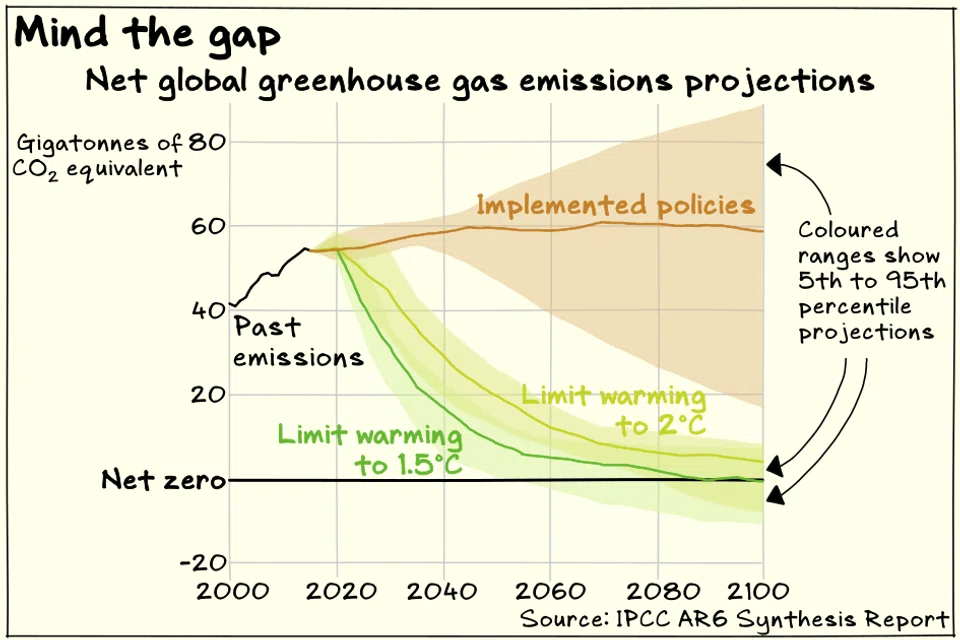
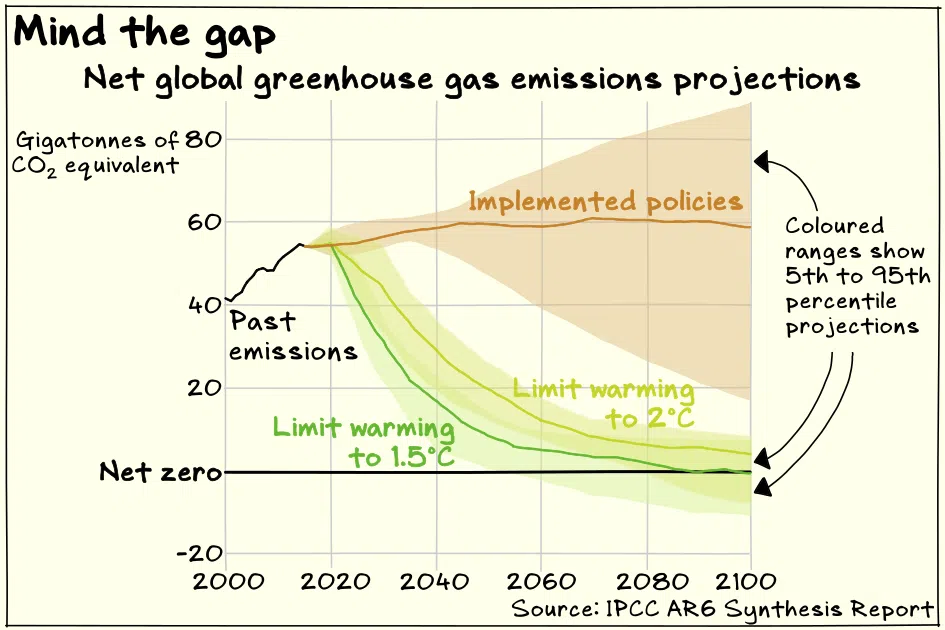
The answer to that question is actually already known and, unfortunately, the answer is no. The United Nations’ 2022 Emissions Gap Report found that the world is currently on track for temperatures to rise between 2.4 and 2.6 degrees Celsius against pre-Industrial levels based on existing policies. This is significantly above the scientifically agreed thresholds of 1.5 and 2 deg C beyond which the effects of climate change might be catastrophic.
What is not known is how the countries at COP will respond. Some issues that are likely to come into play are:
- Urgent action still needed: Global warming accumulates and accelerates, which means intervention is more effective if it happens earlier. It also implies, however, that early inaction is costlier to rectify later.
- Need for rapid decarbonisation: It is not enough for governments and businesses to act early. They also have to do more. This could mean adjusting targets and policies to be more ambitious.
- Higher risk of ‘hot house’ scenario: The Network for Greening the Financial System has outlined four possible climate change scenarios based on a matrix of transition risks on one axis and physical risks on the other. Current global policies have the world headed for a hot house future, in which global policies are inadequate (low transition risk) and temperatures exceed critical thresholds (high physical risk). This scenario calls for significantly more investments into adaptation measures, as opposed to mitigation projects. Unfortunately, adaptation investments and financing are far behind what’s being spent on mitigation efforts.
- Higher risk of ‘disorderly’ and ‘too little, too late’ scenarios: Policymakers might respond by implementing policies that are more aggressive to attempt to avert the hot house future; but that would raise transition risk. If the policies work, we could be headed for a disorderly world in which warming is limited but transition costs are high. If the policies don’t work, we could be looking at a world in which costs are high but warming comes anyway – or too little, too late. Either way, disruption from transition efforts will increase significantly. This could manifest in the form of higher carbon taxes, higher inflation and higher risk of stranded assets, among others.
- Louder calls for a just transition: The prospect of higher costs will probably be accompanied by many discussions about how to make the transition “just”, which at its core is about mitigating the social impact of decarbonisation. In the hands of politicians, businesses and investors, social justice has been distilled into money – and everybody wants lots of that. The Just Energy Transition Partnership (JETP) coal phase-out programme for Indonesia has therefore been delayed amid unresolved questions surrounding who pays what, and how much.
Other Run-up to COP28 reads
- Leading investor-focused groups call for ‘urgent course correction’ in climate policy
- World losing race to meet climate goals, COP28 president says
Singapore & South-east Asia
Thumbs up or down for palm oil in jet fuel?
Show of hands: Should sustainable aviation fuel (SAF) allow palm oil to be used as a feedstock? The answer to that question appears to largely depend on which part of the world you call home.
Singapore has joined the pro-palm oil camp, with Acting Transport Minister Chee Hong Tat urging “a pragmatic approach based on science and evidence, instead of an ideological approach based on pre-conceived bias and dogma”.
That would put Singapore – and its South-east Asian neighbours – at odds with Europe, where palm oil-derived SAF isn’t kosher.
The opponents of palm oil argue that allowing its use as a feedstock will enable and support unsustainable agricultural practices, which has long been a criticism of the oil palm industry.
On the other hand, supporters of palm oil as a feedstock point out that there’s a shortage of feedstock for biofuel-based SAF and palm oil, if responsibly sourced, can help to ease that bottleneck. SAF is already significantly higher priced than traditional aviation fuel; and unless the industry can bring down its price, widespread uptake will remain elusive.
Regardless of the arguments for or against, the palm oil issue threatens to split the SAF market and raise compliance issues for aircraft operators. With SAF adoption still hitting obstacles, this is not a helpful situation for the industry.
Other South-east Asia reads
- Be first mover or ‘a very good No 2’? Keppel Infrastructure MD on why hydrogen projects face impasse
- Climate Impact X to launch price benchmarking contracts for cookstove projects






