Issue 66: Singapore’s electricity imports still far from assured; apparel makers underestimate climate risk

In this issue: Many more steps are needed before Singapore’s conditional approvals for electricity import projects become operational, while floods and heat could hit apparel hubs with billions in losses.
Singapore
Baby, it ain’t over ’til it’s over
There are many sayings that are meant to temper the fervent optimists among us, to pour cold water on undercooked celebrations as Lenny Kravitz’s It Ain’t Over ’til It’s Over plays in the background.
Don’t count your chickens before they hatch, as they say. It ain’t over till the fat lady sings. Saying you’re three-quarters of the way to your low-carbon electricity import targets might be premature when you’ve only given conditional approvals, the transmission cables haven’t even been laid yet and actual production is still years away.
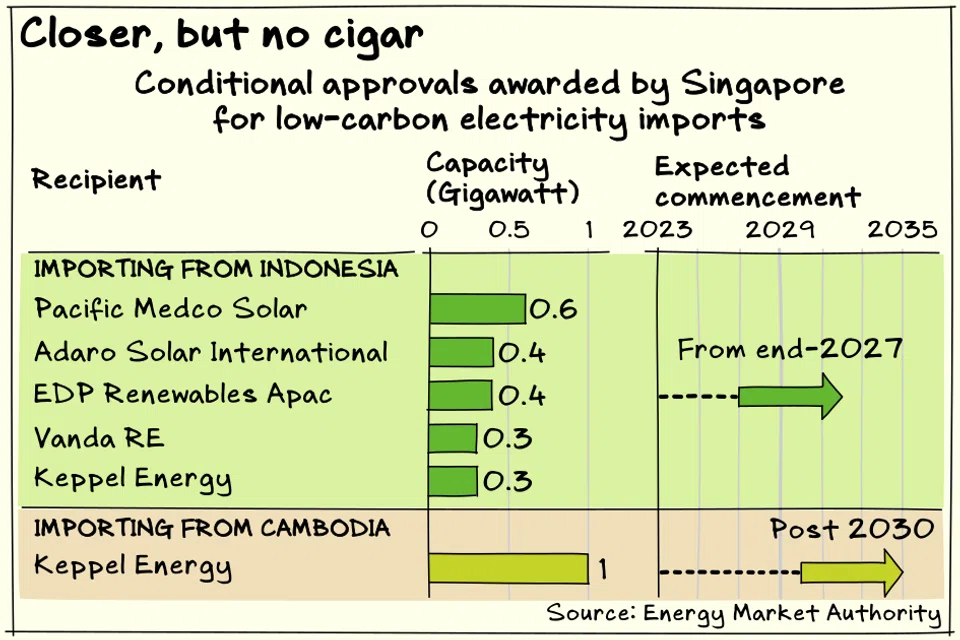
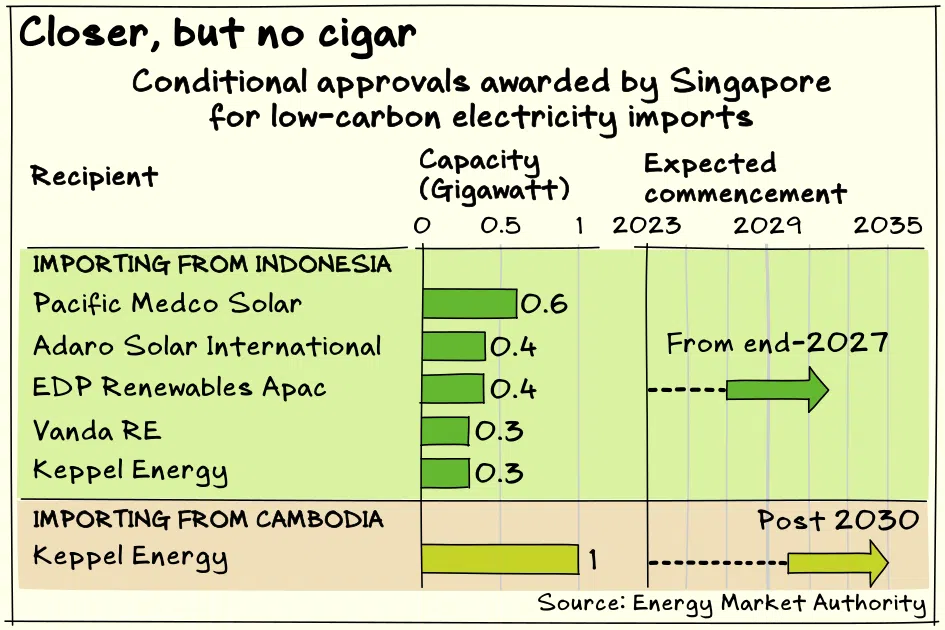
Maybe that last adage is rarely used, but it’s definitely useful in digesting the latest announcement by Singapore’s Energy Market Authority (EMA). On Sep 8, EMA said it had awarded conditional approvals to five projects to import 2 Gigawatts (GW) of low-carbon electricity from Indonesia to Singapore. The headline of the announcement proclaimed: “Singapore now 1 GW away from meeting target of importing 4 GW of low-carbon electricity by 2035”.
It’s true that Singapore has given conditional approval for projects that will import 3 GW of capacity, but that capacity is realised only if completed and operational. There are a few reasons why that’s a big if.
The first is that a conditional approval is still many, many steps away from commercial operations. The request-for-proposal process for low-carbon electricity imports is a multi-stage affair, of which a conditional approval is one of the earliest. It goes like this:
- Proposal submission
- EMA review of proposal
- EMG grants conditional approval if the proposal is assessed as “technically and commercially viable”
- Awardee works to meet EMA’s conditions, such as conducting further studies and engaging relevant parties
- EMA grants conditional licence if the conditions are met
- Awardee further develops the project and achieves financial close – defined as the developer securing and accessing all necessary financing for the project
- EMA grants importer licence, conferring authority to import electricity if the proposal meets EMA’s requirements
- Awardee builds, tests and commissions plants and equipment
- Commercial operations begin
Conditional approval is certainly an important milestone. Even though it is not yet a full licence, receiving the conditional approval gives project developers a level of certainty and support that allows them to take the project further. That’s the multi-stage approach working by design.
But many steps lie ahead before the current proposals will make it to production. Among the conditions that the awardees will need to meet before they can proceed to the next stage include conducting a marine survey on the proposed route for undersea power cables. How and where to lay the cables and interconnectors will have to be done in consultation – and with the approval of – the Indonesian government. The developers will also need to build solar plants and battery energy storage systems (BESS) in Indonesia. Unlike domestic infrastructure projects in which parties and objectives are all familiar and aligned, these electricity import projects must cross borders – sometimes more than one. The complexities are significantly greater.
The Indonesian projects are not expected to become operational until 2027 at the earliest. An earlier conditional approval for imports from Cambodia, awarded to Keppel Energy, has a “post-2030” timeframe.
A lot could happen from now until those target dates. This is not to downplay the significance of the progress being made. Singapore has taken the first concrete steps towards its 4 GW import goal, and conditional approval marks a deepening of commitment from procurer and awardee to advance the project. But these are early days yet.
Other Singapore reads
- BlackRock, SGX launch climate action ETF at local equity record of US$426 million
- New research institute to build talent in coastal protection, flood management to tackle rising seas
South-east Asia
Clothesmakers not dressed for the climate
Centres of apparel manufacturing, including Cambodia and Vietnam, could face US$65 billion of lost export earnings between 2025 and 2030 due to extreme weather, says a study by Schroders and Cornell University.
Job creation in the four hubs – which comprise Bangladesh and Pakistan in addition to the two South-east Asian countries – could also be fewer than projected by 950,000 jobs.
The key risks that apparel companies are underestimating are damage and loss due to flooding and heat, the study’s authors said. Under a scenario with elevated heat and flooding levels, workers could suffer from heat stress and factories might have to shut down.
The study adds to the well-established phenomenon of businesses underestimating the risk of climate change. A 2021 paper by Boston University law professor Madison Condon argued that “market myopia” about climate risks stemmed from a few factors:
- A lack of high-resolution asset-level data for risk assessment;
- Outdated risk models;
- Misalignment of incentives;
- Short-term biases exacerbated by climate change misinformation; and
- Regulatory capture by corporate interests.
Condon argues for regulators to build up technical climate expertise, and for disclosure rules to be science-based. Closing the gap between knowledge and action, however, requires systemic transformation beyond mere disclosures. She gives this example: “The knowledge that your local port has a high risk of being wiped out by a hurricane has limited use when shipping alternatives do not exist.”
Those risks are unquestionably higher now, with the recent synthesis report from the Global Stocktake of the Paris Agreement confirming that the world has fallen far short of where it needs to be to avert catastrophic global warming.
Other South-east Asia reads
- Green groups slam World Bank for backing Indonesian coal plants
- Breathless Indonesians irate over air pollution crisis
Other good reads
- Global Stocktake’s ‘shift the trillions’ call turns climate spotlight on private sector
- Apac consumers willing to pay more for sustainable products, but large-scale solutions still lacking: Deloitte