

Issue 72: Singapore’s LNG reality and energy imports; the JETP that won’t take off

In this issue: In this issue: Imported electricity plays a larger role in Singapore net zero ambitions, while Indonesia’s US$20 billion coal phase-out programme is still stuck on the ground.
Singapore
The importance of imports for net zero
Singapore’s plan to build a new liquefied natural gas (LNG) terminal raises questions about whether the country will miss its goals of hitting peak emissions by 2030 and of achieving net zero by 2050. The answer could well hinge on the country’s ability to secure green energy imports.
Singapore announced on Oct 24 that it will develop and operate a second LNG terminal, with an aim to begin operations by the end of the decade. The new terminal will have a peak supply capacity of five million tonnes per annum (MTPA), which is a little under half the existing terminal’s peak capacity of about 11 MTPA.
In explaining the move, Singapore’s Deputy Prime Minister and Finance Minister Lawrence Wong broadly laid out three reasons why the new terminal is needed.
The first is to improve energy security in anticipation of “continued disruptions in the global energy market”. It was noted that the additional capacity will allow Singapore to meet its natural gas demand entirely by LNG, which is kind of a big deal for LNG given that it accounted for just 40 per cent of Singapore’s natural gas imports in 2022. The remaining 60 per cent of Singapore’s imported natural gas came via pipelines that originated in neighbouring countries. Pipelines expose Singapore to the willingness of the originating country to keep the taps open, an issue that has surfaced recently with Indonesia raising the prospect of restrictions on gas exports. LNG, which is transported via ships, can be sourced globally.
The second reason is that LNG is expected to be increasingly used as a maritime fuel that is less carbon intensive than diesel. While the maritime industry is still seeking a clear long-term winner in the race to replace diesel, LNG-ready vessels have already been built and more are expected. Singapore is a major bunkering hub, and will need to respond to the industry’s needs.
The third reason for another LNG terminal is a practical recognition that Singapore does not yet have “scalable options when it comes to renewable energy”, the minister said. Until Singapore can secure enough green electricity imports, green hydrogen’s economics become feasible or other options such as geothermal or nuclear energy become practical, Singapore must unfortunately continue to rely on fossil fuels for energy. As far as fossil fuels go, natural gas has among the lowest emissions.
Whatever the motivation, the fact is that a second terminal by the end of the decade means the fuel is likely to remain a significant piece of Singapore’s energy mix for years to come. That will make it rather challenging for Singapore to achieve its goal of hitting peak emissions of 60 million tonnes of carbon dioxide equivalent by 2030.
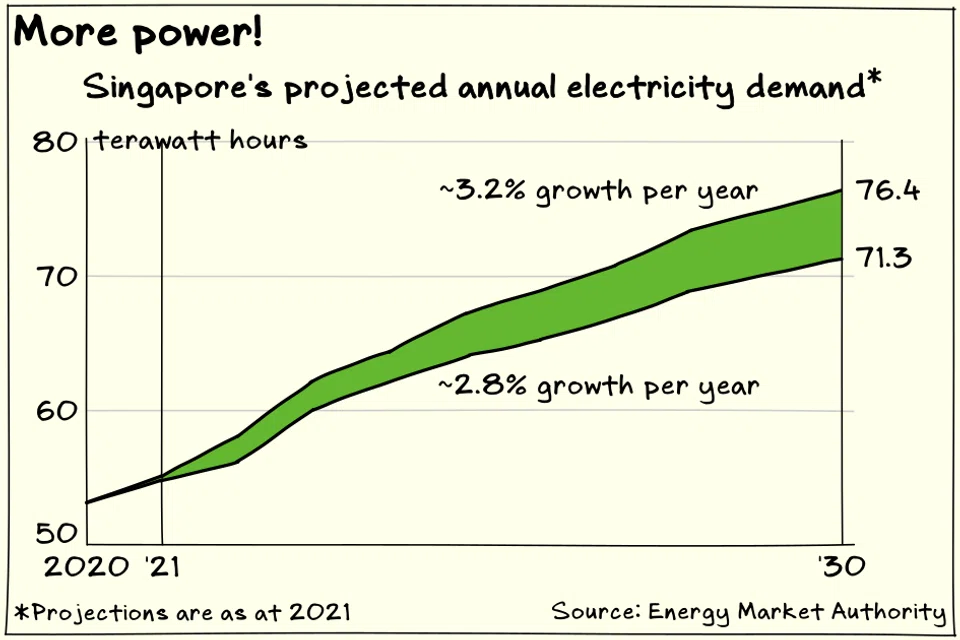
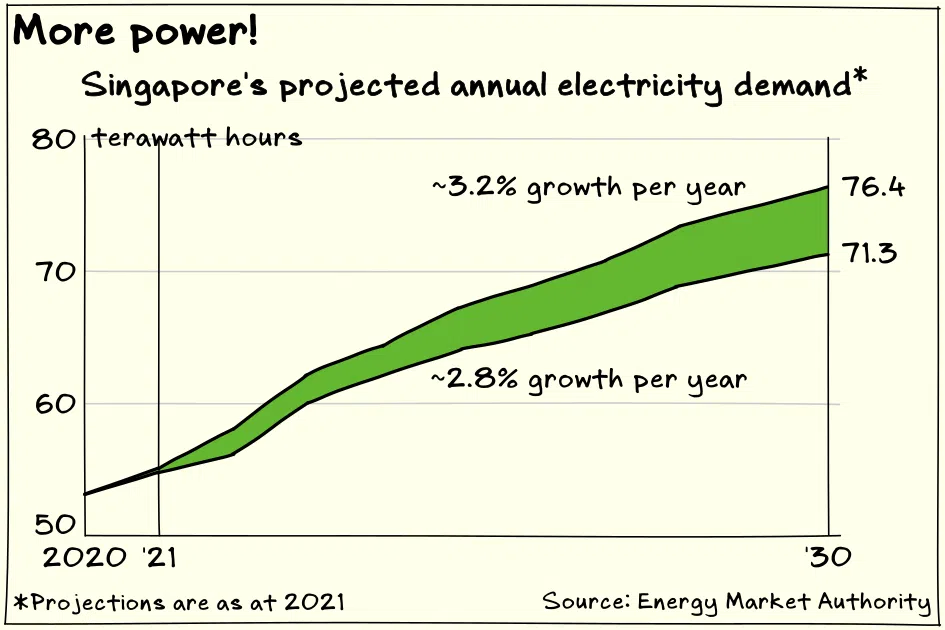
In 2020, Singapore produced 49.7 million tonnes of carbon dioxide equivalent, of which about 40 per cent came from the power sector. Electricity market projections by the Energy Market Authority in 2021 forecast electrical demand to grow at a compounded annual growth rate between 2.8 per cent and 3.2 per cent until 2032; this means that in 2030 Singapore could consume about 71.3 to 76.4 terawatt hours of electricity, or about 34 per cent to 44 per cent above 2020 levels.
Natural gas fuels almost all of Singapore’s electricity generation, hovering around 95 per cent over the past decade. If Singapore’s sources of electricity generation and the fuel they depend on do not change for the rest of this decade, the increase in electricity demand could generate power-based emissions of around 26 to 29 million tonnes in 2030. Even if Singapore’s non-power emissions stayed flat from 2020 onwards (they won’t), the increase from power alone would take Singapore’s emissions to between 56 and 58 million tonnes. That’s uncomfortably close to the targeted peak of 60 million tonnes.
Clean energy imports could alter the equations significantly.
On the same day that the new LNG terminal was announced, Singapore tied up a deal to import 1.2 gigawatts of mostly offshore wind-generated low-carbon electricity from Vietnam. In addition to earlier deals to secure 2 GW from Indonesia and 1 GW from Cambodia, Singapore is now on track to achieve its goal of importing 4 GW of clean energy by 2035. If those imports were to come online now, they would account for above 30 per cent of total electricity generation capacity as at end-June 2023.
If Singapore can cut 30 per cent of power emissions, its chances of achieving peak emissions at 60 million tonnes become much more achievable.
Green energy imports have become the strategy with the most immediate success in this early stage of Singapore’s decarbonisation journey.
Singapore could try to add enough renewable or low-carbon energy sources to reduce its reliance on natural gas, but as the minister explained, that’s dependent on imports and technology becoming scalable. Some of the potential solutions that Singapore has mentioned, such as carbon capture, utilisation and storage, have questionable prospects for scaling up.
Singapore could also try to reduce emissions from its other major sources of emissions, namely industry and transportation. Industries accounted for 44 per cent of the country’s emissions in 2020, so Singapore could potentially make significant progress if its oil and gas, chemicals, waste and water industries can significantly reduce their emissions. But that’s a big if, given that these industries are up against the same scaling issues that Singapore faces with its energy fuel mix. Forget the Green Lantern; the superhero everyone seems to need now is Green Hydrogen.
The transportation sector will probably benefit as Singapore’s shift towards electric vehicles reduces tailpipe emissions, but even then the impact would be lessened if the grid that’s used to charge the batteries is still predominantly powered by natural gas.
Unlike other approaches, which rely on as-yet unproven and as-yet unscalable technologies, imports use proven technology. For imports, the bigger uncertainties are political and commercial in nature.
Other Singapore reads
- Sembcorp, Keppel, YTL consortiums among Singapore’s 6 shortlisted ammonia developer candidates
- Singapore to set up single gas buyer for power generation sector in 2024
South-east Asia
Why can’t JETP just do it?
Indonesia’s US$20 billion Just Energy Transition Partnership (JETP) programme looks no closer to breaking a stalemate between the country and the JETP donors and investors.
During Singapore’s International Energy Week, Indonesian Deputy Coordinating Minister of Maritime Affairs and Investments in Infrastructure and Transportation Rachmat Kaimuddin lamented that Indonesia can’t get affordable financing for its transition needs.
He said that private-sector investors still prioritise financial returns, which makes them interested only in projects such as renewable power assets with clearer cash flow and profit outlooks. As a result, much-needed transition-related projects such as transmission infrastructure and early coal retirement, which are less lucrative, struggle to get funding.
Those comments come with less than a month to go before the Nov 15 anniversary of the establishment of the Indonesian JETP programme. Indonesia had initially planned to announce an investment plan in August, but that has been delayed, with a new target of Nov 20.
There has clearly been a huge expectation gap among the JETP parties. Indonesia thought that the money pledged for the programme would be available at much more concessionary rates than what it has found.
The fact that Indonesia wants JETP to help fund coal phase-out projects has also raised concerns about potential misuse of the funds because of the complexities of such deals. It has not helped that Indonesia has been taking unorthodox measures that have raised red flags in sustainability circles.
Indonesia is considering changing its sustainable finance taxonomy to make it possible for newly built coal plants to obtain the highest-level “green” label if they were “aimed at the energy transition”. This is a far lower barrier than the initial framing, which allowed green labels only for already-built coal plants that are being retired early. Sustainability organisations have fiercely criticised the move as a big step backward.
With such a wide misalignment of expectations and approaches, the Indonesian JETP has been stuck in place for almost a year.
Other South-east Asia reads
- S-E Asia ESG bonds issuance falls for third straight quarter
- Bilateral power trading is laying the foundation for the Asean power grid
Other good reads
TRENDING NOW

LTA proposes combining car COE categories, adding rebate-surcharge system

StarHub to acquire MyRepublic’s mobile business amid ongoing telco consolidation

DBS, OCBC, UOB rout lops billions off STI as inflation, rate concerns spook investors

Grab CEO’s wife Chloe Tong on life with Anthony Tan and finding her purpose

