

Issue 82: Carbon tax starts to hurt; growing green interest in India
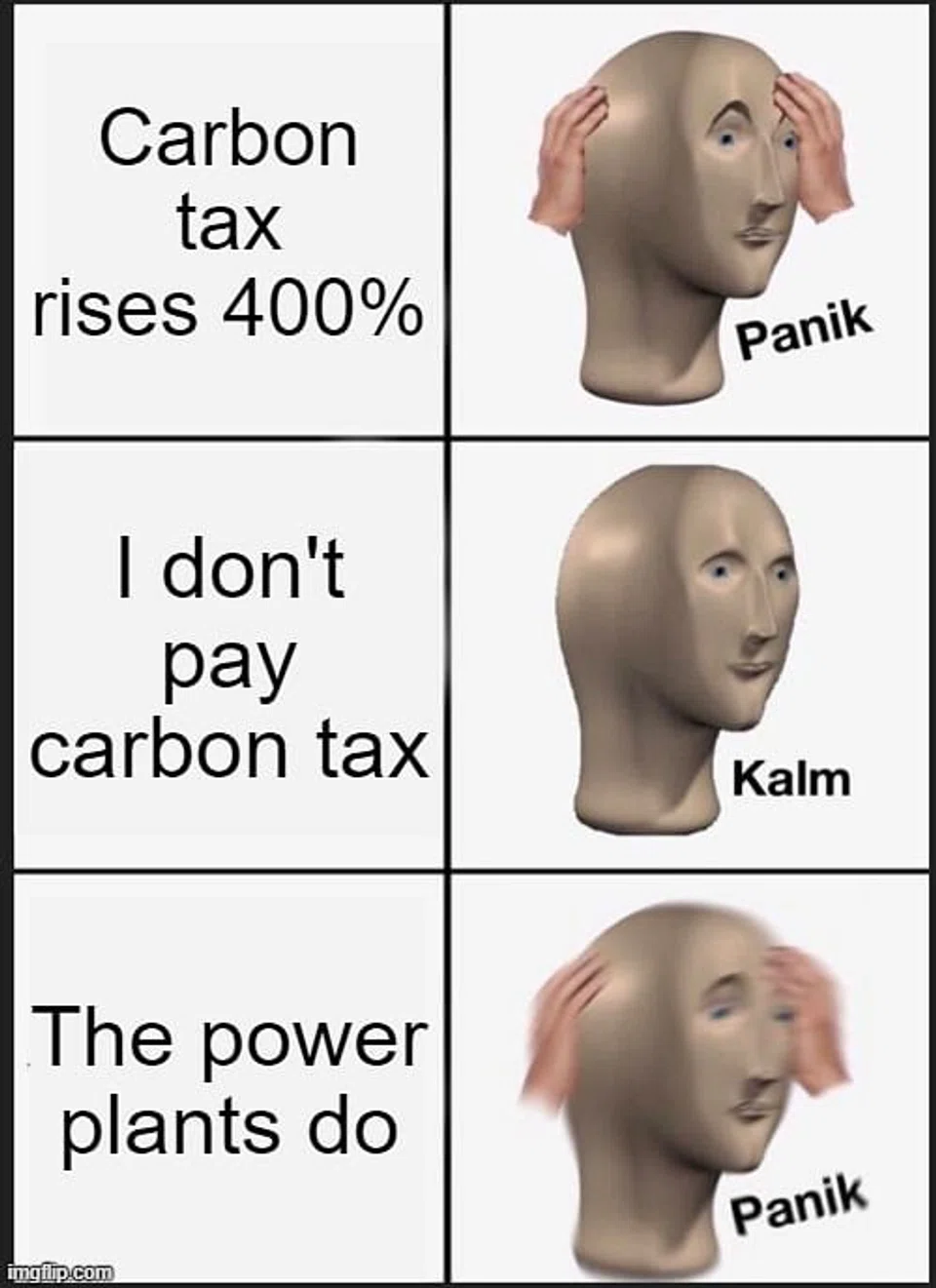
In this issue: Consumers are feeling the sting of Singapore’s carbon tax hike, while the nation’s sovereign wealth fund chases green investments in India.
Singapore
Carbon tax starts to hurt with little respite in sight
At the strike of midnight on Jan 1, 2024, Singapore’s carbon tax jumped from S$5 to S$25 per tonne of greenhouse gas emissions.
Consumers are feeling the effects of that hike. Just before 2023 ended, state energy suppliers announced that electricity and gas tariffs would rise by 5.1 per cent and 4.2 per cent, respectively, in tandem with the jump in carbon tax, along with the scheduled hike in goods and services tax.
There had been some expectation that the government’s International Carbon Credit (ICC) framework would bring some respite. The framework paves the way for companies to offset up to 5 per cent of their taxable emissions by buying credits from voluntary carbon markets.
If companies could buy credits for less than the prevailing tax rate, they could pad the impact of the stiff climb in carbon tax – both this year and in years to come. The carbon tax is set to rise to S$45 a tonne in 2026 and to between S$50 and S$80 a tonne by 2030.
After enlisting some industry help to decode the byzantine list of eligible carbon crediting programmes and methodologies under the ICC framework, however, it seems to me that the ICC framework presents the power generation players with little to no recourse.
Papua New Guinea is the sole country on the list, which severely limits the voluntary credits accessible under the ICC framework.
Worse still, none of the country’s eight existing projects on Verra’s Verified Carbon Standard (VCS) qualifies.
VCS is the world’s largest carbon registry, and Verra certifies the most number of carbon credits available on the voluntary carbon markets.
A bulk of these credits are, however, from project-level forest conservation carbon projects that use the Redd+ framework, which Singapore is not prepared to include.
The ICC framework allows other competing carbon registries, but it is unclear exactly how many qualifying projects those contain and how many credits they would supply.
Of course, the ICC framework is only just getting started.
Genevieve Soh, chief product and strategy officer at Singapore-based carbon exchange Climate Impact X, said 179 VCS projects across 31 countries could qualify for inclusion (assuming the same parameters as those Singapore has agreed with Papua New Guinea were applied on all VCS credits).
Singapore’s Ministry of Sustainability and the Environment and National Environment Agency have said each country’s eligibility would have slightly different parameters, but Soh’s figure indicates the universe of credits that could qualify if the host country was not a factor.
The going is slow, though. Of the 31 countries, Singapore negotiators have made headway to collaborate on carbon credits with four: Kenya, Columbia, Paraguay and Senegal.
Singapore is closest to signing an agreement with Paraguay, having “substantively concluded” negotiations with the South American country at the COP28 conference in Dubai last month. Memorandums of understanding have been signed with the remaining three countries.
Soh said the country with the greatest number of VCS credits in the pipeline that could meet Singapore’s current bar is India.
She counts 18 potential projects – although some are still under development or pending registration and verification approval – with the collective potential to supply 31 million credits a year.
China, meanwhile, hosts the highest number of projects with the same methodologies as those approved for Papua New Guinea: 81 projects that could supply 29 million credits.
All in all, the 179 projects hold the potential to supply some 97 million carbon credits a year.
Another difficulty: Not all these projects produce carbon credits that cost less than Singapore’s S$25 per tonne tax rate.
The base cost of running a project that avoids the conversion of grasslands would range from US$4 (S$5.31) to US$40 a tonne of emissions avoided, while a project dealing with agricultural land management would cost US$10 to US$70 a tonne, according to advisory firm Trove Research.
This figure excludes carbon trading costs and other fees, though, which means the final cost of credits could be slightly higher.
There is still time for the Singapore government to plump up its ICC offerings, of course. Companies have till Jun 30, 2025 to buy the credits they would like to use to offset their 2024 emissions.
Also, Singapore’s carbon tax applies only to roughly 50 facilities with emissions that exceed the taxable threshold of 25,000 tonnes annually – covering about 80 per cent of the country’s emissions.
Companies here will likely need just two million-odd carbon credits yearly to satisfy their tax offsetting needs, going by the 57.7 million tonnes of emissions recorded in 2021.
Other Singapore reads
EY proposes sustainability funding for SMEs, tax incentive changes in its Budget 2024 wish list
Singapore office landlords bank on green leases, ESG compliance to woo tenants at higher rents
Asia
Chasing green in India
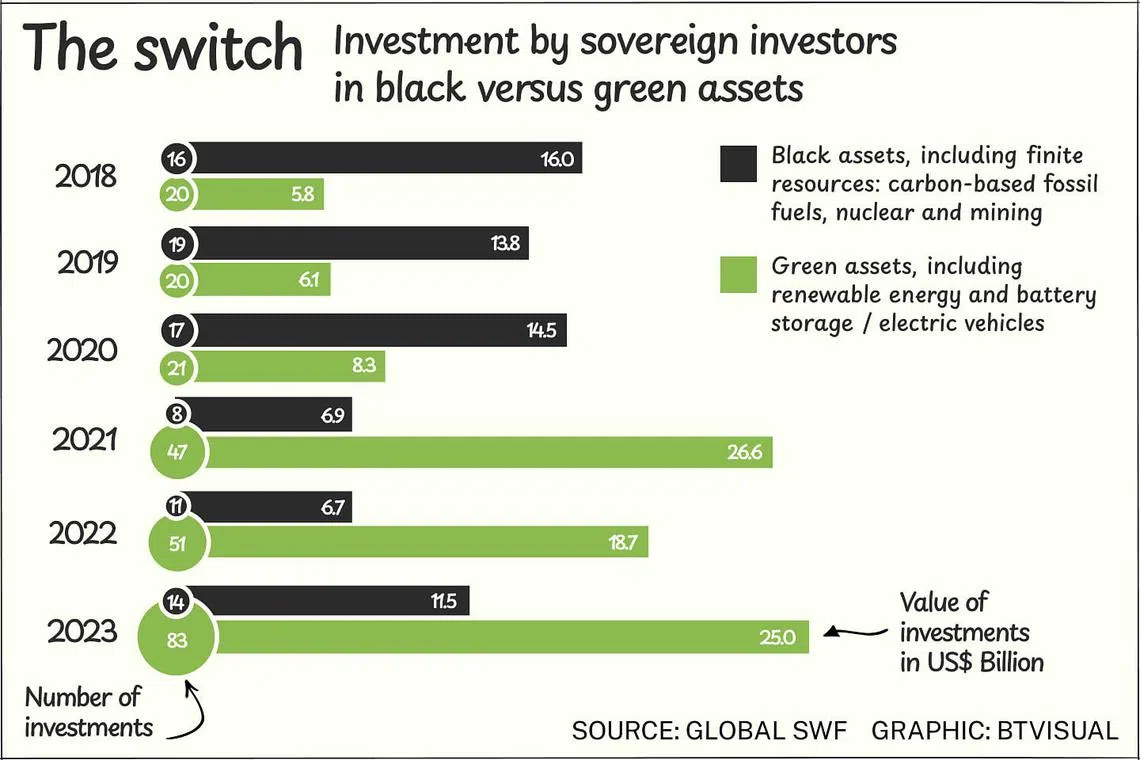
India has become the second most popular investment destination for state-owned investors, after the United States, according to a report by sovereign wealth fund tracker Global SWF.
This was especially significant for Singapore’s GIC, whose investments in emerging markets in 2023 were three times what they were in 2022.
GIC went big on the energy transition last year, with Global SWF singling out the state investor as “aggressively” pursuing its green energy agenda.
It pumped nearly US$5 billion into the sector, even as its overall investment activity fell 36 per cent in volume and 48 per cent in value. GIC deployed a total of US$20.9 billion in fresh capital in 2023.
What’s attractive in India for GIC?
GIC participated in a US$700-million capital raise for Indian renewable energy group Greenko, alongside the Abu Dhabi Investment Authority.
GIC also teamed up with Greenko’s founders and Petronas’ clean energy unit Gentari to produce five million tonnes of green ammonia annually, equivalent to one million tonnes of green hydrogen, by 2030.
This is a fifth of India’s target for green hydrogen production, and a tenth of Europe’s target for green energy imports by 2030.
The interest in green hydrogen is high, as it is one alternative feedstock for the chemical industry.
GIC worked at this outside of India as well. It snapped up a stake in InterContinental Energy, which is developing a portfolio of green hydrogen projects in Australia and the Middle East; and it is backing Sweden’s H2 Green Steel, which is set to utilise green hydrogen.
In India, GIC also partnered meter manufacturer Genus Power Infrastructures to fund a US$2 billion advanced metering infrastructure platform. The Indian government is pushing for the implementation of smart meters that allow the integration of renewable energy sources.
Other significant Indian green deals investments by Canada’s British Columbia Investment and Netherlands’ APG into renewables company Mahindra Susten, and Qatar Investment Authority’s 39.2 billion-rupee (S$625.4 million) bet on Adani Green Energy.
India will likely continue to draw investments, as the International Monetary Fund projects the country will grow at an average annual rate of 6.3 per cent – a faster clip than Indonesia’s 5 per cent, and China’s 3.9 per cent – in the next five years.
Other Asia reads
How Asia can lead the global energy race to net zero
Huge renewables opportunities remain in Asean: Maybank IBG report
Good reads
Investor protection has not improved in Singapore: Mak Yuen Teen
World’s biggest banks made US$3 billion on green debt last year
TRENDING NOW

Genting Singapore trails MBS, but helps anchor Malaysian parent group’s finances

He built the Vingroup empire. Now South-east Asia’s richest man is handing some key roles to his sons

CDL to invest S$5 billion, target S$6 billion divestments under refreshed strategy

Stocks to watch: CDL, Centurion, Oiltek, Geo Energy Resources

