

Kuok Maritime-led group launches electric supply boat as industry prepares for 2030 green target
Singapore aims for all-new harbour craft to be fully electric or compatible with net-zero fuels by 2030

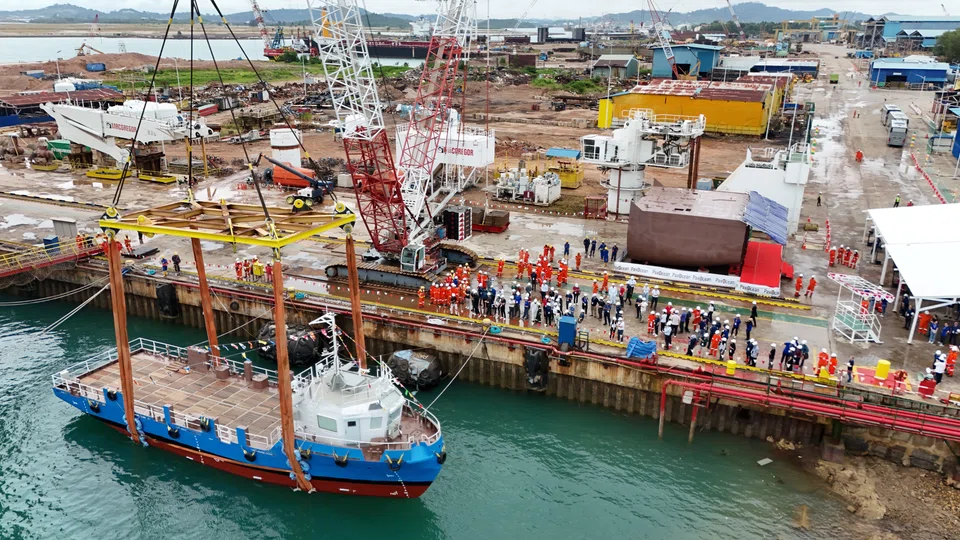
[BATAM] An alliance of companies led by Kuok Maritime Group (KMG) on Wednesday (Feb 5) launched an electric supply boat and started construction on an electric tug – both of which are among the first and largest electric harbour craft designed to operate in local waters.
These vessels are part of a broader effort by the 27-member Coastal Sustainability Alliance (CSA) to decarbonise the maritime industry.
The vessels’ development also comes ahead of new regulation. From 2030, Singapore will require all new harbour craft to be fully electric, capable of using pure biodiesel, or compatible with net-zero fuels such as hydrogen.
Electric vessels currently require high capital expenditure. The electric supply boat and the electric tug, for example, each cost two to three times more to build than their conventional counterparts.
That said, there are significant cost and efficiency advantages, said Tan Thai Yong, chairperson of the CSA and chief executive of KMG unit PaxOcean Group.
“Maintenance and operating expenses for electric vessels are definitely lower than for diesel-driven ones, because firstly, you don’t have the main engines; you don’t need to do major overhaul,” he said.
In addition, with battery technology “developing very fast”, the price is set to drop in future, he added.
Tan was speaking to reporters at PaxOcean’s Pertama shipyard in Batam, Indonesia, on Wednesday, following the launch of the electric supply boat and the keel-lay ceremony for the electric tug.
The electric supply boat, called PXO-EXL-1, can accommodate a payload of 40 tonnes or 60 pallets – about four times that of a conventional supply boat. This means that it can efficiently deliver goods to multiple ships on a single trip – what Tan dubbed as going on a “milk run”.
The boat also provides 60 per cent energy savings over a conventional lighter – a flat-bottomed barge vessel – that makes multiple trips, said the CSA in a statement.
The alliance will bring together international shipping agencies to explore offtaking arrangements and trial the electric supply boat in the second half of this year.
PXO-EXL-1 is the sixth vessel in the growing fleet of full electric harbour craft in Singapore, noted Kenneth Lim, MPA’s assistant chief executive for industry and transformation.
“To better support the operation of these vessels, MPA is already working with institutes of higher learning… and partners to develop training programmes to reskill the maritime workforce in handling and maintaining electric vessels,” he said in a speech at the Batam event.
Lim also emphasised the need to develop charging infrastructure for electric vessels: “We must work with technology providers and operators to deploy high-powered chargers at suitable locations to support the operation of these vessels.”
Tan echoed the need for charging infrastructure to keep pace with the adoption of electric vessels, and also for such facilities to be standardised.
“The last thing we want is (a situation) like in the past for handphones – with each model using a different kind of charging port; it’s very difficult to manage,” he said.
Industry collaboration
The CSA’s upcoming electric tug, called PXO-ACE-1, is slated for completion in Q1 2026. It is the first such vessel to be assembled, delivered and operated in Singapore, and is supported by the Maritime Innovation and Technology Fund of the MPA.
The tug incorporates advanced technologies for propulsion, energy storage and battery management systems, said the CSA. It is also designed to be able to use zero-carbon fuels, such as ammonia or methanol.
Singapore’s maritime industry has been exploring the transition towards such green fuels, while also stepping up on energy-efficient retrofits. MPA aims for “green ships” to make up half of the Singapore Registry of Ships fleet by 2050.
Lim of the MPA highlighted the benefits of collaborating on sustainability efforts. For instance, he noted that the design of the electric supply boat was enhanced through collaboration with research institutions, such as the Technology Centre for Offshore and Marine, Singapore, and the Solar Energy Research Institute of Singapore.
As a result, the boat’s efficiency increased by about 5 per cent, “contributing to a further reduction in the total cost of ownership”, he said.
“These innovations will drive greater energy and cost efficiencies, paving the way for a more sustainable and economically viable maritime industry,” added Lim.
TRENDING NOW

Things to know about DBS’ incoming chairman Anthony Lim

DBS eyes prime brokerage business as Q3 profit falls 5% on weaker trading income

Royal Group and Sunset Hospitality abandon plans to open Casa Mett hotel off Orchard Road

George Yeo adds 100,000 Wilmar shares at S$2.97 apiece, taking stake to over 1 million shares

