

A test case for energy resilience: Lighting up a village with solar batteries
Clean-energy firm GoRental is bringing accessible and affordable electricity to a remote Chiang Mai village
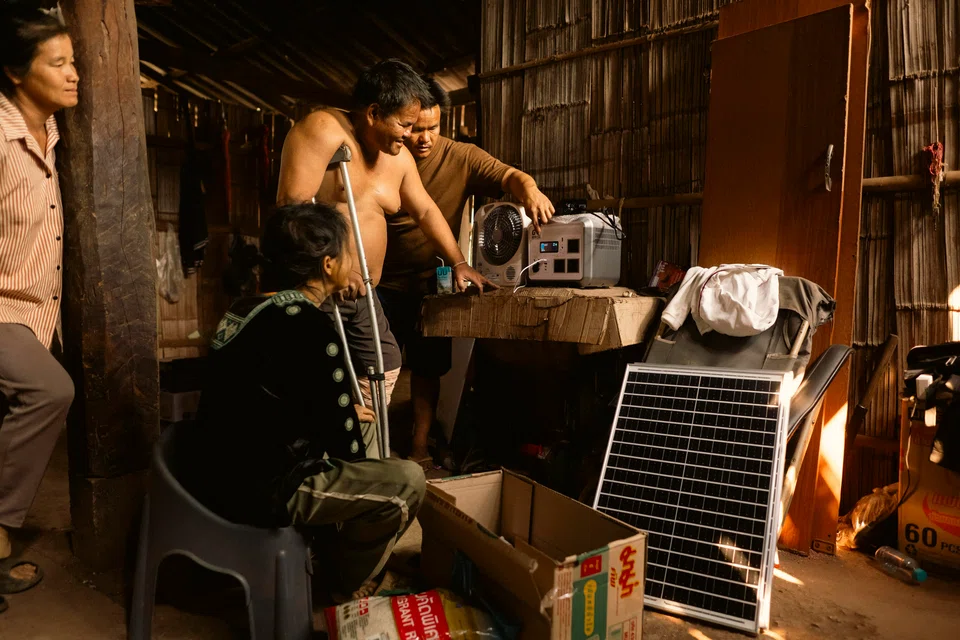
[CHIANG MAI] Huay Nam Rin village is off the grid.
Perched in the mountains about 45 km from Chiang Mai in northern Thailand, the small Hmong farming community has long lived with minimal electricity. What little power it has comes from a handful of diesel generators and repurposed car batteries, charged with second-hand solar cells.
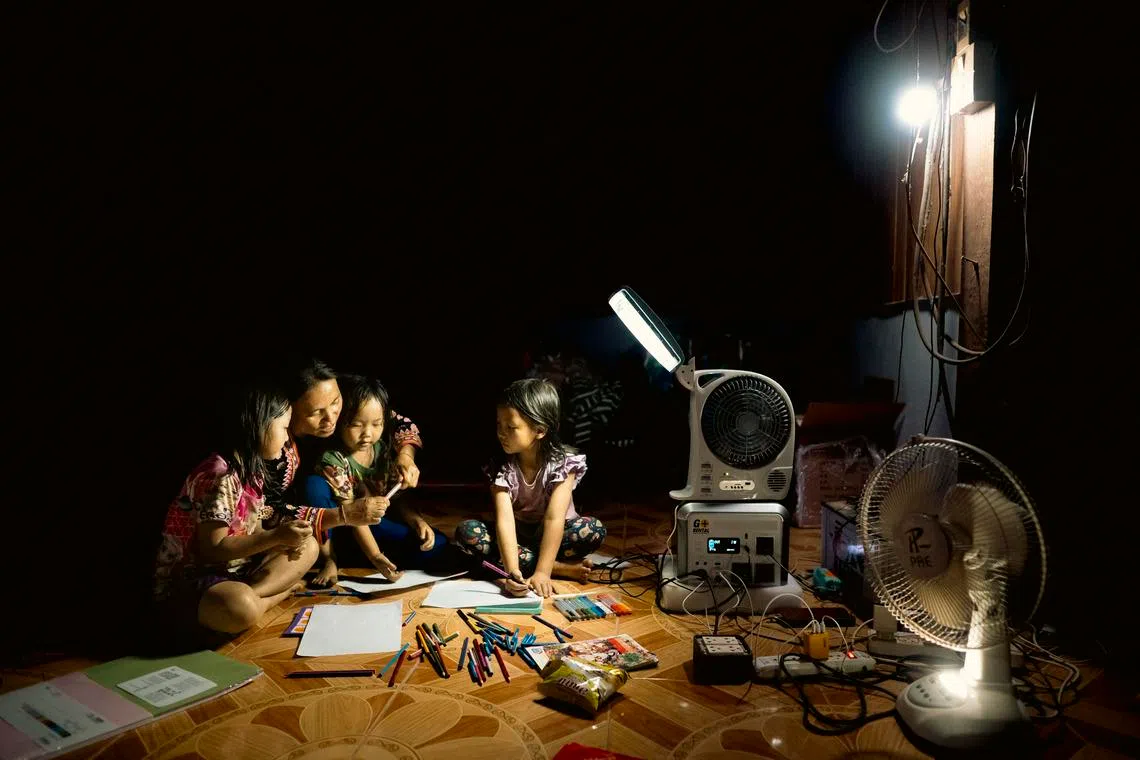
Electricity is therefore used sparingly. The repurposed car batteries can only power one appliance at a time; they also pose a safety risk.
“The batteries are old; they can only go for one or two hours at most,” said village chief Kriangkai Suya. “During the day, we can’t use them for things such as cooking, otherwise we won’t have light at night.”
Lighting, therefore, is a “huge problem”, he added.
“At night, when old people need to visit the toilets outside their houses, they can fall because they cannot see the ground clearly. There are also dangerous animals like snakes that you can’t see in the dark.”
'%3e%3cpath%20d='M12.1475%2025.5262C13.7713%2025.4295%2014.94%2023.913%2014.94%2021.8832C14.94%2019.5359%2013.474%2018.093%2011.5917%2018.093C11.3745%2018.093%2010.9582%2018.093%2010.8393%2018.1413V25.2086L11.8891%2025.5745C11.8891%2025.5745%2012.207%2025.5262%2012.1475%2025.5262ZM11.4934%2017.6281C13.2567%2017.6281%2014.3843%2016.4292%2014.3843%2014.4501C14.3843%2012.372%2013.275%2011.2973%2011.4339%2011.2973H10.8393V17.6305H11.4934V17.6281ZM6.66078%2025.6482L7.39265%2025.5492C8.02617%2025.4502%208.26403%2025.3053%208.26403%2025.1097V11.6149C8.26403%2011.4193%208.1451%2011.3709%207.23484%2011.249L6.68137%2011.173L6.6219%2010.7588H11.9508C15.7153%2010.7588%2017.0624%2012.0797%2017.0624%2014.1578C17.0624%2015.9666%2015.7748%2017.1909%2013.4969%2017.6305V17.7041C16.111%2017.948%2017.6571%2019.5382%2017.6571%2021.7636C17.6571%2024.3318%2015.8937%2026.0417%2012.1109%2026.0417H6.60132L6.66078%2025.6482Z'%20fill='%232B2B2B'/%3e%3cpath%20d='M20.6287%2025.6505L21.5596%2025.5515C22.1725%2025.4779%2022.4104%2025.3076%2022.4104%2025.112V11.249H21.9346C20.073%2011.3479%2018.982%2013.0095%2018.408%2014.6227L18.1907%2015.5018H17.6555L18.1701%2010.7588H29.3837L29.6421%2015.4787H29.1664L28.9491%2014.6227C28.3728%2012.8645%2027.3047%2011.2743%2025.5002%2011.249H24.9856V25.1856C24.9856%2025.3812%2025.1251%2025.4548%2025.9965%2025.5515L26.7695%2025.6505L26.829%2026.0417H20.5693L20.6287%2025.6505Z'%20fill='%232B2B2B'/%3e%3c/g%3e%3cdefs%3e%3cclipPath%20id='clip0_5242_21648'%3e%3crect%20width='24'%20height='16.8'%20fill='white'%20transform='translate(6%2010)'/%3e%3c/clipPath%3e%3c/defs%3e%3c/svg%3e)
Singapore clean-energy firm GoRental is hoping to change this.
The company provides the village with portable solar-powered battery systems, which are charged during the day and are capable of powering multiple appliances simultaneously.
These provide a safer alternative to diesel generators and improvised car batteries. They can also store energy while running devices, allowing villagers to conserve electricity for night-time use while still operating fans, rice cookers and mobile chargers throughout the day.

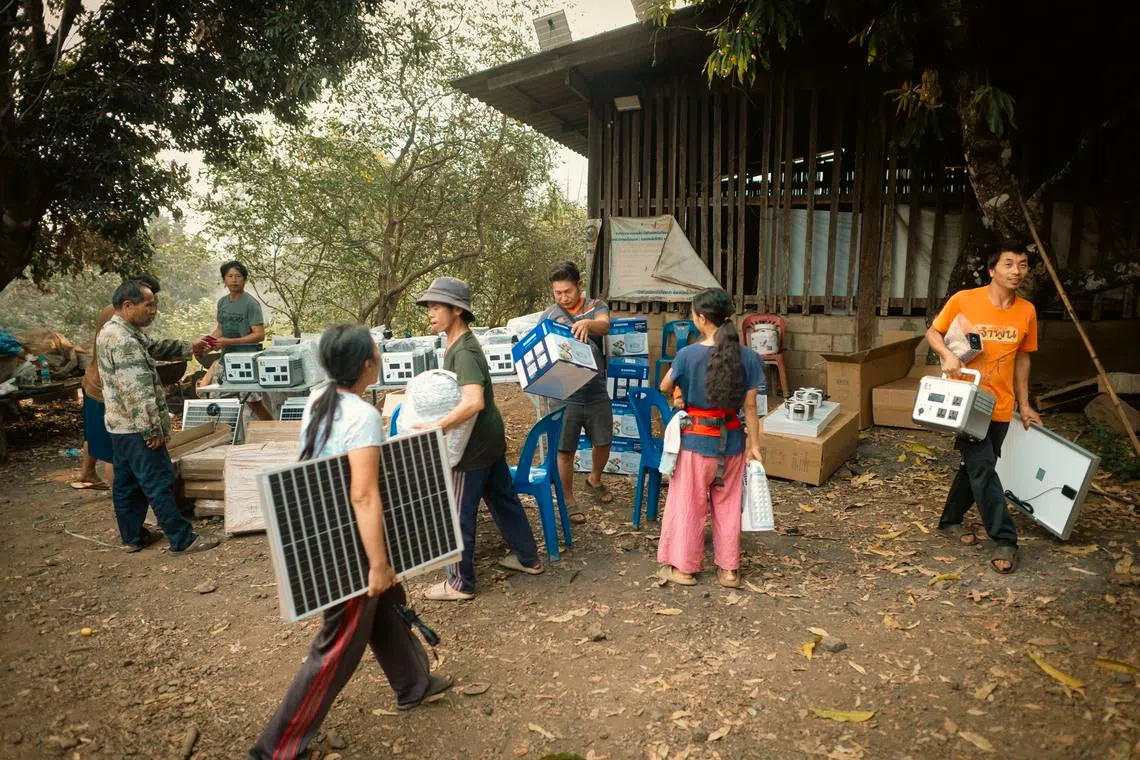
The deployment forms part of GoRental’s #Powertoempower initiative, which is aimed at using the company’s battery systems and know-how to deliver practical clean-energy solutions to underserved communities.
Distributed to households in Huay Nam Rin, the battery units effectively function as a village-scale microgrid, providing dependable and sustainable electricity, despite the area’s lack of grid access.
Thirty-one portable battery energy storage units and 60 solar panels were provided from Mar 30 to Apr 1. These accounted for about 40 kilowatts (kW) of distributed renewable mobile microgrid capacity and 8 kW of solar generation.
The set-up can power essential daily needs such as lighting and phone charging, while reducing reliance on kerosene lamps and diesel generators, which are costly and carbon-intensive.
“Reliable electricity changes more than a room after dark,” said GoRental founder Colin Peh. “It affects how families live, how children study, and whether a community feels it still has a future.”
The company expects the battery units to last at least 10 years, noting that over that time, each home could receive up to 4,380 kW-hours (kWh) of sustainable power, while avoiding about 12 tonnes of carbon emissions.
Beyond the immediate benefits, Peh hopes that the Huay Nam Rin village engagement will showcase how modular battery solutions and the microgrid system can provide sustainable and cost-efficient energy, particularly as volatile oil markets are pushing governments and industries to prioritise energy resilience.
From film sets to clean energy
GoRental traces its origins not to the power sector, but to the movie industry.
Peh founded True Colour Media in 2014, providing equipment rental and technical support for productions from local films such as Ah Girls Go Army to Hollywood titles such as Crazy Rich Asians.
Film-making set-ups typically rely on diesel-powered generators, but these produce disruptive noise and fumes.
Seeking a quieter and more cost-efficient alternative, Peh began exploring battery-based power systems, which eventually led to the founding of GoRental in 2017.
The company now leases portable battery solutions that provide electricity on-demand to a range of sectors, events and customers.
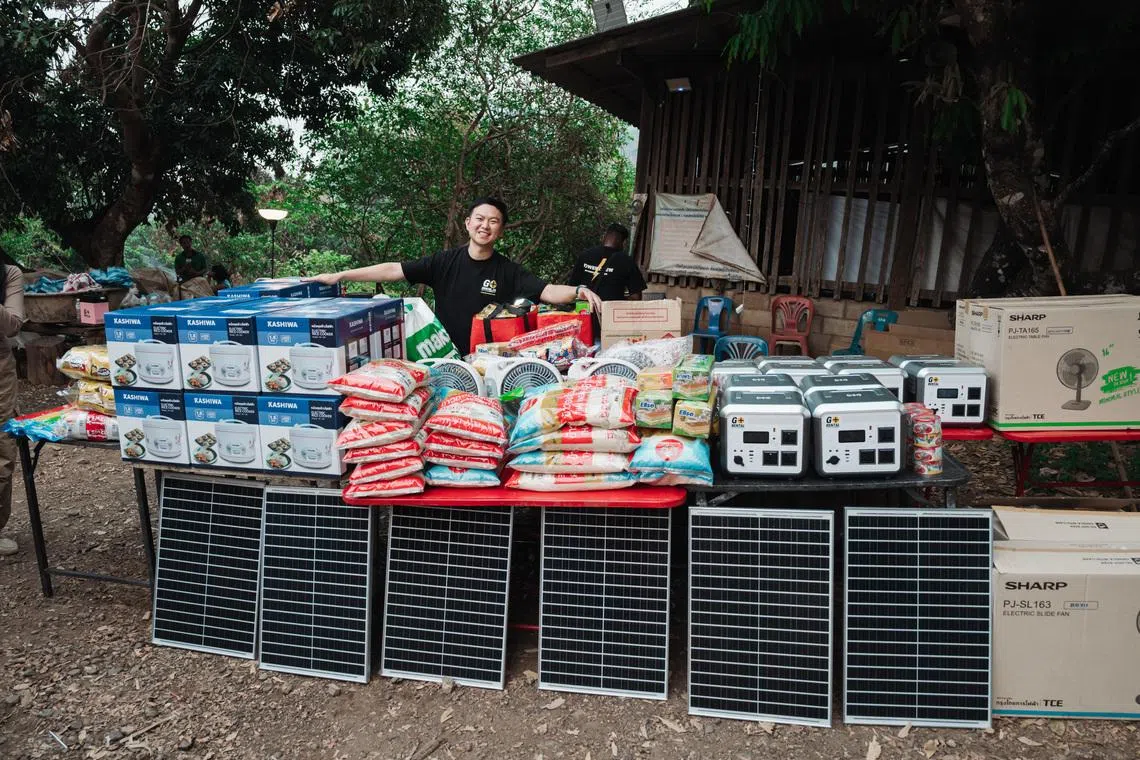
Battery systems offer advantages over diesel generators, including silent operation and minimal maintenance, said Peh.
Sustainability is also a key advantage; in 2020, GoRental acquired a solar facility in Tampines to charge its battery units, allowing the company to effectively store and provide sustainable energy on demand.
Its batteries can also be integrated with solar cells for clean on-site charging.
GoRental’s battery units are designed to be modular, allowing for different scales of deployment. It has supplied sustainable power to infrastructure and construction firms, as well as major events in Singapore, including Formula 1 and Singapore’s National Day Parade.
At the same time, it serves mid-scale and small-scale customers, such as households that lease battery units to power aquariums.
It was these very qualities – portability, solar compatibility, modularity and scalability – that made the technology particularly suited for rural electrification in Huay Nam Rin village.
“If we already have technology that works, then the question becomes where else it should go,” said Peh. “It should not stop at events or commercial sites. It should reach communities that have been waiting for something as basic as dependable power.”
Resilience in focus
The initiative comes as energy security and resilience concerns gain urgency across South-east Asia amid the ongoing Middle East oil crisis. Thai authorities have moved to manage higher global oil prices by adjusting diesel price controls, expanding fuel-relief measures and urging energy-saving action as subsidy pressures mount.
In Singapore, the public sector has been directed to reduce electricity consumption across government facilities to save energy.
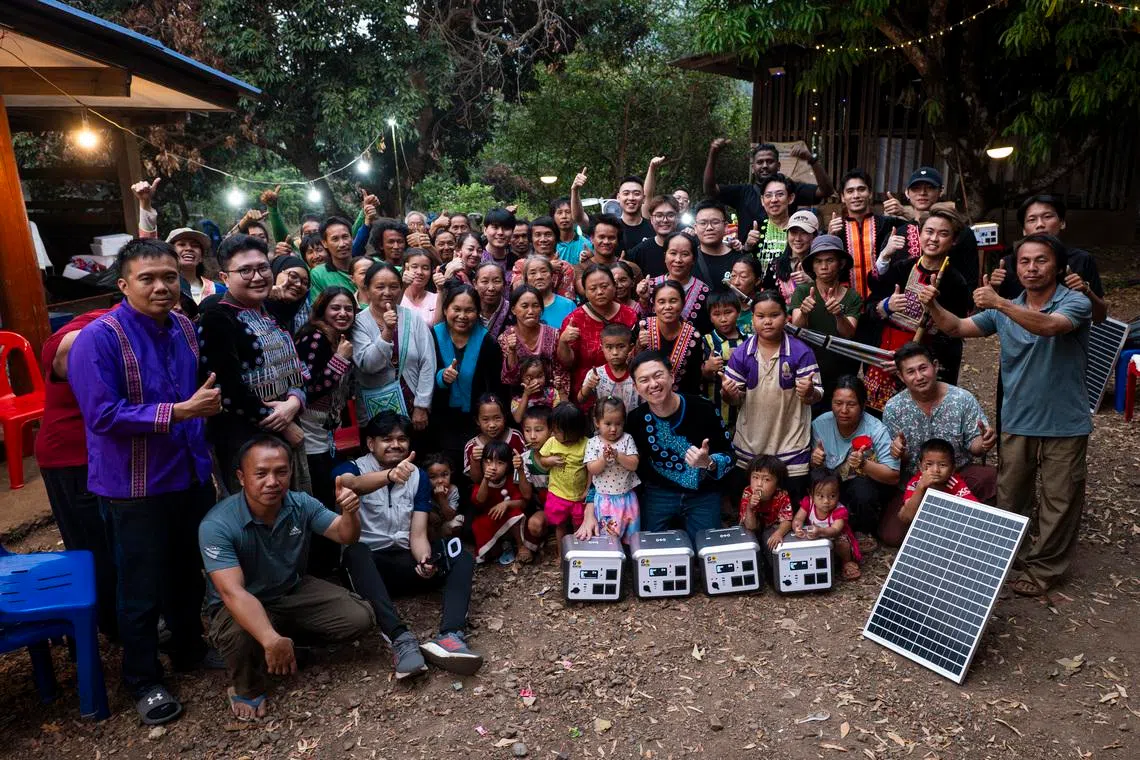
Peh believes that solar-powered battery systems have a part to play in supporting sustainability and energy resilience.
The Huay Nam Rin project was intended as “a live demonstration of how (GoRental’s) portable and scalable microgrid systems perform under real constraints”.
The deployment is expected to reduce fuel dependency and provide 127,020 kWh of renewable power across the village while avoiding more than 360 tonnes of emissions over 10 years.
Just as crucially, GoRental hopes that the project will showcase the battery set-up’s cost efficiency as a power source. It estimates that the deployment could offset more than US$250,000 in fuel and maintenance costs of running diesel generators over a decade, potentially lowering power costs by up to 60 per cent.
Peh said that it is important to illustrate this practicality and economic viability for solar-powered battery energy to be seen as an alternative to fuel use in South-east Asia. He added that, even in grid-connected areas such as Singapore, solar-charged battery systems can supplement conventional electricity supply, reducing reliance on fossil-fuel-based grid power.
In the construction sector, for instance, GoRental deploys hybrid systems with diesel generators providing backup power; these produce reliable output while still reducing fuel use and saving costs in the long run.
Scaling impact across South-east Asia
GoRental hopes the Huay Nam Rin engagement will serve as a model for future deployments across South-east Asia.
Under its #Powertoempower initiative, it aims to scale similar projects in collaboration with NGOs and community partners, particularly in areas where access to dependable electricity remains fragile.
The firm is planning expansion into Malaysia in June, where it has been awarded a microgrid project in Sarawak, and is looking to partner a Malaysian foundation or NGO to support a local roll-out of the initiative. Further deployments in Thailand and Cambodia are targeted for 2026, followed by Indonesia in Q4.
In the newly lit Huay Nam Rin, the villagers are happy to be the starting point.
“I’m proud and happy for the villagers to have a better life,” said Suya. “Now kids can read at night and connect to the Internet to study. It’s a better life having light for the whole day and the whole night.”
The writer was invited by GoRental to observe the battery deployment programme at Huay Nam Rin village

Decoding Asia newsletter: your guide to navigating Asia in a new global order. Sign up here to get Decoding Asia newsletter. Delivered to your inbox. Free.
Copyright SPH Media. All rights reserved.
TRENDING NOW

ComfortDelGro appoints two new independent directors

Once staunchly pro-China, Malaysian Chinese businesses are now distancing themselves from Beijing

NoonTalk needs continued financial support from CEO Dasmond Koh, auditors warn

DP Architects sets the benchmark for sustainability disclosure and design

