

LNG should be phased out like coal, civil society groups say in protest at ADB meet

Wong Pei Ting
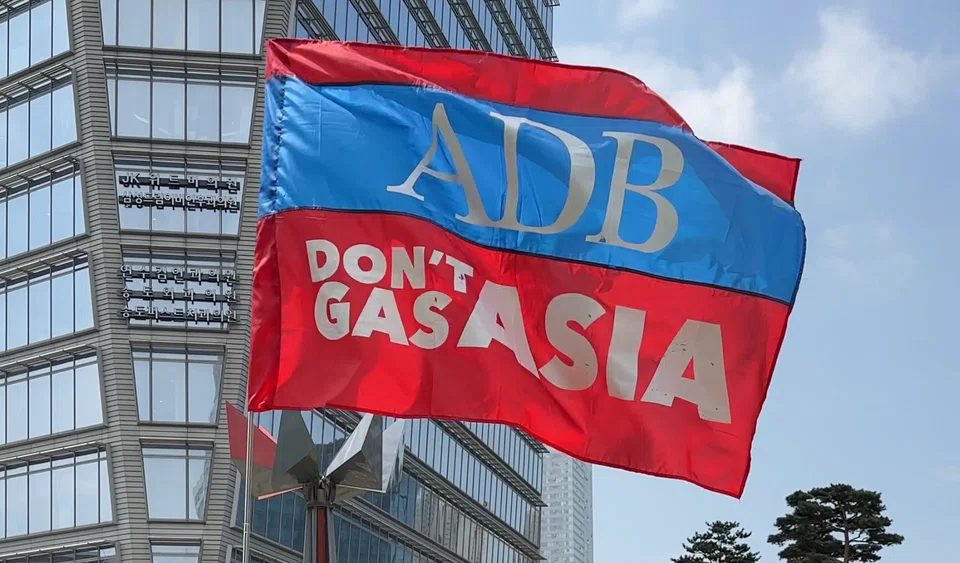
THE Asian Development Bank’s (ADB) take on liquefied natural gas (LNG) as a transitional fuel in Asia’s green energy transition is facing pushback from a number of civil society groups that attended its 56th Annual Meeting in Incheon, South Korea.
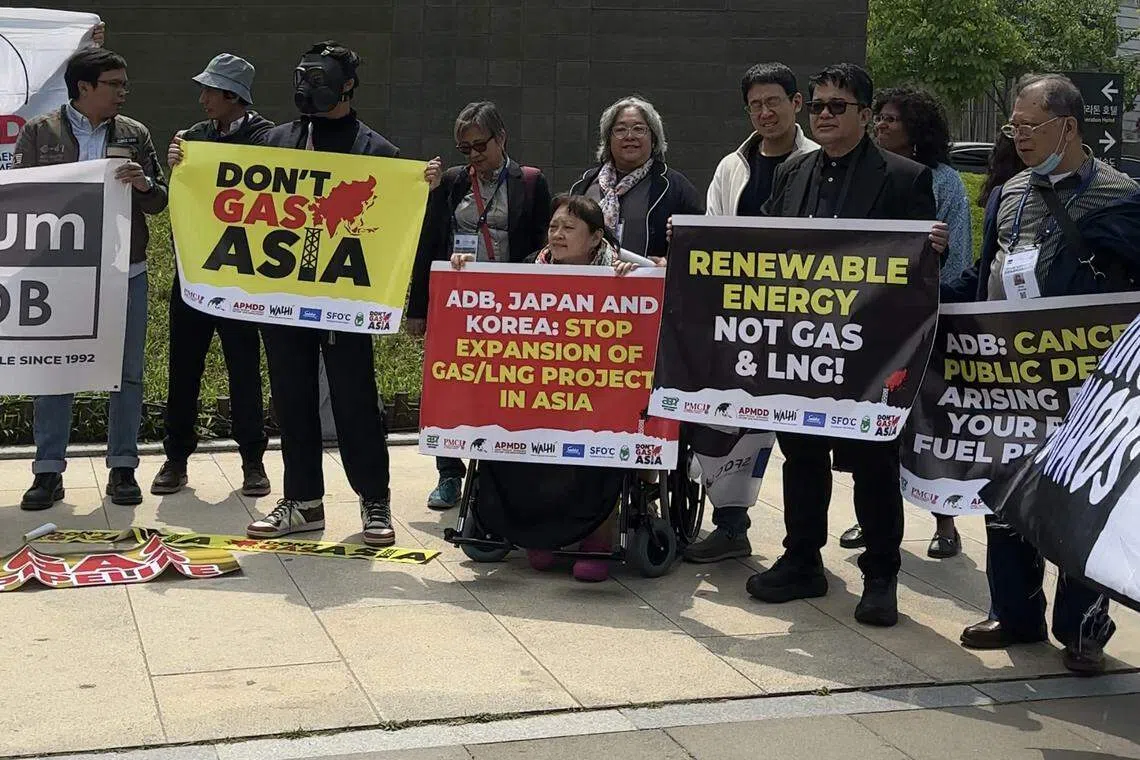
As the regional development bank’s annual governors’ business session was in motion on Thursday (May 4), the groups held a small protest near the venue chanting: “Asian banks, no, thanks. We don’t need fossil gas.” They also carried signs and waved flags carrying messages, including “Don’t gas Asia”, and “No more false solutions!”.
The protest also took aim at Japan’s and South Korea’s part in pushing LNG as a low carbon solution for the region. Japan, which holds ADB presidency, is a big supporter and promoter of gas, while South Korea is one of the biggest developers of gas, campaigners charged. The protest was organised by about 30 campaigners, but a police permit allowed only 20 of them to attend.
Speaking to The Business Times (BT), the protest’s coordinator, Lydinyda Nacpil of the Asian Peoples’ Movement on Debt and Development, said: “People are really expecting that this transition is direct to clean and safe energy. So this is for us a big scam for governments and financial institutions like the ADB to keep promoting gas as transition.”
Gas is as harmful as coal, she added, pointing out that the largest component of fossil gas is methane, a potent greenhouse gas with more than 80 times the warming power of carbon dioxide over the first 20 years after it reaches the atmosphere.
In response, an ADB spokesperson told BT that the bank believes natural gas has a role to play as a transitional fuel that can support power system flexibility, but these are under “specific circumstances”.
He added that any ADB support for natural gas projects, if undertaken, will be subject to “strict screening criteria”. Strict conditions include ensuring overall emissions reductions against a business-as-usual case, and confirmation of unavailability of technically, economically and financially viable cleaner options to provide the same energy services.
The project will also have to be aligned with the country’s nationally determined contributions under the Paris Agreement, and use the “best available technology”.
The spokesperson further said its energy policy stated that the bank will not support any natural gas exploration or drilling.
ADB will also be selective in its support for midstream and downstream natural gas initiatives, he added, noting, for instance, that the economic viability analysis of the respective projects should include the social cost of carbon emissions.
Expert reacts, says gas is ‘the answer’ for now
Asked for his view, energy expert Victor Nian presents the case for why it is not realistic for Asia to move straight to renewables.
On paper calculation, one might argue that renewables can bring carbon emission down significantly, but Dr Nian told BT the impact to the grid and cost of integrating that tremendous amount of intermittent renewables pose practical challenges to the region.
This is the case even with significant investment in energy storage which will, anyway, drastically increase the overall cost of electricity delivery to consumers, he added.
Dr Nian, who is the co-founder and chief executive officer of Singapore-based independent think tank Centre for Strategic Energy and Resources, said a cleaner alternative to coal to provide grid balancing and baseload electricity is needed, and gas is “the answer”.
There is rising interest in alternatives such as nuclear and hydrogen, but technologies around these are still not ripe for adoption, he noted. Besides, gas is a less polluting alternative to coal and the region presently has an abundance of gas, he pointed out.
Dr Nian further referenced the European Union (EU) Taxonomy, a list of economic activities that can be considered environmentally sustainable, and said gas was named as a “transitional measure”. That shows gas’ strategic importance as an option to gradually move away from coal and eventually fossil fuel, he said.
On the broader topic of energy transition, “it is not always about where we are transitioning to, but also important to remember where we are transitioning from”, he said. “Along the way, every single decision we make will have an impact on the triple bottom line (people, planet and profit) of sustainable development – the question is how do we balance it.”
“Natural gas is part of the energy transition journey which is a reality the region and the world must face,” he concluded.
Not so fast
These responses do not allay the groups.
Nacpil said technologies are already available to ensure grid flexibilities to better integrate renewable energy variabilities. These technologies and new grid arrangements render the baseload approach “obsolete”, she added.
She claimed the big cost of renewables is only at the beginning. “Once the plants are set up, the costs of operations and energy provisioning are far less compared with fossil fuel plants throughout the lifetime of the plants, because the sources of energy are free and local. There’s no need to purchase or import.” she said.
Furthermore, there are already many studies which say that the average cost per kilowatt hour of renewables is lower than coal or gas, she added.
TRENDING NOW
OCBC Q3 profit rises 3% to S$2.04 billion, slightly above expectations
Stocks to watch: OCBC, IHH Healthcare, FLCT, SingPost, Koh Brothers Eco Engineering

From legacy to launch: Francis Yeoh and Yeoh Pei Xien on family unity and YTL’s next‑gen ventures
Wealthy Indonesians snap up government bonds as yields near 8%: OCBC

