Low-carbon electricity trading between Singapore and India being mulled, says global solar body
Project is technically feasible but a detailed study on the commercial viability still has to be conducted

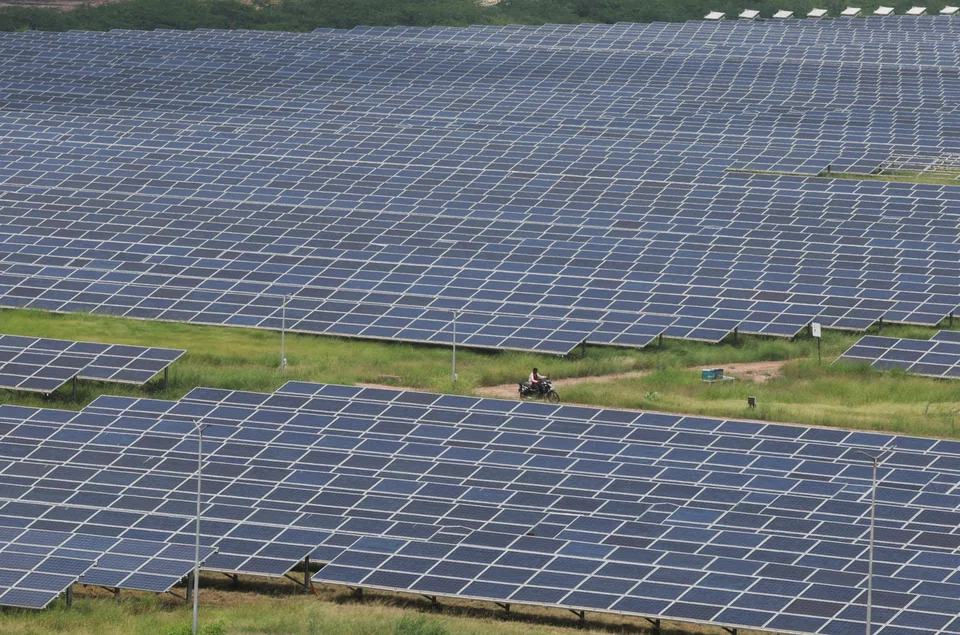
[SINGAPORE] Early discussions on connecting the power markets between Singapore and India, with the ultimate goal of transmitting low-carbon electricity to the city-state have begun, said Ashish Khanna, director-general of the International Solar Alliance.
The project is technically feasible, although a detailed study on the commercial viability still has to be conducted, said Khanna in an interview with The Business Times.
Singapore’s latest electricity tariffs, which surged as a result of the ongoing Iran war, stood at S$0.297 a kilowatt-hour (kWh) for the three-month period between April and June this year. This is more than five times the cost for solar generation in India, which is around US$0.054 per kWh, indicated an April 2026 report from energy think tank Ember.
“If the transmission charges are not too high, and there is a technical reliability of the undersea line, there is a lot of win-win potential for both Singapore and India to trade power,” he said.
Even if it is cheaper to transmit electricity from nearby South-east Asian countries to Singapore, importing power from a farther place such as India can still make economic sense if the savings from producing electricity is greater than the extra cost of transmitting it over the longer distance.
The second major factor is enhanced energy security for Singapore, a priority for many governments amid global geopolitical tensions. Sourcing solar power from a diverse set of locations strengthens the city-state’s power resilience.
'%3e%3cpath%20d='M12.1475%2025.5262C13.7713%2025.4295%2014.94%2023.913%2014.94%2021.8832C14.94%2019.5359%2013.474%2018.093%2011.5917%2018.093C11.3745%2018.093%2010.9582%2018.093%2010.8393%2018.1413V25.2086L11.8891%2025.5745C11.8891%2025.5745%2012.207%2025.5262%2012.1475%2025.5262ZM11.4934%2017.6281C13.2567%2017.6281%2014.3843%2016.4292%2014.3843%2014.4501C14.3843%2012.372%2013.275%2011.2973%2011.4339%2011.2973H10.8393V17.6305H11.4934V17.6281ZM6.66078%2025.6482L7.39265%2025.5492C8.02617%2025.4502%208.26403%2025.3053%208.26403%2025.1097V11.6149C8.26403%2011.4193%208.1451%2011.3709%207.23484%2011.249L6.68137%2011.173L6.6219%2010.7588H11.9508C15.7153%2010.7588%2017.0624%2012.0797%2017.0624%2014.1578C17.0624%2015.9666%2015.7748%2017.1909%2013.4969%2017.6305V17.7041C16.111%2017.948%2017.6571%2019.5382%2017.6571%2021.7636C17.6571%2024.3318%2015.8937%2026.0417%2012.1109%2026.0417H6.60132L6.66078%2025.6482Z'%20fill='%232B2B2B'/%3e%3cpath%20d='M20.6287%2025.6505L21.5596%2025.5515C22.1725%2025.4779%2022.4104%2025.3076%2022.4104%2025.112V11.249H21.9346C20.073%2011.3479%2018.982%2013.0095%2018.408%2014.6227L18.1907%2015.5018H17.6555L18.1701%2010.7588H29.3837L29.6421%2015.4787H29.1664L28.9491%2014.6227C28.3728%2012.8645%2027.3047%2011.2743%2025.5002%2011.249H24.9856V25.1856C24.9856%2025.3812%2025.1251%2025.4548%2025.9965%2025.5515L26.7695%2025.6505L26.829%2026.0417H20.5693L20.6287%2025.6505Z'%20fill='%232B2B2B'/%3e%3c/g%3e%3cdefs%3e%3cclipPath%20id='clip0_5242_21648'%3e%3crect%20width='24'%20height='16.8'%20fill='white'%20transform='translate(6%2010)'/%3e%3c/clipPath%3e%3c/defs%3e%3c/svg%3e)
The Singapore-India connection also does not have to wait for the completion of the Asean power grid, as both developments can advance concurrently, Khanna said.
“When Singapore is providing conditional licences to get electricity from neighbouring countries through interconnections, at the same time, it can also explore the option of buying additional power from India,” he added.
Pre-feasibility studies conducted have mapped out two possible routes.
SEE ALSO

The first one would involve a land corridor spanning 4,000 km that connects the north-eastern part of India to Singapore through Myanmar, Thailand and Malaysia.
“That will be a significantly cheaper way to connect countries, but it faces a lot of political problems, as well as right of way issues, because you have to connect through a lot of forests,” said Khanna.
The second option is via undersea cables of more than 3,000 km starting from the east coast of India through the Andaman and Nicobar islands before it reaches Singapore.
Part of a global energy grid
Having a Singapore-India power connection is envisioned as a step towards a much larger goal: connecting regional grids from South-east Asia, South Asia and the Middle East.
The International Solar Alliance, a treaty-based organisation set up after the 2015 Paris Agreement with 125 countries as members, has a mandate to mobilise US$1 trillion to deploy almost 1,000 gigawatts of solar energy around the world.
The initiative seeks to connect the regions of Australia, South-east Asia, South Asia, Middle East, Africa and then Europe.
This offers many advantages, particularly reducing the need for costly battery storage. By connecting nations, the issue of night-time energy demand is mitigated.
“Since the sun does not set anywhere, if Singapore were to need power in the night when there is no solar, there may still be sunlight in the Middle East and India,” added Khanna.
“Countries that are doing a lot of solar need a lot of batteries, or they are looking at other ways for energy security. But if you connect all the nations, then not everybody needs to invest in batteries for night-time energy.”
The global solar body has been meeting with authorities in South-east Asia and India, multilateral banks such as the Asian Development Bank and World Bank, as well as private sector subsea cable manufacturers to see how the different stakeholders can collaborate to bring this inter-regional connectivity to fruition.
Of course, there are significant hoops to jump through before a Singapore-India connection can become reality.
Even if studies have shown that it is commercially viable, issues on how the risk should be allocated between the governments and private investors would need to be resolved. Mobilising the capital required would also be a significant challenge.
Harmonising standards for subsea cables across different markets is another hurdle. Unlike subsea optic fibres for the Internet, the world has not set a global standard for subsea transmission cables.
There are also limited manufacturing capabilities for high-voltage direct cables. “So if the governments were to prioritise this interconnection at some point of time, it will also require some acceleration of manufacturing capability in the private sector,” said Khanna.
But before the private sector is even willing to invest the capital, governments need to work out in-principle agreements.
“No one will set up a large manufacturing unit unless there is an assurance from the government that such a large project is coming,” he said.
Coming to an agreement on the use of renewable energy certificates, the pricing, wheeling charges – areas that Asean governments are still discussing in relation to the Asean power grid – will all have to be negotiated.
Decoding Asia newsletter: your guide to navigating Asia in a new global order. Sign up here to get Decoding Asia newsletter. Delivered to your inbox. Free.
Copyright SPH Media. All rights reserved.